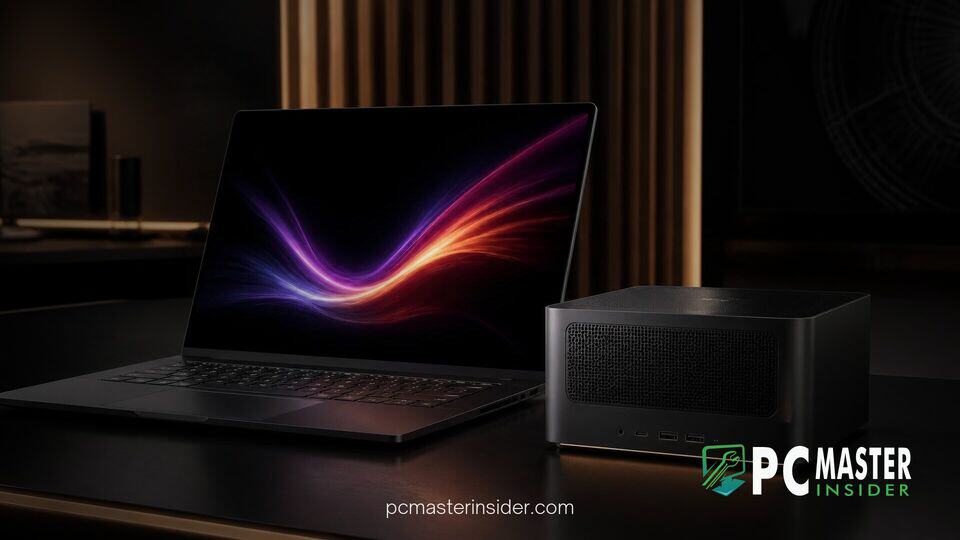
COLORFIRE has expanded its workstation hardware portfolio by introducing two high-performance systems designed around AMD's latest APU architectures. The new product lineup features the Lingchuang Mini Pro desktop workstation and the Lingchuang K16 mobile workstation laptop, targeting software developers, researchers, and digital creators requiring heavy local inference capabilities.
The announcement emphasizes a growing trend toward high-bandwidth, unified memory systems capable of handling large AI models directly on local hardware without sending data to external cloud infrastructures. With support for expansive unified memory pools, both devices aim to lower technical barriers for engineers running multi-agent AI pipelines locally.
COLORFIRE Introduces Strix Halo-Powered Mini PC and Workstation Laptop
Under its COLORFIRE sub-brand, parent company Colorful has unveiled two distinct computing platforms aimed at AI inference, content creation, and software development. The flagship desktop offering, the COLORFIRE Lingchuang Mini Pro, incorporates AMD's flagship Gorgon Halo processor architecture, officially designated as the Ryzen AI Max+ Pro 495. Meanwhile, the portable Lingchuang K16 mobile workstation operates on the Ryzen AI Max+ 395 system-on-chip.
Both devices focus on offering workstation-grade computing within compact form factors. By leveraging AMD's Zen 5 processor cores integrated with high-performance RDNA graphics compute units, COLORFIRE provides unified memory architectures that treat system RAM as graphics memory when needed. This hardware layout is tailored to help development teams avoid the high latency and monthly subscription costs associated with cloud-hosted AI APIs.
Lingchuang Mini Pro Desktop Workstation Specs and Features
The centerpiece of COLORFIRE's desktop release is the Lingchuang Mini Pro mini PC. Equipped with the 16-core, 32-thread AMD Ryzen AI Max+ Pro 495 APU, the compact desktop is engineered to run demanding multi-threaded developer tasks alongside machine learning frameworks. The processor features boosted clock speeds up to 5.2 GHz and integrates an AMD XDNA 2 neural processing unit designed for local AI acceleration.
Memory configuration is the defining highlight of the Lingchuang Mini Pro. The system supports up to 192GB of high-speed LPDDR5X-8533 unified memory. Thanks to AMD's flexible memory allocation controls, users can assign as much as 160GB of this pool directly as dedicated video memory (VRAM) to feed the integrated Radeon 8065S graphics engine. This massive video buffer allows engineers to run ultra-large language models and complex 3D rendering workloads that would typically overwhelm standard desktop graphics cards.
Standard configurations for the mini PC will start at 96GB of unified memory, ensuring that even baseline models retain significant VRAM headroom. The desktop chassis is engineered to maintain low thermal constraints while occupying minimal desk real estate, positioning it directly against similar compact developer platforms like the Minisforum MS-S1 Workstation and mobile AI workstations.
Lingchuang K16 Mobile Workstation Specifications
For creators and developers who require desktop-class local AI performance in a portable format, COLORFIRE has officially launched the Lingchuang K16 mobile workstation. The laptop features an all-metal chassis housing a 16-inch IPS display with a 2560x1600 resolution and a fast 180Hz refresh rate.
Under the hood, the Lingchuang K16 is powered by the AMD Ryzen AI Max+ 395 processor, backed by a robust cooling design that permits an overall processor power budget of up to 160W TDP. This high power limit lets the processor's Zen 5 CPU cores and integrated Radeon 8060S graphics operate at elevated sustained speeds. System configurations support up to 128GB of unified memory, with up to 96GB assignable to VRAM.
Additional hardware highlights of the Lingchuang K16 include:
- Storage: Dual internal M.2 PCIe slots shipping with a factory 2TB PCIe 4.0 NVMe SSD.
- Power & Mobility: Integrated 99 Wh battery designed to meet maximum commercial flight carry-on allowances.
- Connectivity: Support for Wi-Fi 7, HDMI 2.1, an SD card reader, and an OCuLink port for high-bandwidth external GPU or storage expansions.
- Security: Built-in fingerprint reader for quick biometric authentication.
Native support for software environments such as AMD ROCm allows developers on the Lingchuang K16 to run deep learning frameworks and autonomous AI agent software natively without an active internet connection.
Market Impact and Availability
The introduction of COLORFIRE's new workstations reflects a broader industry shift toward high-bandwidth unified memory systems. While desktop discrete GPU shipments have seen steady demand in consumer markets—as highlighted in recent reports on desktop GPU shipments—specialized local AI tasks are driving interest toward integrated APU architectures that eliminate PCIe bus bottlenecks through unified RAM access.
As memory technologies evolve, reports like the TrendForce DDR5 price report indicate that memory bandwidth costs remain a critical consideration for system manufacturers. By soldering high-speed LPDDR5X-8533 memory directly to the platform, manufacturers like COLORFIRE can deliver wide memory bus bandwidths reaching over 270 GB/s, enabling smooth local inference on large models.
The COLORFIRE Lingchuang K16 mobile workstation has officially gone on sale on Chinese retail platforms, including JD.com, with a starting price of ¥34,999 (approximately $5,218 USD) for the 128GB memory and 2TB SSD configuration. While official global pricing and regional launch dates for the desktop Lingchuang Mini Pro have not yet been announced, COLORFIRE's new entries clearly demonstrate the growing viability of compact local AI hardware.