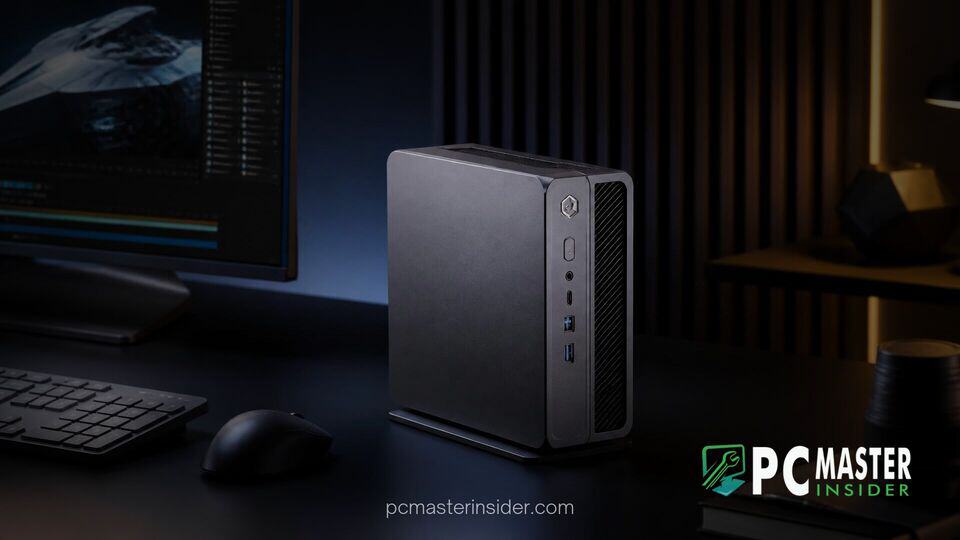
Acemagic has officially showcased its new flagship F9A mini workstation at the IFA 2026 technology show in Berlin, making it one of the first PC manufacturers to adopt AMD's highest-tier silicon platform. The compact desktop delivers immense computational capability into a small form factor, combining cutting-edge processor architecture with massive unified system memory aimed at software developers, creative professionals, and artificial intelligence researchers.
At the core of the newly unveiled flagship variant is the AMD Ryzen AI Max+ Pro 495 processor. By housing this top-spec processor in a chassis measuring just 158.5 x 158.5 x 81.5 mm, Acemagic intends to offer full workstation capabilities without taking up valuable desk space.
Acemagic Launches F9A AI Mini Workstation at IFA 2026
The acemagic f9a mini workstation ryzen ai max pro 495 configuration marks a noticeable shift in high-performance small-form-factor computing. Packed inside a 2-liter aluminum enclosure that takes aesthetic design cues from sleek modern desktop setups, the F9A targets power users who require substantial parallel processing capacity for local AI workloads, video rendering, and heavy multitasking.
Acemagic announced two configurations during its presentation at Messe Berlin. While an entry-level version features the standard Ryzen AI Max+ 395 processor paired with up to 128GB of LPDDR5X memory, the premium F9A Pro 495 variant steps up the capabilities across the board. The flagship system scales memory capacity up to an unprecedented 192GB of high-speed LPDDR5X-8533 memory, providing memory bandwidth rarely seen in small desktop chassis.
Key Hardware Specs of the AMD Ryzen AI Max+ Pro 495
The processing heart of the F9A is built around AMD's Strix Halo architecture, utilizing 16 full performance Zen 5 CPU cores and 32 threads. The processor operates with base clock speeds starting at 3.1 GHz and can boost up to 5.2 GHz when extra computational headroom is needed. To keep high-throughput workloads fed with data, the chip includes 80MB of combined cache (16MB L2 and 64MB L3).
Graphics tasks are handled by the integrated AMD Radeon 8065S GPU based on the RDNA 3.5 graphics architecture. Featuring 40 compute units running at clock frequencies up to 3000 MHz, the integrated graphics engine approaches the performance levels of dedicated mid-range laptop graphics cards. The integrated XDNA 2 Neural Processing Unit (NPU) provides 55 TOPS of dedicated AI compute, contributing to an overall system AI rating of 131 TOPS across the CPU, GPU, and NPU engines combined.
Unified Memory Architecture for Running Local LLM Workloads
The standout feature of the F9A PRO 495 is its expansive unified memory architecture. Traditional desktop setups require data to be mirrored between system RAM and dedicated GPU VRAM, creating bandwidth bottlenecks and capacity limits when working with large datasets. In the F9A, the CPU cores, Radeon graphics, and XDNA 2 NPU all access a shared pool of up to 192GB of unified memory.
Users can allocate up to 160GB of this shared memory pool directly as video memory. This layout makes the mini system uniquely equipped to run parameter-dense Large Language Models (LLMs) entirely locally without relying on expensive cloud infrastructure or multi-GPU server setups. Acemagic demonstrated that the machine is capable of running quantized models like DeepSeek V4 Flash locally, as well as handling up to 120B Q4 models and 300B Mixture-of-Experts (MoE) architectures.
This capability provides software engineers and AI researchers with a private, low-latency environment to test and deploy open-weight models on their local desktop workstations.
Thermal Design, Connectivity, and Compact Form Factor
Cooling a 120-watt rated processor within a 2-liter desktop enclosure presents a significant engineering challenge. Acemagic addresses this thermal requirement using a custom multi-fan cooling setup paired with vapor chamber technology to maintain stable operating frequencies under sustained heavy workloads.
Despite its small physical footprint, the F9A offers extensive external connectivity. The rear and front I/O ports include two high-speed 40Gbps USB4 connectors, two 2.5GbE LAN ports for fast local network connectivity, Wi-Fi 7 wireless networking, and Bluetooth 5.4 support. Display outputs are handled by HDMI 2.1 and DisplayPort 2.1 connectors, supporting multi-monitor high-resolution workflows.
For users needing additional graphics acceleration or ultra-fast storage access, the F9A includes a dedicated OCuLink port operating over PCIe 4.0 x4. This allows direct connection to external graphics dock enclosures without the performance overhead associated with traditional external interface standards. Internal storage expansion is provided via an M.2 2280 PCIe 4.0 x4 NVMe slot supporting up to 4TB solid-state drives.
With its high memory ceiling, robust processing specs, and versatile expansion ports, the Acemagic F9A mini workstation represents a major leap forward for small desktop systems designed to tackle next-generation AI and software development workloads.