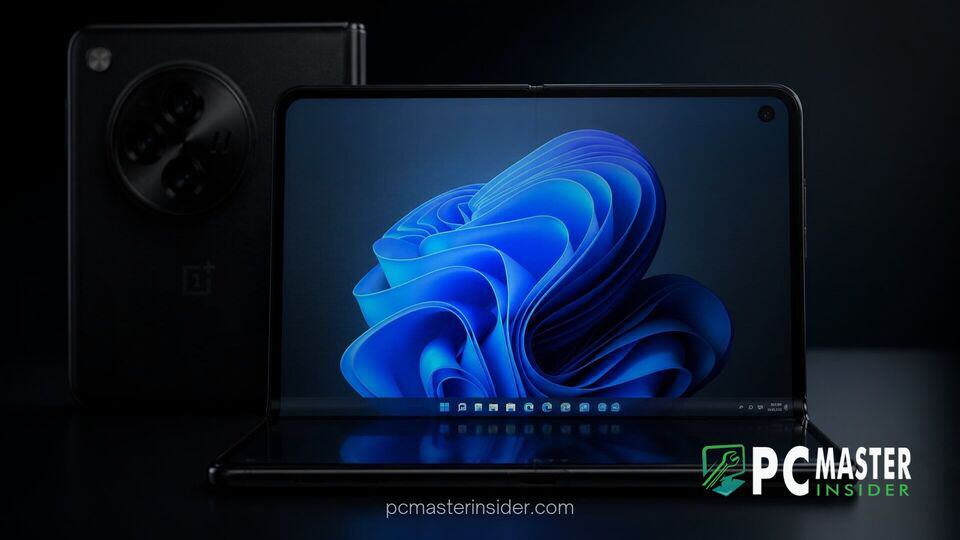
Independent developer Kevin Shroff has achieved a major milestone in mobile hardware modification by porting Microsoft's flagship operating system to run natively on the OnePlus Open foldable smartphone. By completely wiping the stock Android system from the device's internal storage, the project runs Windows 11 ARM64 directly on bare-metal hardware without relying on virtual machines or cloud streaming layers.
The achievement marks one of the most technical bringing-up efforts on a modern high-end foldable handset. While several essential components like wireless networking and graphical acceleration remain active work-in-progress areas, the installation highlights how versatile current silicon platforms have become when decoupled from their default operating environments.
Developer Wipes Android to Boot Windows 11 on OnePlus Open
The project, hosted publicly under the open-source repository oneplus-open-windows on GitHub, replaces OxygenOS and the underlying Android boot sequence entirely. Rather than setting up a dual-boot environment or executing within an emulation container, Shroff loaded customized UEFI and ACPI tables onto the device to hand off control directly to the Windows kernel.
When powered on, the OnePlus Open initializes directly into Windows 11 WinPE or the full desktop environment. The operating system manages the physical hardware natively, allocating system resources across the device's components without any Android framework sitting underneath.
Hardware Specs and Desktop Scaling Configuration
Underneath the hood, the OnePlus Open is driven by Qualcomm's Snapdragon 8 Gen 2 processor (SM8550) paired with 16GB of high-speed memory and 512GB of internal UFS storage. Windows 11 recognizes all eight logical CPU cores out of the box, offering full native 64-bit ARM processing performance.
To make desktop interaction practical on the inner 7.82-inch folding display, Shroff configured the Windows display driver to execute at 300% UI scaling. This adjustment ensures system dialogues, start menu items, desktop icons, and standard win32 applications remain easily clickable using finger taps. Demonstrations published by the developer showcase fast navigation through native utilities like the Windows Calculator, system settings menus, and standard file structures.
windows 11 native boot oneplus open: Current Progress and Technical Limitations
Achieving a project centered around a windows 11 native boot oneplus open setup required addressing the fundamental architectural differences between Android and Windows. Modern Android smartphones rely on device tree structures provided by OEM Linux kernels to map out board layout and hardware addresses. Windows 11, conversely, expects standardized ACPI firmware descriptions to enumerate system controllers, memory maps, and interrupt lines.
To overcome these barriers without building an operating system stack entirely from scratch, Shroff adapted established community efforts. The port leverages existing codebases from Project Mu, Project Aloha, Mesa/Topaz, and UniXNU/NativeAdreno to build out the custom UEFI boot environment and bridge low-level hardware interfaces.
Touch Navigation Success Versus Missing Connectivity Drivers
At its current stage of active development, several core hardware subsystems are functional, while others present significant engineering hurdles:
- Functional Features: The internal folding display renders a clear framebuffer desktop, the native touchscreen input driver handles multi-touch gestures accurately, internal UFS storage supports direct OS installation, and USB debugging host modes function over the Type-C port.
- Partial Capabilities: The outer cover display can be cleared to a neutral black framebuffer image, though dynamic panel switching and hinge state detection between folded and unfolded postures remain incomplete.
- Unfinished Drivers: Full WDDM hardware GPU acceleration for the Adreno 740 graphics module is actively undergoing bring-up. Wireless Wi-Fi network adapters can detect local SSIDs but cannot reliably complete handshake connections yet. Audio output, Bluetooth radios, internal camera pipelines, and cellular baseband connectivity are currently non-functional due to missing target drivers.
What Native Mobile Ports Mean for the Windows on ARM Ecosystem
Projects aiming to boot desktop operating systems on smartphone hardware are not entirely unprecedented. Modders previously brought original Windows on ARM builds to older devices like the Lumia 950 XL and Snapdragon 845-equipped phones like the OnePlus 6T and Poco F1 through the Renegade Project community. However, bringing Windows 11 to a modern foldable form factor introduces unique possibilities for pocket-sized productivity software.
Recent architectural advances within Microsoft's desktop platform have simplified cross-architecture deployment. Features such as cloud-based recovery workflows and refined software execution layers showcase how flexible the operating system has become on ARM devices. Developers looking into legacy application testing or specialized mobile debugging frequently monitor these bare-metal experiments to gauge how standard desktop user interfaces scale across atypical aspect ratios.
At the same time, Microsoft continues building out enterprisewide platform stability across its desktop footprint. Recent administrative updates, including expanded FIDO2 passkey controls and unified enterprise patch policies like consolidated Autopatch features, highlight Microsoft's main focus on standard ARM laptop and desktop deployments.
While the port on the OnePlus Open is an impressive proof-of-concept for enthusiast modders, it remains far from an everyday smartphone replacement. The absence of cellular voice connectivity, power management for suspend-resume cycles, and camera integration means users should not expect to convert their daily devices into foldable Windows PCs anytime soon. Nonetheless, the project offers a fascinating glimpse into how powerful modern mobile chips have become when pushed beyond their default mobile software constraints.