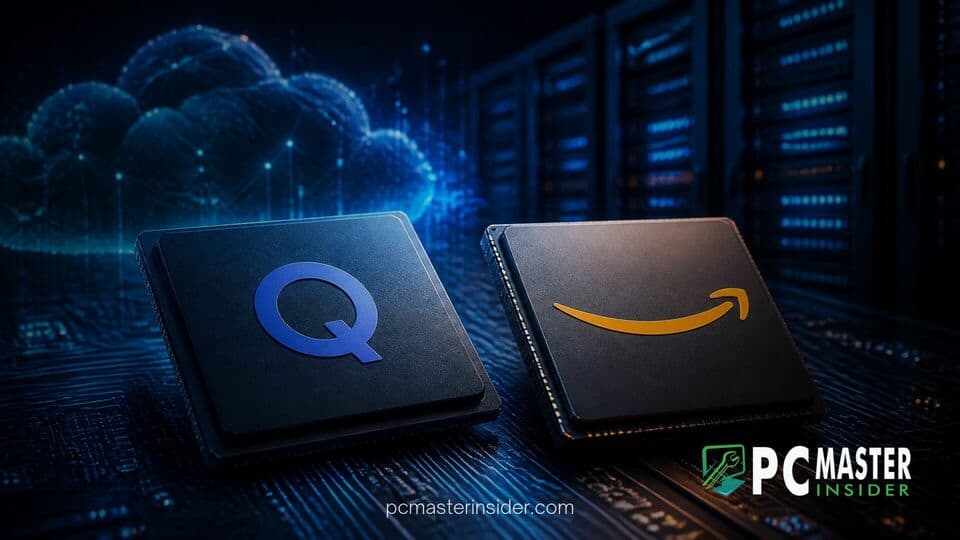
Qualcomm Technologies and Amazon have unveiled a multi-generational product collaboration focused on developing custom artificial intelligence silicon and high-speed networking hardware for Amazon Web Services data centers. The landmark agreement expands Qualcomm beyond its traditional mobile market and provides AWS with tailored hardware optimized for large-scale AI inference workloads.
Under the multi-year partnership, Qualcomm will co-develop customized AI inference processors and supply high-performance optical connectivity hardware capable of data transfers up to 1.6 terabits per second. According to regulatory filings, the commercial framework enables Amazon to purchase up to $60 billion in Qualcomm server chips, system solutions, and manufacturing services over time.
Qualcomm and Amazon Custom Silicon Partnership
The collaboration centers on building custom hardware specifically engineered for AI inference. While AI model training requires immense raw compute, running trained models in live production demands exceptional power efficiency, lower latency, and high bandwidth. By leveraging Qualcomm's historical expertise in low-power architecture alongside Amazon Web Services infrastructure requirements, the two companies plan to optimize cost and power consumption across hyperscale data centers.
As part of the commercial arrangement, Amazon was granted a warrant to acquire up to 25 million shares of Qualcomm common stock at an exercise price of $161.26 per share. Vesting of these equity warrants is tied directly to commercial milestones and purchase volumes over the life of the agreement. Qualcomm executives confirmed that initial production activities are already underway and that revenue from the deal will begin registering in the company's fiscal financial reports immediately.
This initiative builds upon broader shifts across the cloud compute landscape, where major hyperscalers are increasingly moving toward tailored silicon architectures to avoid single-vendor lock-in. While Amazon continues to deploy its proprietary Trainium and Inferentia chips, adding custom Qualcomm silicon gives AWS another scalable, power-efficient alternative. This strategy closely mirrors hardware investments across the sector, such as when Meta detailed its custom MTIA AI silicon chips to support its internal data center workloads.
Optical Interconnects and High-Bandwidth Architecture
Beyond compute engines, modern AI clusters suffer severe throughput bottlenecks when moving massive datasets between servers and storage racks. To eliminate these data transfer bottlenecks, the partnership heavily emphasizes high-speed optical connectivity technologies.
Qualcomm will supply AWS with advanced Serializer/Deserializer (SerDes) and optical Digital Signal Processor (DSP) solutions engineered to support bandwidth speeds reaching 1.6T. Moving from copper to ultra-fast optical interconnects allows giant server clusters to act as a unified, low-latency computing engine. The integration of high-bandwidth networking ensures that chip-to-chip communication keeps pace with modern foundation models.
The agreement is reciprocal in technical scope. Qualcomm will expand its internal deployment of AWS cloud infrastructure and utilize Amazon Bedrock AI capabilities to accelerate its own electronic design automation (EDA) processes. Utilizing cloud-native AI tools during chip design cycles allows engineers to tape out complex silicon faster while improving yield rates on leading-edge manufacturing nodes.
Strategic Impact on the AI Infrastructure Market
This alliance represents a critical strategic pivot for Qualcomm as it aggressively diversifies beyond mobile devices. The company has previously taken steps into alternative markets, such as supplying processors for edge devices like when Qualcomm launched the Horizon Ultra AI PC with Snapdragon silicon. However, securing a multi-billion-dollar commitment from the world's largest cloud provider firmly establishes Qualcomm as a serious contender in hyperscale data center hardware.
For Amazon, diversifying its silicon pipeline helps safeguard against persistent semiconductor supply constraints. Hyperscalers worldwide are racing to secure sufficient hardware capacity to power generative AI tools. Similar capacity pressures have forced competitors to take drastic measures, such as when Microsoft targeted 38 gigawatts of data center capacity to resolve systemic compute shortages.
Industry analysts view the deal as a clear signal that enterprise AI computing is shifting toward specialized, heterogeneous environments. While merchant GPUs remain popular for training massive frontier models, tailor-made inference accelerators and ultra-fast optical fabrics offer better cost performance for real-world deployments. Other chipmakers are making similar structural bets, such as when NVIDIA invested in MediaTek for custom AI chip development and when OpenAI partnered with Samsung Foundry for next-generation chips.
Qualcomm management stated that the company expects its data center market revenue to reach $5 billion by fiscal year 2027, with long-term targets exceeding $15 billion by fiscal 2029. By combining multi-generational custom compute with 1.6T optical interconnects, Qualcomm and Amazon are laying a long-term foundation designed to handle the growing computational demands of cloud-based artificial intelligence.