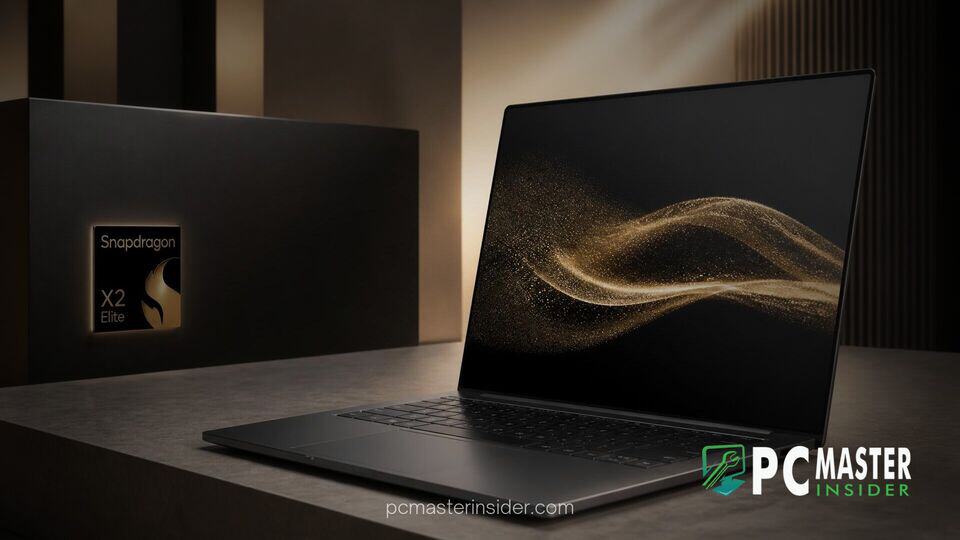
Qualcomm Technologies and Middle Eastern artificial intelligence developer HUMAIN have unveiled the Horizon Ultra, a next-generation laptop designed for heavy on-device processing. Officially revealed during the LEAP 2026 technology event, the system leverages Qualcomm's Snapdragon X2 Elite processor to run complex models directly on local hardware without constant cloud connectivity.
The announcement represents an important expansion for Saudi Arabia-backed HUMAIN into hardware, following earlier software and infrastructure initiatives. Built with dedicated neural processing capabilities and high-efficiency compute cores, the Horizon Ultra aims to set a new baseline for enterprise and developer productivity.
Qualcomm and HUMAIN Announce Horizon Ultra AI PC
The newly introduced device marks a milestone in the market for specialized computing hardware. Under the hood, the system integrates Qualcomm silicon to deliver on-device execution for localized language models, security algorithms, and automation workflows. The launch underscores growing momentum for Windows on ARM architecture across commercial environments.
The collaboration comes at a time when technology providers are racing to optimize hardware for low-latency tasks. Previous market developments, such as how AMD and Cisco deployed Instinct MI355X infrastructure with HUMAIN, show how rapid infrastructure expansion in the region is now extending directly into end-user devices.
Snapdragon X2 Elite Architecture Details
At the heart of the Horizon Ultra is Qualcomm's Snapdragon X2 Elite system-on-chip. The silicon features an 18-core Oryon CPU configuration, updated Adreno graphics, and an expanded Hexagon Neural Processing Unit (NPU) capable of executing tens of trillions of operations per second. This multi-node architecture distributes compute tasks dynamically across specialized engines, ensuring maximum energy efficiency during heavy operations.
By shifting computational demands away from cloud datacenters, the Snapdragon X2 Elite allows complex generative and analytical tools to execute locally. Physical hardware features revealed for the laptop include a sleek grey chassis carrying the tag Designed in the Kingdom of Saudi Arabia, a bilingual keyboard layout, dual USB-C interfaces, continuous cellular data options, and active thermal management designed to handle sustained computational loads.
On-Device AI and Windows 11 Integration
The system is tailored to take full advantage of modern operating system optimizations. By pairing Qualcomm hardware with advanced software capabilities, users can run enterprise automation tools without experiencing system slowdowns. As hardware manufacturers push performance limits, platform developers continue refining backend responsiveness. Recent updates, including how Windows 11 expanded its Low Latency Profile CPU boost to all apps, help ensure that background scheduling operates smoothly alongside intensive local tasks.
Local execution also addresses critical enterprise concerns surrounding data privacy and latency. Sensitive business workflows remain strictly on the device, eliminating the need to transmit telemetry or proprietary internal records across external networks during processing sessions.
This integration also aligns with broader ecosystem efforts to bring domain-specific models directly into daily user workflows. Earlier initiatives, such as when Microsoft partnered with HUMAIN to integrate ALLAM models into Copilot, laid the groundwork for regional language support and customized assistant pipelines on modern hardware.
Target Rollout and Commercial Availability
HUMAIN and Qualcomm confirmed that the Horizon Ultra will initially target enterprise customers, research institutions, and government sectors requiring high-level data governance. Enterprise availability is scheduled to begin following the LEAP 2026 showcase, with wider commercial rollout phases planned throughout the year.
Industry benchmarks will soon evaluate how the Snapdragon X2 Elite holds up against rival x86 and custom silicon offerings. Standardized testing frameworks, such as the recently launched MLPerf Client v2.0 benchmark for AI PCs, are expected to provide clear performance metrics on local image generation and agentic task execution once consumer review units become available.
Future Roadmap and HUMAIN OS Transition
Looking ahead, HUMAIN plans to build upon the Horizon Ultra hardware platform by introducing software tailored for autonomous background agents. Future updates are expected to expand native application support, enabling specialized agentic tools to execute continuous productivity workflows in the background without user intervention.
As hardware capabilities mature, hardware vendors are increasingly focused on multi-device conversion and portable form factors. Innovations across the market, like the TECNO MEGABOOK T15 360 Pro convertible laptop previewed for IFA 2026, reflect a broader industry push toward versatile mobile designs optimized for specialized workloads.
The launch of the Horizon Ultra AI PC represents a notable step in expanding hardware production in the Middle East. By combining Qualcomm's high-efficiency Snapdragon X2 Elite silicon with customized local software integration, the initiative establishes a competitive platform for local, secure enterprise computing.