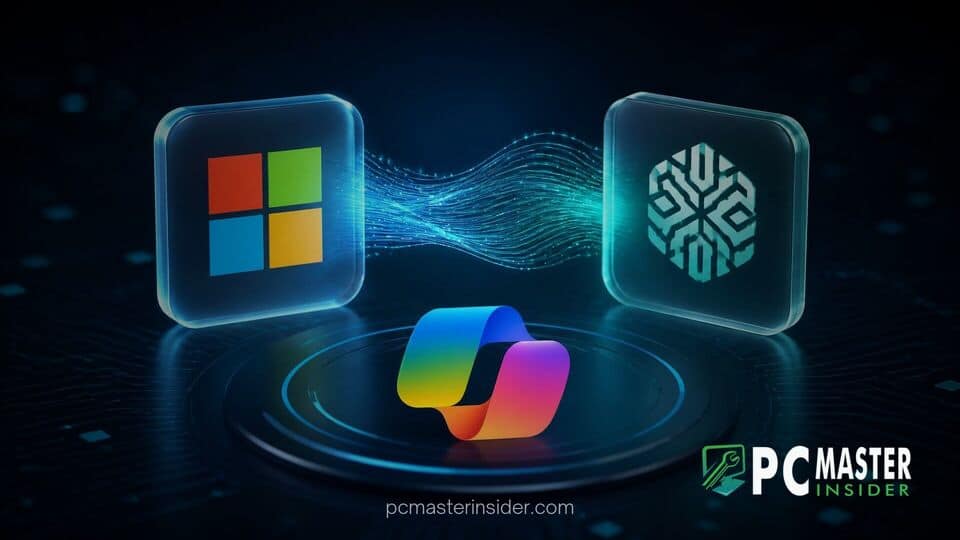
Microsoft has announced a strategic partnership with HUMAIN to integrate the advanced ALLAM series of large language models directly into the Microsoft Copilot ecosystem. The collaboration aims to significantly enhance native Arabic language capabilities, contextual understanding, and regional AI performance across enterprise workplace applications.
By bringing HUMAIN's state-of-the-art Arabic AI architecture into Microsoft 365 Copilot and Azure Cloud infrastructure, both companies intend to offer public and private sector organizations highly localized generative AI tools. The move addresses long-standing demand for enterprise-grade productivity assistance optimized specifically for complex Arabic nuances, dialects, and technical terminology.
Microsoft HUMAIN ALLAM AI Integration Copilot
The core objective of the Microsoft HUMAIN ALLAM AI integration in Copilot is to deliver seamless, native-quality Arabic interaction across everyday productivity tools such as Word, Excel, Teams, and Outlook. Rather than relying solely on translation layers over western-centric models, the direct integration of ALLAM provides enhanced semantic accuracy, cultural alignment, and complex document processing capabilities natively within enterprise workflows.
Microsoft and HUMAIN Announce Strategic AI Partnership
Under the official partnership framework, Microsoft and HUMAIN will work jointly to deploy localized models directly on Azure, ensuring compliance with local data sovereignty and security regulations. As enterprises across the Middle East rapidly digitize operational workflows, access to secure, locally trained foundational models has become a strategic priority for government agencies, educational institutions, and multinational firms operating in the region.
The partnership combines HUMAIN's deep domain expertise in Arabic artificial intelligence research with Microsoft's global enterprise scale, hyperscale infrastructure, and deep application stack. Organizations leveraging Microsoft 365 Copilot will soon be able to select ALLAM models as part of their standard assistant configuration, allowing custom prompt processing tailored to regional business standards.
Bringing ALLAM Arabic Models to Microsoft 365 Copilot
The integration of ALLAM into Microsoft 365 Copilot allows enterprise users to draft complex business correspondence, analyze localized dataset trends, and automate routine administrative tasks using natural Arabic commands. Rather than relying on rigid syntax, ALLAM models are specifically trained on vast regional datasets that accommodate modern standard Arabic as well as specific industry jargon.
For instance, enterprise users working inside financial spreadsheets or executive reporting suites can interact with their datasets naturally. As Microsoft 365 Copilot expands Python data analysis features in Excel, the addition of native ALLAM model support ensures that regional data scientists and business analysts can perform sophisticated operations without language barriers hindering prompt precision.
Joint Engineering Teams and Deployment Initiatives
To support smooth technical execution, joint engineering teams from Microsoft and HUMAIN have established dedicated deployment pipelines within Azure Machine Learning. These initiatives focus on optimizing latency, reducing compute overhead, and fine-tuning ALLAM model parameters for real-time text generation, summarization, and query resolution.
Engineers are also working to ensure that enterprise security controls, role-based permissions, and administrative oversight remain consistent across all workloads. As organizations adopt modern AI workflows, managing user privileges and communication channels remains paramount. This focus on control aligns with broader cloud governance trends, similar to how Microsoft Teams adds option to automatically block external meeting bots to protect sensitive organizational discussions from unauthorized automated monitors.
Strategic Impact on Microsoft Enterprise AI Expansion
The alliance with HUMAIN represents a key milestone in Microsoft's strategy to broaden its global enterprise footprint by tailoring AI solutions to regional markets. By incorporating specialized regional foundational models alongside existing foundational offerings like OpenAI's GPT suite, Microsoft offers enterprise customers broader flexibility in model selection and operational deployment.
This localized model integration strategy also fits into Microsoft's modern software distribution cadence. Rather than waiting for massive multi-year enterprise platform upgrades, cloud services receive continuous backend improvements. This approach reflects how Microsoft retires release wave model in favor of continuous AI roadmap updates, ensuring that performance enhancements and new regional model deployments reach customers rapidly without disruptive overhaul cycles.
Industry analysts note that localized partnerships will be vital as cloud providers compete for market share in regions with strict data residency laws and distinct language requirements. Providing native, high-accuracy language processing helps reduce hallucination rates and improves the adoption rate of digital assistants among non-English-first workforces.
Availability and Integration Timeline
The initial preview phase of the ALLAM model integration within Microsoft 365 Copilot and Microsoft Azure is scheduled to roll out to select enterprise preview customers over the coming months. Broad commercial availability for commercial and government accounts in target regions is expected to follow shortly thereafter.
Microsoft and HUMAIN indicated that future phases of the collaboration will include custom model fine-tuning services for localized government agencies and high-security sectors, alongside expanded developer tools within Azure AI Studio. As enterprise digital transformation continues to accelerate, the availability of specialized, sovereign-compliant language intelligence will play an essential role in driving workplace productivity.