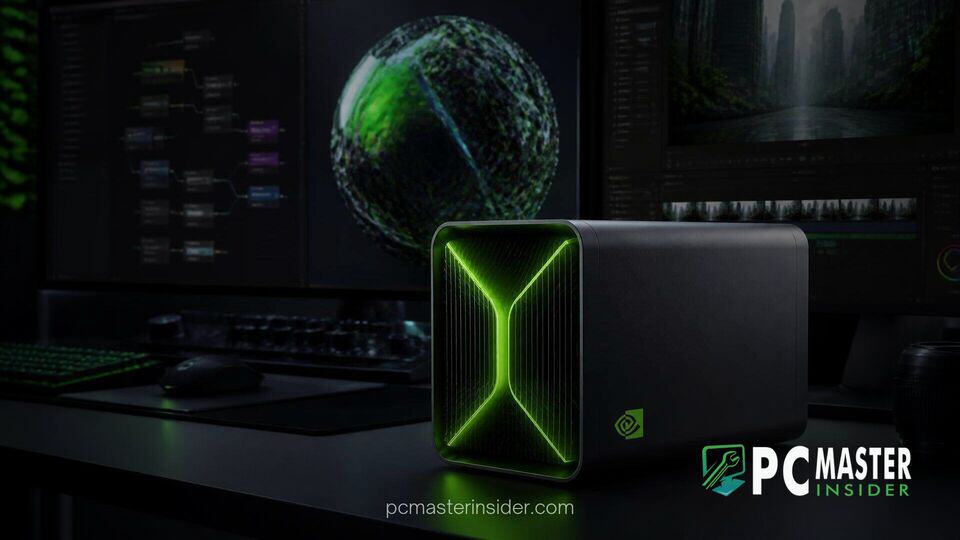
Nvidia has officially released its RTX Spark platform, marking a major structural shift in high-performance personal computing. Built in close partnership with Microsoft and MediaTek, the new hardware system combines Grace Arm CPU cores with Blackwell GPU architecture and high-bandwidth unified memory to run local AI workloads on client devices.
The release targets creators, developers, and power users who require heavy local AI processing without relying on cloud infrastructure. Laptops powered by RTX Spark from major OEM partners have begun shipping, while compact desktop versions are scheduled to launch next month.
Nvidia RTX Spark Launch Windows PC Platform Architecture
The core of the Nvidia RTX Spark launch Windows PC environment centers on a unified system-on-chip design. Unlike traditional x86 desktops that separate the main system RAM from the graphics frame buffer, RTX Spark joins up to 20 custom Arm-based Grace CPU cores alongside a Blackwell-generation RTX graphics processor using high-speed interconnects. This design allows both the CPU and GPU to share up to 128GB of high-speed unified memory.
By eliminating memory transfer bottlenecks over PCIe lanes, the platform provides local machine learning models with direct access to massive memory pools. This capability allows developers to run complex, multi-billion parameter open-source Large Language Models (LLMs) and image synthesis models locally on a laptop. As demand for fast memory configurations rises in AI workstations, Nvidia's unified design approach ensures sustained low-latency throughput across heavy computational tasks.
The onboard Blackwell graphics processor brings fifth-generation Tensor Cores and dedicated ray tracing units to mobile form factors. Nvidia claims the platform offers up to 1 petaflop of FP4 AI processing capacity, providing high throughput for client-side model fine-tuning, automated coding scripts, and real-time inference tasks.
Nvidia Unveils RTX Spark Platform for Local AI Workloads
The launch reflects a deliberate shift across the PC ecosystem toward running persistent AI agents locally rather than routing every request through external servers. Running local AI agents preserves data privacy, reduces operational latency, and keeps proprietary creative code or intellectual property within the system.
To support this push, Microsoft has integrated Windows 11 with specific execution environments designed to isolate background AI agents operating on RTX Spark systems. Users can run personal autonomous agents that index local file systems, process video media, or write scripts without exposing system permissions to external threats.
Hardware and Architecture Focus for Creators and Power Users
For creative professionals, local compute power translates into real-time rendering and AI acceleration within established software suites. Nvidia has worked alongside major software vendors to optimize professional software for the new hardware layout. Applications such as Adobe Photoshop, Premiere Pro, and Blender have received updates engineered specifically to utilize the platform's unified architecture.
Video editors benefit from native 4:2:2 hardware encode and decode engines, enabling fluid timeline performance on high-resolution camera footage without proxy generation. Additionally, 3D artists can render scenes using ray tracing hardware while dedicated Tensor Cores handle AI denoising simultaneously.
Optimized AI Workflows and Ecosystem Integrations
The launch coincides with broader operating system adjustments across the Windows platform. As Microsoft continues refining system responsiveness and memory handling, including recent memory management optimizations for Windows 11, hardware like RTX Spark aims to maximize those OS improvements by providing vast overhead for multitasking.
Software developers can run popular open-source models such as Llama, Qwen, Mistral, and Flux locally via optimized frameworks. Nvidia also introduced Nemotron models optimized specifically for execution on RTX hardware, enabling developers to build agentic tools that operate locally on client systems.
Performance Scaling for AI Agents and Heavy PC Tasks
While the architecture uses Arm-based CPU cores, compatibility layer optimizations in Windows on Arm allow existing x86 applications to run smoothly alongside native ARM64 software. Outside of workstation applications, the platform maintains strong capabilities for secondary uses, including PC gaming.
Systems support full feature sets like DLSS frame generation and Reflex low-latency modes. Similar to recent graphics updates like Nvidia's DLSS technology enhancements, the integrated Blackwell GPU scales performance up to high resolutions while keeping power consumption manageable within slim chassis designs.
In independent evaluation, hardware reviewers praised the platform's overall polish and capabilities. Tom's Hardware noted, "The fact that NVIDIA, Microsoft and their partners have delivered such a capable, compatible and polished platform even in its first at-bat should put the rest of the PC industry on notice." Meanwhile, Tom's Guide highlighted the shift toward localized compute power, describing the machine as a statement of intent for running fully autonomous, CUDA-accelerated tools directly on portable devices.
Global Launch Event Details and Availability
Hardware systems built around RTX Spark are available immediately from major computer manufacturers, including ASUS, Acer, Dell, HP, Lenovo, MSI, Gigabyte, and Microsoft Surface. Initial laptop configurations come in thin 14-inch and 16-inch form factors. Small form-factor desktop builds tailored for continuous background processing are expected to enter the market shortly.
Pricing for entry configurations with 18 CPU cores starts near $2,600, while top-tier 20-core systems equipped with 128GB of unified memory reach higher price brackets targeting enterprise developers and workstation users. Users upgrading to these new devices should ensure their operating systems are up to date, especially as Microsoft moves closer to ending support for older Windows 11 releases.
The release of RTX Spark signals a clear pivot toward desktop-class local AI processing. By combining heavy GPU acceleration, unified memory, and power-efficient Arm cores into a unified Windows PC platform, Nvidia and Microsoft have opened a new chapter for mobile workstation performance.