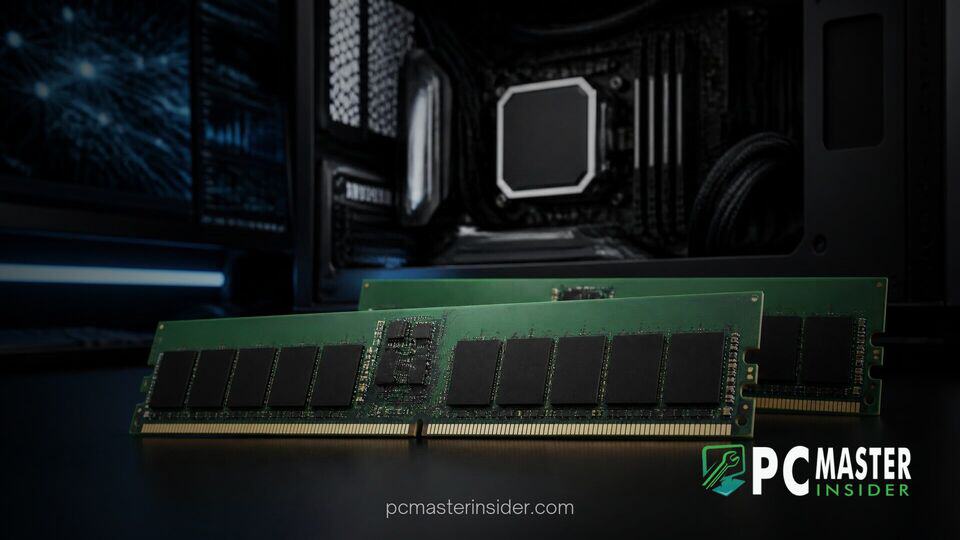
Advanced memory specialist Netlist announced the official expansion of its LIGHTNING Ultra-Low Latency (ULL) DDR5 RDIMM family. The next-generation DDR5-6000 and DDR5-6400 memory modules target agentic AI workstations, high-performance enterprise servers, and memory-bound computing tasks.
Designed to address severe latency bottlenecks in modern computing, these new registered memory modules provide drop-in compatibility across current AMD and Intel server environments. As memory-intensive applications scale across data centers, reducing main-memory delay has become critical for maintaining high system throughput.
Netlist Expands LIGHTNING Family with Low-Latency DDR5 RDIMMs
Netlist unveiled the latest additions to its LIGHTNING product portfolio, bringing high-speed performance and reduced access latencies to enterprise systems. The new product line is specifically engineered for workloads that require constant, low-latency access to massive memory-resident datasets, such as agentic AI agents, vector databases, and real-time financial modeling.
The demand for high-performance enterprise memory arrives at a crucial moment for hardware architects. Enterprise deployments are facing tighter supply conditions, with 32GB DDR5 desktop RAM kits hitting elevated prices across retail channels. While consumer desktop configurations struggle with volatile pricing, enterprise vendors are prioritizing specialized modules that deliver measurable speed benefits within standard thermal and electrical envelopes.
Specifications of DDR5-6000 and DDR5-6400 Modules
The updated LIGHTNING ULL DDR5 RDIMM lineup introduces two primary speed grades: DDR5-6000 and DDR5-6400. Operating at standard JEDEC-compliant 1.1V native VDDQ power levels, the modules feature integrated Power Management Integrated Circuits (PMIC) directly on the DIMM board. They incorporate advanced sideband bus management protocols, including I2C, I3C, and legacy SMBus, alongside on-board temperature monitoring sensors.
Each module features a dual 40-bit sub-channel architecture with 32 data bits and 8 ECC bits per channel, maintaining enterprise-grade error correction integrity. The physical design adheres strictly to standard JEDEC 31.25mm height specifications, ensuring complete mechanical compatibility with existing server racks and workstation chassis.
Latency Improvements for Intensive Computing Tasks
In memory-sensitive applications, dataset size frequently exceeds the storage capacity of processor caches. When a system experiences a cache miss, CPU cores are forced to wait for data retrieval from primary system memory. Netlist addresses this stall time by optimizing loaded memory latency across the entire module architecture.
Internal testing conducted by Netlist on standard Intel and AMD server platforms demonstrated between 5% and 10% lower loaded memory latency compared to conventional enterprise DDR5 RDIMMs. By reducing the total delay associated with memory access cycles, processing units experience fewer idle wait states, allowing system builders to extract greater efficiency from high-core-count processors.
Targeting AI Workstations and Enterprise Servers
The rise of agentic AI frameworks and autonomous LLM workflows has shifted enterprise infrastructure requirements. Unlike traditional static batch inference, agentic models continuously query memory-resident knowledge bases, execute iterative code loops, and adjust parameters in real time. The compute environment demands continuous memory bandwidth, a dynamic that hardware developers are aggressively targeting across the industry.
Software automation platforms like CoreWeave's Forge platform automate continuous AI development across cloud environments, highlighting how critical rapid hardware response times have become for end-to-end AI pipelines. Beyond artificial intelligence, Netlist is targeting financial services applications, scientific simulations, high-frequency trading platforms, and cloud infrastructure operations.
Drop-In Compatibility with AMD and Intel Platforms
A central design feature of the LIGHTNING ULL DDR5 RDIMM series is its plug-and-play capability. The modules are designed to integrate seamlessly without requiring custom motherboard BIOS modifications or proprietary firmware tweaks. They offer native compatibility with leading enterprise hardware platforms, including Intel Sapphire Rapids, Emerald Rapids, and Granite Rapids processors, as well as AMD EPYC Genoa and Turin server architectures.
This JEDEC-compatible design allows data center administrators to upgrade existing server deployments or configure new systems using standard memory profiles. Modules automatically adjust performance profiles within factory system limits, giving enterprise deployment teams a straightforward path toward lower memory latency.
"As AI models and memory-resident datasets grow, system builders need standards-based memory solutions designed to improve responsiveness on server platforms," stated Devon Park, Vice President of Marketing at Netlist. "Our expanded LIGHTNING family gives enterprise customers a proven path to higher performance without forcing platform redesigns."
Commercial Availability and Qualification Details
Netlist confirmed that the next-generation LIGHTNING ULL DDR5 RDIMMs are available for customer evaluation, platform qualification, and deployment. Enterprise hardware partners, system integrators, and data center operators can contact Netlist sales directly to request compatibility documentation and evaluation samples.
As enterprise architectures continue to grapple with memory bandwidth bottlenecks, solutions that deliver direct latency improvements within standard JEDEC guidelines offer a clear efficiency advantage. Netlist's expansion of its DDR5 lineup reflects a growing industry trend toward specialized, low-latency memory configurations tailored specifically for next-generation computing.