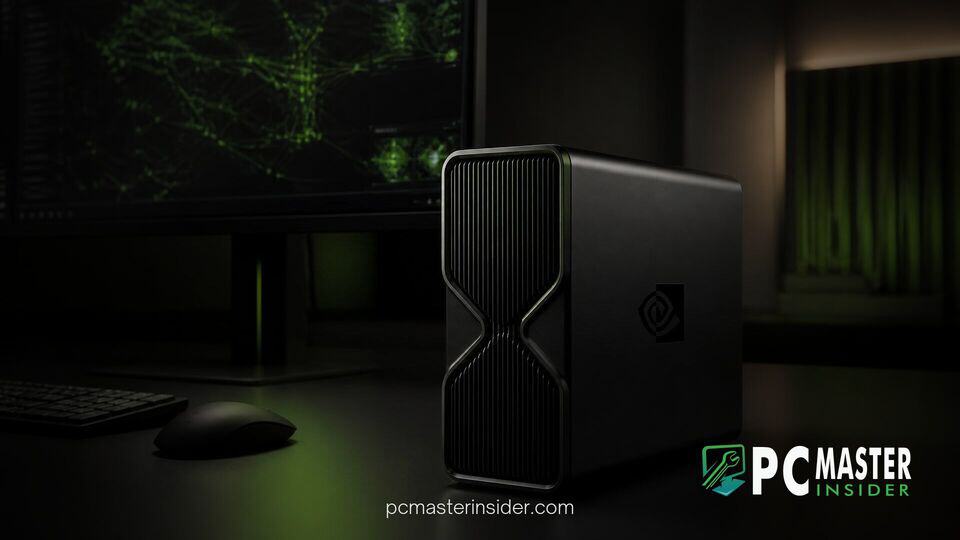
Nvidia has officially expanded its ARM-based workstation ecosystem with the immediate launch of small form factor systems built on the RTX Spark platform. These mini PCs combine high-throughput graphics compute with up to 128GB of high-speed unified memory, bringing enterprise-grade local artificial intelligence workloads straight to creator and developer desks.
Designed to run complex artificial intelligence agents, high-resolution rendering, and large language models locally, the new hardware line provides an always-on desktop counterpart to portable AI hardware. By performing processing locally, these dedicated desktop platforms remove the latency and ongoing per-token subscription fees associated with cloud API endpoints while preserving user data privacy.
Nvidia RTX Spark Compact AI Desktop Systems Bring Heavy Compute to Small Enclosures
The launch of the nvidia rtx spark compact ai desktop ecosystem marks a major step forward in bringing massive system memory bandwidth and low-power processing into compact desktop form factors. Building on the initial rollout of RTX Spark laptops earlier in the year, the desktop form factor addresses a specific need for persistent, always-on desktop stations. While mobile systems are optimized for portability, desktop units can sit connected to high-speed local networks and handle continuous background tasks without thermal throttling or battery constraints.
Compact AI mini PCs operate within a tight 140-watt thermal design power (TDP) envelope while yielding up to 1 petaflop of FP4 AI performance. This level of performance enables local execution of open-source artificial intelligence models with up to 120 billion parameters. Modern software engineering teams and digital content creators increasingly depend on local execution to handle code generation, video synthesis, and real-time asset rendering, avoiding cloud queue delays.
Nvidia RTX Spark Hardware Specifications and Memory Architecture
At the center of every RTX Spark desktop is the Nvidia RTX Spark N1X superchip, developed in close engineering collaboration with MediaTek. The chip architecture pairs a 20-core Nvidia Grace CPU based on ARM architecture with an Nvidia Blackwell graphics processing unit featuring 6,144 CUDA cores. Communication between the processor and graphics engine relies on Nvidia NVLink-C2C interconnect technology, which creates a high-bandwidth link between the two execution engines.
The stand-out structural feature of the system is its unified LPDDR5X memory architecture, which scales up to 128GB. Traditional PC builds separate CPU system RAM from dedicated GPU video memory (VRAM), which often leads to severe memory capacity bottlenecks when loading multi-gigabyte neural networks or massive 3D scenes. Unified memory allows both the Grace CPU cores and Blackwell Tensor Cores to address the entire 128GB pool seamlessly. This unified approach allows creators to load 3D scenes exceeding 90GB into memory without crashing, while developers can allocate system memory directly to GPU buffers depending on current application requirements.
Additionally, Microsoft Task Manager memory updates inside Windows 11 help users monitor how much unified memory is allocated between local models and standard background applications. Standard hardware features across the platform also include integrated 10-Gigabit Ethernet connectivity, ensuring rapid transfers of multi-gigabyte dataset files and model weights across local area networks.
Partner Desktop Systems from ASUS, Dell, and MSI
Hardware vendors have begun releasing their custom implementations of the RTX Spark compact architecture. Early market entries include the ASUS ProArt GR1X mini PC and the MSI EdgeMesa N AI+ Series, both housed in compact chassis measuring around 1.1 liters in volume. These compact chassis feature dedicated cooling solutions, including custom vapor chamber modules designed to keep internal components cool under long computing sessions.
Systems from Dell are also debuting alongside the initial launch batch, with additional products from Acer, Gigabyte, HP, and the upcoming Microsoft Surface RTX Spark Dev Box slated to launch in the coming months. System pricing reflects the workstation nature of the platform, with premium 128GB configurations starting near $4,499 depending on storage options and vendor cooling implementations.
Software support for the platform is built on Windows 11 on ARM. The platform supports native ARM applications, Linux environments via Windows Subsystem for Linux (WSL), and full acceleration for CUDA-based AI tools. Creative tools such as Adobe Creative Cloud, Blender with DLSS Ray Reconstruction, and local generation interfaces like ComfyUI run natively on the desktop platform.
Target Workloads for Local AI Agents and Developers
Nvidia is positioning these compact desktops as dedicated hubs for continuous software processing. Personal AI agents run most efficiently when they remain online 24 hours a day, watching local files, running routine automation scripts, and responding instantly without waiting for cloud servers. A dedicated desktop lets users leave persistent agents active while taking a secondary laptop on the road.
For AI engineers, local desktop execution allows rapid fine-tuning of open models using tools like Unsloth, alongside orchestration frame frameworks like Hermes Agent. Developer workflows benefit from local model routing engines that automatically keep routine tasks processing on the local Blackwell GPU while redirecting highly complex requests to cloud clusters when needed.
The launch of RTX Spark mini PCs demonstrates a broader hardware trend toward local AI acceleration on personal hardware. As hardware manufacturers continue to refine unified memory designs and low-power ARM architectures, high-performance computing capabilities will become increasingly available right at user desks.