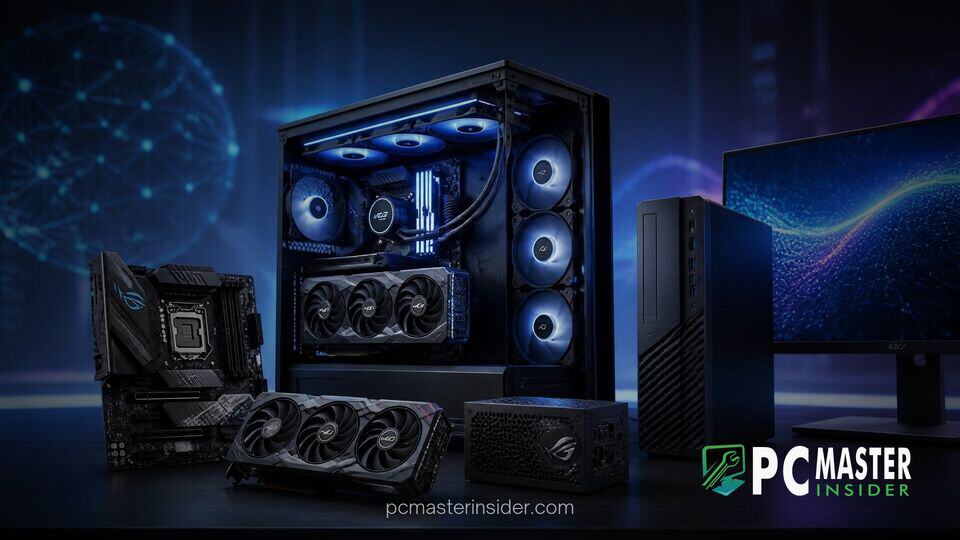
Hardware manufacturer ASUS has launched a broad initiative to turn standard desktop hardware into dedicated platforms for running agentic artificial intelligence locally. The strategy covers a wide range of hardware components, specialized workstations, and software tools designed to help custom PC builders deploy AI assistants on their own systems.
By targeting DIY enthusiasts, creators, and enterprise users, the framework aims to reduce reliance on third-party cloud computing platforms while giving users complete control over data privacy and operating costs. The expansion marks a major industry shift toward offloading continuously running AI agent workflows from remote data centers to local desktop setups.
ASUS Unveils Agent Computer Local AI Architecture
The core of the initiative relies on an architecture designed to support autonomous software agents that execute multi-step workflows without constant cloud API interactions. Unlike standard chatbot interfaces that answer individual queries, agentic systems run continuous background tasks, search internal files, write software code, and process multi-step instructions independently. Moving these workflows to desktop systems lets builders bypass ongoing subscription fees and per-token cloud API charges.
To support this architecture, ASUS is emphasizing flexible deployment choices: local, cloud, or hybrid. In a fully local setup, large language models (LLMs) and small language models (SLMs) process data entirely on system hardware. In a hybrid arrangement, everyday task processing stays on the PC while heavier computation offloads to cloud endpoints. Similar hybrid approaches are becoming common across desktop computing ecosystems, as seen in projects like GitHub Copilot Fusion local model routing for developer platforms.
Hardware Support Across DIY Motherboards and Workstations
The hardware push spans several ASUS component lines, making AI support a core feature of desktop builds. DIY motherboard platforms across the PRIME, TUF Gaming, Republic of Gamers (ROG), and ProArt series now feature hardware optimizations tuned for AI inference workloads, multi-GPU scalability, and high-speed memory bandwidth. These motherboards work alongside high-capacity graphics cards and dedicated accelerators.
For high-end builders and enterprise setups, ASUS is matching motherboard updates with heavy-duty workstations like the ExpertCenter Pro series. These systems support multi-GPU setups capable of handling hundreds of gigabytes of video memory (VRAM). This capacity allows developers and researchers to host open-source AI models locally without hitting memory bottlenecks. Similar enterprise hardware setups have expanded across the industry, including systems like the Gigabyte AI TOP AERO desktop, which also targets local AI workloads through high unified memory capacity.
Software Integration and Hybrid AI Deployment Models
Hardware capabilities depend heavily on software integration. To bridge this gap, ASUS introduced dedicated applications and diagnostic utilities designed to manage local model workloads. Software tools such as ASUS Zenni Claw offer users an entry point for setting up daily productivity assistants, automated research workflows, and document generation tools locally. These tools interface directly with open-source model runners like Ollama, making model deployment accessible to non-enterprise users.
Software developers and power users can also manage hardware resource allocation through central control interfaces. By monitoring real-time GPU utilization, VRAM allocation, and thermal limits, system builders can tune performance based on active workloads. Software tools built for local processing mirror operating system trends where intelligent background management becomes central, such as Copilot PC diagnostics in Windows 11 designed for system evaluation.
Privacy remains a central selling point for local software deployments. Processing confidential documents or sensitive codebases locally ensures data never leaves the physical machine. Operating systems dedicated entirely to local inference, such as Kora OS for Linux desktops, highlight a broader push toward keeping processing tasks on user hardware. Enterprise security frameworks are also adapting to protect local software instances, reflecting initiatives like process container isolation for AI agents on client devices.
Total Operating Cost Management for PC Builders
Running local AI agents involves balancing initial hardware investment against ongoing operational costs. While cloud-hosted AI endpoints charge per API token or through subscription models, local setups require upfront investments in high-VRAM graphics cards, fast system memory, and robust cooling. However, for businesses or developers running continuous background agents, local processing eliminates unpredictable monthly bills.
To assist users in evaluating system requirements, ASUS introduced the "Find Your ASUS Agent Computer" configuration tool. The utility evaluates workload types, desired model sizes, and budget targets to recommend specific component combinations. Mainstream builds focusing on smaller 7-billion to 14-billion parameter models can run on single high-end consumer GPUs, whereas teams processing 70-billion parameter models locally require multi-card workstation setups.
Availability and Ecosystem Roadmap
Components supporting the Agent Computer framework are shipping through retail channels and hardware integrators. Prebuilt systems and standalone motherboards, graphics cards, power supplies, and workstation cases are available globally. Software packages like Zenni Claw are rolling out to compatible system builds alongside ongoing firmware updates.
As desktop hardware capabilities increase and open-source AI models grow more efficient, local agent computing is expanding into everyday desktop builds. By offering connected hardware components and setup software, ASUS is positioning its DIY PC ecosystem to support autonomous software workflows alongside traditional gaming and content creation workloads.