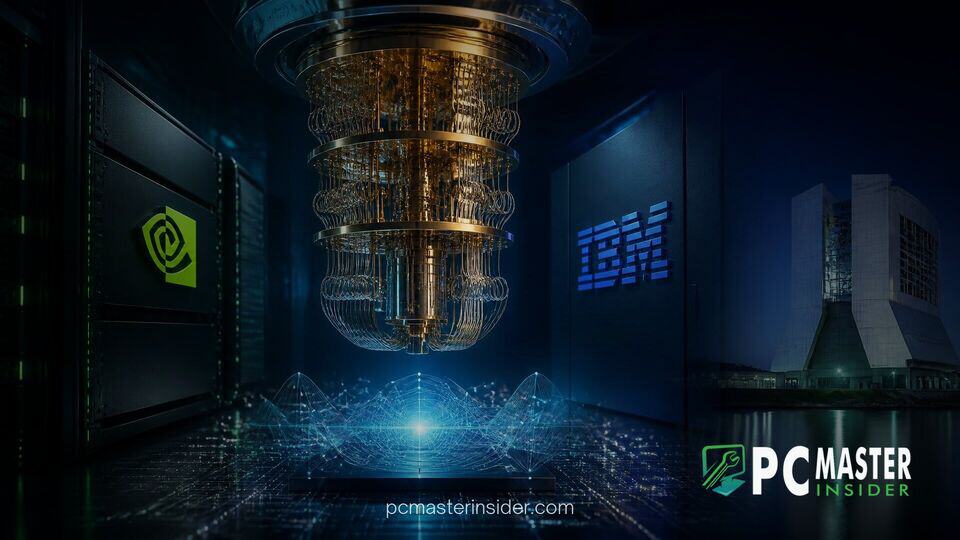
At the Supercomputing 2026 conference in Chicago, Nvidia, IBM, and the U.S. Department of Energy's Fermi National Accelerator Laboratory announced a partnership to establish a modular quantum computing platform. The joint project aims to link classical supercomputers directly with quantum hardware to accelerate scientific discovery in high-energy physics.
By bringing together industry computational systems and national laboratory research facilities, the project tackles the computational bottlenecks that currently prevent quantum processing units from operating efficiently at a large scale. The co-design architecture is structured to pioneer scalable, fault-tolerant supercomputing.
Nvidia, IBM, and Fermilab Partner on Quantum Computing Platform
The strategic alliance creates a shared environment to construct, test, and refine modular quantum-classical architectures. Rather than treating quantum processors as isolated units, the collaborative platform physically co-locates Nvidia accelerated computing clusters with quantum hardware housed at Fermilab's Superconducting Quantum Materials and Systems (SQMS) Center.
This initiative bridges high-performance classical supercomputing and quantum execution, allowing researchers to evaluate real-time telemetry, latency overheads, and hardware control systems under realistic laboratory conditions. The platform provides a testbed to analyze how classical nodes and quantum processors scale when working in tandem.
Integration of Classical Supercomputing and Quantum QPUs
The core configuration of the co-design testbed physically pairs Nvidia DGX B200 systems alongside IBM's quantum processing units, including the IBM Quantum Nighthawk processor. Nighthawk represents one of IBM's most capable devices, capable of executing complex circuits across 120 qubits at operational speeds reaching 100,000 samples per second.
Connecting high-throughput graphics processing units with quantum hardware addresses a primary challenge in hybrid computational workflows. Single, monolithic quantum processors encounter physical limits in qubit scaling. Connecting multiple quantum processing units through low-latency quantum interconnects is critical for achieving larger computational capacities.
Researchers will initially model and emulate communication protocols between connected quantum modules. This involves measuring link errors, network latency, and feedback parameters to guide hardware developments at the SQMS Center. Subsequent phases of research aim to integrate Fermilab's nine-cell superconducting radiofrequency cavity hardware directly into the system architecture. These ultra-coherent structures will be evaluated as quantum memories and entanglement buffers to extend coherent system operations.
CUDA-Q and Slurm Integration for Error Correction
To orchestrate complex computational tasks across hybrid machines, the partners are expanding software integrations between supercomputing infrastructure and quantum platforms. IBM and Nvidia have integrated the open-source Quantum Resource Management Interface with the Slurm workload manager. This update allows high-performance computing centers to schedule quantum hardware alongside traditional graphics processors and central processing units through standardized queuing systems.
Coinciding with the platform announcement, Nvidia introduced updates to its CUDA-Q software library, including a specialized decoder algorithm named TCBP-JOBS. Quantum error correction requires real-time decoding, where classical software processes measurement streams to detect physical errors before quantum states degrade. The TCBP-JOBS decoder achieved decoding speed increases of up to 13,000 times compared to existing standard algorithms in specific benchmarks.
Accelerated decoding capabilities shorten the time needed to prototype quantum error-correction routines. Calculations that previously required weeks of classical simulation can now be processed in under an hour. This software performance expansion supports research teams attempting to implement fault-tolerant computational workflows.
The software environment also ties into broader industry efforts to manage complex high-performance tasks. As tech organizations collaborate across software infrastructure, such as recent efforts surrounding the SGLang Consortium for open-source frameworks, standardized management layers remain vital for scalable enterprise computing.
Scientific Research Goals and Future Outlook
The primary scientific focus of the platform centers on complex calculations in high-energy and nuclear physics. Fermilab will manage domain scientist access and application workflows through its distributed HEPCloud infrastructure. Researchers from international research centers, national laboratories, and academic institutions will use the co-design system to tackle problems that exceed the limits of classical computers acting alone.
Target domain applications include modeling lattice gauge theories, simulating complex neutrino interactions, and calculating nuclear structures. By applying hybrid quantum-classical algorithms to these fundamental problems, particle physicists intend to define concrete hardware and software requirements for future generations of fault-tolerant quantum computers.
In initial tests demonstrating the potential of hybrid setups, researchers from IBM, RIKEN, and Nvidia successfully simulated strongly correlated iron-sulfur clusters. Utilizing classical graphics processing nodes alongside quantum hardware, the team achieved simulation accuracy levels 79 times closer to leading classical methods than previous attempts.
"Some of the most fundamental problems in science remain out of reach without access to quantum computing," noted Jerry Chow, IBM Fellow and chief technology officer of quantum-centric computing. "Scaling quantum and classical together will open new frontiers in high-energy and nuclear physics and beyond."
Anna Grassellino, chief technology officer at Fermilab and director of the SQMS Center, highlighted the collaborative potential of bringing together hardware, software, and scientific domain experience. The multi-year initiative establishes an integrated operational path forward as the industry transitions from isolated quantum experiments toward unified high-performance computing installations.
By systematically addressing hardware modularity, low-latency interconnects, and resource management, the partnership between Nvidia, IBM, and Fermilab sets a foundation for practical hybrid supercomputing in scientific research.