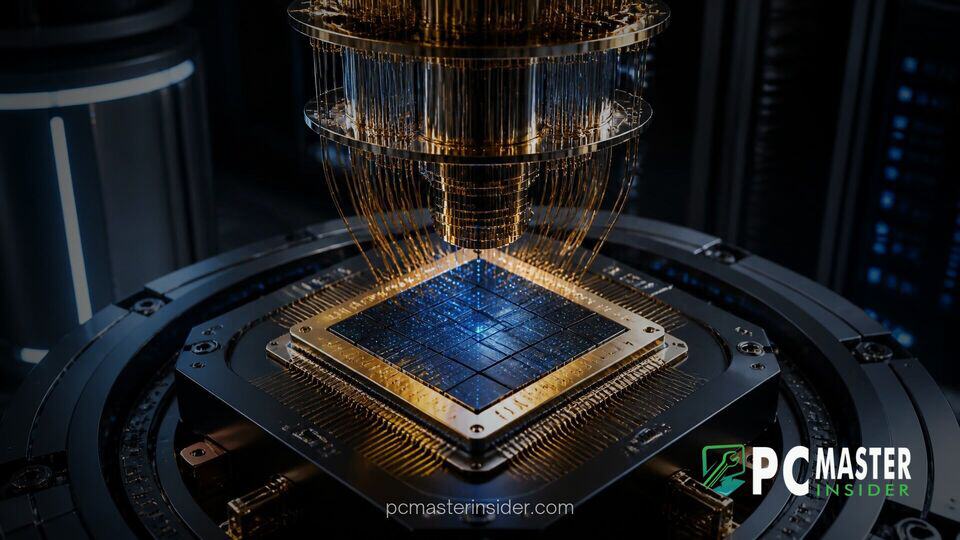
IBM has formally announced its next-generation quantum hardware architecture, the IBM Quantum Nighthawk r3 processor, designed to execute up to 10,000 quantum operations across 520 programmable qubits . The announcement expands on IBM's updated quantum computing roadmap, highlighting significant operational throughput gains and laying out multi-chip scaling plans for the coming years .
IBM Quantum Nighthawk r3 Processor Delivers Major Breakthrough in Scale
The newly outlined IBM Nighthawk r3 processor represents a substantial scaling effort over its immediate predecessor, the Nighthawk r2 chip . While Nighthawk r2 featured 120 programmable qubits within a total of 458 physical quantum elements, Nighthawk r3 scales the architecture up to 520 programmable qubits built from 2,034 physical components . The revised architecture retains the high-speed square-lattice geometry introduced in earlier iterations while enhancing system-level gate capacity to handle increasingly complex algorithmic workloads .
A critical metric emphasized by IBM is execution depth. Where the current Nighthawk r2 chip was built to handle around 7,500 quantum gate operations, Nighthawk r3 elevates this benchmark to 10,000 accurate operations . By increasing both the usable qubit count and operational depth, IBM aims to enable research institutions and enterprise clients to perform larger computational simulations without running into prohibitive error rates.
Key Specifications and Operational Performance Gains
Beyond raw capacity, throughput remains a fundamental focus for the Nighthawk line. The architectural shift away from older heavy-hexagonal layouts toward square-lattice coupling allows each programmable qubit to connect with up to four neighboring qubits, reducing circuit routing overhead . Coupled with high-speed dissipative qubit reset mechanisms, the Nighthawk architecture allows for rapid re-initialization between circuit executions, reducing repetition delays down to single-digit microseconds .
According to IBM, deployment results from existing partners utilizing Nighthawk hardware show significant speedups over earlier generations. Industrial and research organizations, including European energy provider E.ON and Finnish quantum software developer Algorithmiq, have executed more than 34 billion circuits on Nighthawk systems . E.ON reported up to a 15-fold performance speedup in power-grid optimization algorithms compared to older Heron processors, while magnetic material simulations conducted with Oak Ridge National Laboratory showed a 12-fold increase in processing speed .
Hardware evolution across semiconductor industries has increasingly relied on architectural refinements rather than mere transistor counts, a trend mirrored in classical hardware releases. Similar emphasis on workload optimization and architectural efficiency can be observed across hardware sectors, from specialized enterprise servers to portable systems like the ACEMAGIC mini PC with laptop GPU hardware.
Integration with Classical Computing Infrastructure
IBM emphasized that realizing practical quantum utilities requires tighter coupling between quantum processing units and classical high-performance computing (HPC) systems. Quantum algorithms depend heavily on classical error mitigation routines and pre-processing operations to deliver usable data output. The enhanced IBM Quantum Platform is structured to merge quantum and classical computing workflows within a unified execution environment .
Jay Gambetta, Director of IBM Research, highlighted the dual necessity of speed and accuracy in modern processing tasks. "Useful quantum computing hinges on whether results can be delivered with accuracy and speed, both are fundamental," Gambetta said in a press statement . "As we scale this architecture to larger and more powerful quantum computers, the capabilities of quantum computation will reach new levels as we integrate more closely with classical resources."
This reliance on hybrid processing reflects broader technology trends where specialized co-processors assist central computing architectures. In desktop and server spaces, vendors frequently adjust system platform capabilities to match software demand, such as recent platform shifts where companies prioritizing AI acceleration alter enterprise product lines, similar to how Intel prioritizes server processor capacity over standard desktop parts to handle heavy server workloads.
Future Scaling Roadmap Toward 1,000 Qubits
Looking ahead, IBM confirmed that Nighthawk r3 will feature 10 specialized chip-to-chip interconnects, designated as "l-couplers" . These high-fidelity physical links are built to enable modular scaling by physically binding multiple quantum processors together in cryogenic environments .
Using this modular approach, IBM plans to link two Nighthawk r3 processors into a single unified system containing 1,040 programmable qubits by 2027 . Demonstration tests using earlier prototype links showed transfer fidelities above 99%, providing a foundational baseline for multi-chip quantum scaling . Hardware developers across the industry continue to invest heavily in multi-chip and full-stack integration; for instance, rival chipmakers have expanded software and hardware acquisitions to build unified development platforms, as seen when Intel announced its acquisition of Classiq to bolster its quantum computing stack.
As IBM continues its trajectory toward fault-tolerant quantum computing, the Nighthawk r3 processor serves as a primary bridge, combining increased qubit counts with rapid execution speeds to advance commercial and scientific quantum applications.