
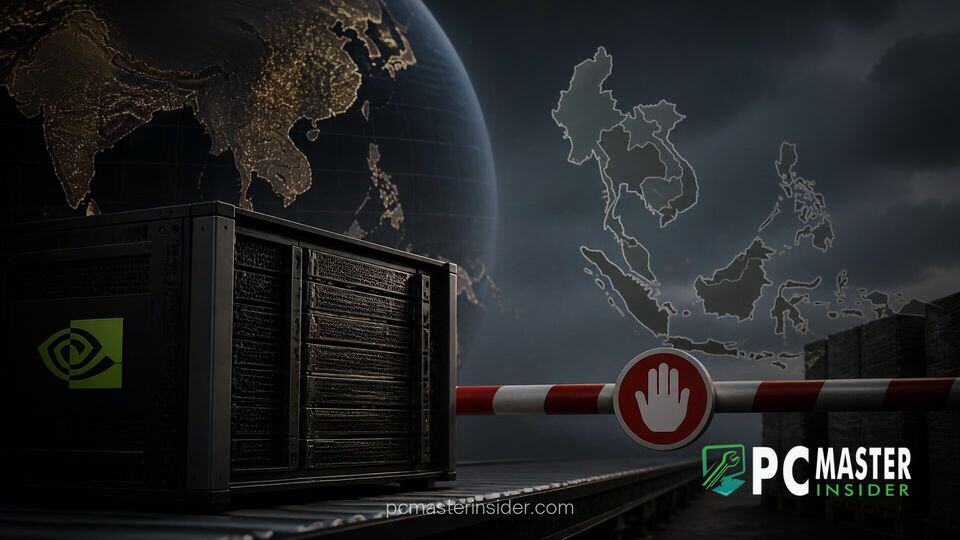
Nvidia has instructed its primary server assembly partners to suspend deliveries of high-performance artificial intelligence systems to four key Southeast Asian nations. The directive affects orders destined for Singapore, Malaysia, Thailand, and Indonesia while hardware vendors work to evaluate compliance requirements under newly updated United States trade controls.
Major hardware manufacturing partners, including Dell Technologies and Supermicro, have begun informing buyers across the affected countries that server orders containing Nvidia processors cannot be fulfilled immediately. Industry sources indicate that the shipping pause stems from efforts to prevent non-compliant entities from accessing restricted computing capacity.
Nvidia Halts AI Server Shipments to Four Southeast Asian Countries
The decision to halt AI server shipments to Southeast Asia reflects expanding efforts by U.S. regulatory authorities to limit unauthorized foreign access to high-performance computing infrastructure. Reports indicate that major server manufacturers were instructed to pause pending orders across the four regional markets to assess new licensing conditions set by Washington. While it remains uncertain whether the delivery pause is a temporary administrative measure or a precursor to long-term supply restrictions, regional enterprise projects and cloud computing infrastructure builds are experiencing immediate operational disruptions.
Nvidia Suspends AI Server Deliveries in Southeast Asia
The suspension marks a significant shift in regional semiconductor distribution. Over the past two years, Southeast Asia has established itself as one of the fastest-growing destinations for data center investments. However, tightening regulatory oversight has created new hurdles for server integration. Hardware integrators assemble raw GPU components into turnkey high-performance server clusters, making these system-level shipments a primary focus for international export verification.
The affected nations serve as major hubs for regional enterprise technology deployments. Singapore hosts a vast network of hyperscale data centers, while Malaysia has recently approved billions in digital infrastructure projects to support local and multinational cloud workloads. Thailand and Indonesia have similarly expanded their data center capacity to meet growing domestic demand for advanced analytics and enterprise automation. With deliveries paused, data center operators across these markets face extended wait times for hardware deployments.
Recent developments in hardware acceleration highlight how tightly linked global supply chains have become. For example, when Nvidia launched RTX Spark compact AI desktops for localized workloads, it signaled growing demand for distributed computing capacity alongside enterprise-grade data centers. When server-scale deliveries hit regulatory roadblocks, regional development plans often slow down across the entire infrastructure stack.
US Trade Regulation Compliance and Scrutiny
The operational freeze directly aligns with updated export control frameworks introduced by the U.S. Department of Commerce's Bureau of Industry and Security. The revised regulations require technology providers to obtain specialized export licenses before shipping advanced AI processors and high-density server configurations to specific third-country destinations, including the four Southeast Asian nations.
Washington's regulatory adjustments aim to close potential bypass routes that allow foreign entities to access top-tier computing power. Historically, entities subject to direct trade sanctions could circumvent hardware purchase restrictions by renting compute capacity hosted in overseas data centers. The latest licensing frameworks mandate that cloud providers operating in foreign jurisdictions must demonstrate that their end users do not include restricted parties.
These regulatory checks arrive at a moment of broader geopolitical and corporate adjustments. Recent shifts in corporate leadership have kept market observers attentive; earlier financial filings showed Nvidia trimming its Intel stake as part of broader strategic asset allocations. Concurrently, global regulatory bodies are enforcing stricter compliance reporting across all international hardware transfers.
Impacted Regions and Partner Directives
Server vendors such as Dell Technologies and Supermicro handle the complex task of packaging GPUs into complete rack-mount solutions. Because these systems integrate specialized networking, cooling, and management hardware, they fall under comprehensive system-level export control definitions. Executives at regional cloud providers have reported that the rapid rollout of export licensing requirements left little lead time to establish standardized compliance procedures, creating immediate operational friction.
The shipping pause has already influenced regional financial agreements. Reports indicate that commercial lenders have paused multi-million-dollar credit arrangements intended to finance regional cloud deployment projects. Without guaranteed delivery timelines for critical processing hardware, financial institutions are taking a cautious approach toward data center expansions across Singapore and Malaysia.
The regional disruption comes alongside existing cost pressures across the broader electronics market. Beyond enterprise GPU restrictions, hardware manufacturers are managing supply chain adjustments across multiple sectors. Similar allocation shifts occurred when Nvidia reportedly cut gaming GPU supply to rebalance inventory across different market segments. When high-end server hardware faces regulatory holds, component allocations across adjacent product lines are frequently adjusted.
Broader Implications for Global AI Hardware Supply Chains
The shipment freeze highlights the increasing complexity of distributing high-performance computing hardware globally. As national security policies become tightly integrated with technology export guidelines, semiconductor developers must navigate stringent verification processes to ensure compliance.
For data center operators in Southeast Asia, the pause creates operational uncertainty during a period of rapid infrastructure growth. Companies seeking to expand regional cloud capacity must now wait for hardware manufacturers and regulatory bodies to formalize licensing channels. Meanwhile, open-source AI developers and commercial enterprises relying on third-party cloud infrastructure may experience higher rental costs or delayed access to top-tier hardware configurations.
Enterprise data centers rely on consistent software and hardware balance. System administrators managing large-scale server clusters regularly deploy stability updates, such as when Microsoft released hotpatch KB5138318 for Windows Server 2025 to maintain network stability. However, maintaining high-uptime infrastructure becomes significantly more challenging when physical server hardware deliveries are halted indefinitely by export rules.
As the U.S. Commerce Department and technology manufacturers refine their compliance workflows, industry analysts expect detailed licensing guidelines to emerge in the coming months. Until those mechanisms are established, server shipments to the four Southeast Asian nations will remain subject to strict administrative oversight.