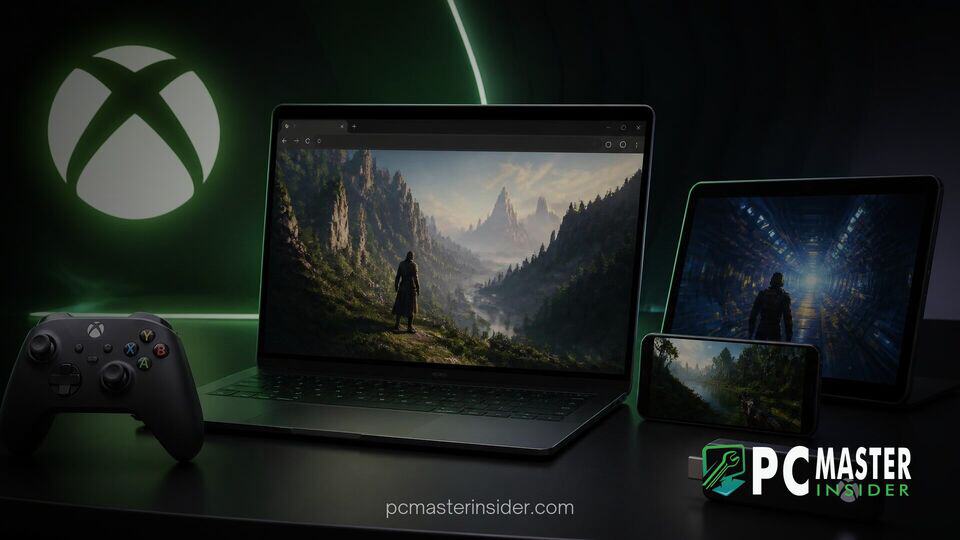
Microsoft has officially announced Xbox Labs, a dedicated internal initiative aimed at expanding how and where video games can be accessed across web browsers and non-native hardware. Revealed by Xbox CEO Asha Sharma, the group will leverage emerging technical breakthroughs such as WebGPU, WebAssembly, and code recompilation to weaken the traditional boundary between console hardware and software play.
Inside Microsoft's New Xbox Labs Initiative
Microsoft Xbox Labs announcement webgpu efforts mark a formalization of experimental research that has been developing across the company's engineering divisions. Led by Xbox Chief Technology Officer Scott Van Vliet, Xbox Labs brings together a specialized team of game developers, software engineers, and research scientists. Rather than operating as a standard game development studio, the unit acts as an innovation incubator designed to turn technical concepts into public-facing features.
In an internal memo sent to employees and shared publicly on Xbox Wire, Asha Sharma explained that Xbox Labs will build its projects in the open, gathering real-time feedback from players and creators. Success for the team will be measured by overall player engagement and community adoption rather than traditional hardware console sales alone. Microsoft confirmed that no external hiring was required to establish Xbox Labs, as the effort reorganizes existing internal talent and ongoing projects under a single, unified banner.
The establishment of Xbox Labs comes alongside other structural updates within Microsoft's gaming division. Recent shifts include the redesign of the Xbox PC App and strategic organizational realignments designed to streamline platform performance across desktop, web, and mobile ecosystems.
Focus on WebGPU, WebAssembly, and Game Recompilation
The primary technical catalyst behind Xbox Labs is the rapid rise of static recompilation and browser-native rendering tools. Over recent months, independent developer communities have successfully decompiled classic PC and console titles, allowing them to run on unsupported operating systems and hardware platforms. Microsoft aims to harness these same techniques officially to make classic and modern titles instantly playable inside standard web browsers.
Central to this initiative are WebAssembly and WebGPU. WebAssembly allows pre-compiled code to run inside a web browser at near-native speeds, bypassing the traditional performance overhead associated with web-based gaming. Complementing it, WebGPU provides web applications with direct access to modern graphics processing units, granting browsers low-level rendering capabilities similar to DirectX 12 or Vulkan. Sharma highlighted in her memo that WebGPU support is now approaching 90 percent global browser availability, rendering browser-based distribution more viable than ever before.
Beyond web browsers, Xbox Labs is investigating translation layers to run Windows PC game builds on alternative silicon architectures, including Apple Silicon hardware. This approach parallels recent operating system advancements where graphic API translation and hardware acceleration are utilized to bridge cross-platform gaps. Hardware performance tuning remains critical to this strategy, much like how PC gamers turn to Game Mode and GPU scheduling in Windows 11 to fix FPS drops and ensure smooth frame rates.
Expanding Xbox Content Across Browsers and Alternative Hardware
By emphasizing recompilation over traditional cloud streaming, Xbox Labs presents a complementary path for game distribution. While cloud gaming relies heavily on remote server farms streaming video feeds to client devices, local execution via WebGPU allows host hardware to run game logic natively inside a browser tab. This drastically reduces latency, eliminates remote rendering server costs, and enables offline capability once browser assets are cached.
This strategy aligns with Microsoft's broader vision of decoupling games from dedicated console hardware. Over the past decade, Microsoft has expanded backward compatibility and cross-platform access across the Xbox ecosystem. With Xbox Labs, classic games from previous console generations could receive second lives through instant-play browser links, removing installation barriers for casual players.
Microsoft acknowledged that native web execution and cross-platform porting challenge established business models that rely on proprietary hardware sales. However, company leadership framed these shifts as net positives for the gaming industry. Making game libraries accessible on any web-enabled device drastically lowers the bar for entry, helping Microsoft reach new audiences on laptops, mini PCs, and non-Windows workstations. Specialized hardware like the ProArt GR1X mini PC or lightweight notebooks could easily host complex titles directly within web browsers without demanding full native installations.
Industry Impact and Future Outlook for Xbox Labs
The launch of Xbox Labs signals a proactive response by a major platform holder to community-driven modding and reverse-engineering trends. In recent months, fan-led projects have successfully brought titles like Halo: Combat Evolved and older open-world games to browser tabs, proving that modern web standards can handle complex 3D environments. By creating an internal team dedicated to similar research, Microsoft can explore these technologies while maintaining control over its intellectual property and copyright frameworks.
Furthermore, Microsoft plans to explore how automated tooling and software intelligence can assist developers in porting legacy codebases. Sharma noted that software development was among the first workloads transformed by automated coding tools, noting that players spend over 72 billion hours annually playing Xbox games—a figure that underlines the immense scale of the gaming ecosystem. Developers utilizing modern software workflows, similar to those adopting AI coding tools for project builds, may soon benefit from Xbox Labs' open-source tooling and porting pipelines.
Initial experiments conducted by Xbox Labs are expected to rollout gradually through the Xbox Insider Program, allowing community members to test browser ports and alternative platform builds firsthand. While Microsoft has not set specific release dates for commercial consumer products, the team's commitment to building in the open guarantees that players will see experimental browser prototypes in the near future.
Through Xbox Labs, Microsoft is taking a clear step toward a hardware-agnostic future. By embracing WebGPU, WebAssembly, and native web execution, the company is positioning its vast library of games to be playable on virtually any screen with a modern web browser.