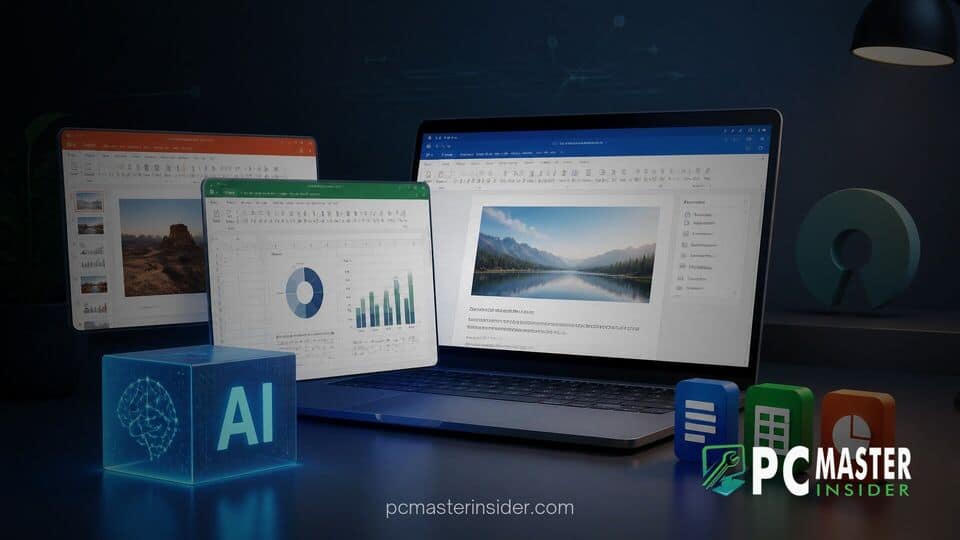
Software developer Brandon Thomas and the ArtCraft project team have officially expanded their open-source mission by releasing a new suite of office productivity applications written in Rust. The new releases, developed with assistance from Anthropic's Claude AI model, are designed as direct, free alternatives to Microsoft Word, Excel, and PowerPoint.
Coming shortly after the team gained attention for releasing open-source alternatives to Adobe's Creative Cloud software, the new tools mark an ambitious push to recreate mainstream proprietary desktop applications through clean-room software development.
ArtCraft Creator Expands Open-Source Suite to Microsoft Office
The latest release introduces open source microsoft office clones ai users can run natively across multiple desktop operating systems. Developed under the ArtCraft banner, the software suite seeks to provide privacy-focused, royalty-free alternatives to subscription-heavy productivity suites. Each application is dual-licensed under the MIT and Apache 2.0 open-source licenses, giving developers and end users complete freedom to inspect, modify, and distribute the underlying source code.
Unlike traditional web-wrapped tools, the entire suite is written in pure Rust, compiling down to fast, light-footprint native binaries for Windows, macOS, and Linux. Cross-platform compatibility has long been a sticking point for productivity software, particularly on Linux desktop distributions. By leveraging Rust alongside WebAssembly compilation targets, the ArtCraft suite aims to deliver identical user experiences and native performance regardless of the underlying operating system.
Introducing GridCraft, DeckCraft, and WordCraft
The newly unveiled productivity lineup consists of three dedicated applications designed to mirror the core functions and user interfaces of Microsoft Office classics:
- WordCraft: A document processor that recreates the familiar ribbon UI, paragraph formatting, tables, tracked changes, and mail merge, while offering native reading and writing for DOCX files.
- GridCraft: A spreadsheet application built to handle XLSX files, featuring a formula engine, cell formatting, dynamic arrays, pivot table structures, and chart generation.
- DeckCraft: A presentation builder supporting PPTX files, slide masters, custom transitions, animations, and dedicated presenter view layouts.
While the repositories on GitHub have accumulated thousands of stars within days of launch, the developers emphasize that all three applications remain in early pre-alpha testing. Basic document editing and file parsing function as intended, but complex formatting edge cases and advanced enterprise features are still undergoing active development.
Role of AI Models in Independent Software Development
The rapid creation of these productivity clones highlights an evolving paradigm in modern software engineering. Brandon Thomas, a veteran engineer with 15 years of industry experience, leveraged Anthropic's Claude model as a synthetic co-developer to handle repetitive boilerplate, parse binary file format specifications, and speed up implementation. Rather than relying on simple code prompt scripts, Thomas structured the codebase so that every UI action corresponds to named terminal commands.
This architectural design choice enables Model Context Protocol (MCP) integration, allowing AI agents to navigate and edit documents inside WordCraft, GridCraft, and DeckCraft directly. The strategy aligns with broader industry trends where autonomous agents execute tasks inside isolated desktop environments. For instance, systems like Microsoft Execution Containers are being designed specifically to sandbox autonomous software processes.
Responding to online debates regarding AI-assisted coding and software quality, Thomas clarified his approach on social media. "AI models enable me to work as an entire company," Thomas noted, explaining that leveraging LLMs allows small developer teams to architect enterprise-scale projects that previously required hundreds of software engineers.
Availability and Future Development Roadmap
All three productivity tools, along with ArtCraft's previous media creation software, are publicly available on GitHub for community auditing, contributions, and testing. Users interested in testing the tools can compile the source code directly or download pre-built installers released for major desktop platforms.
The project's primary focus centers on reaching full file compatibility with standard OpenXML formats used by commercial office packages. Future development goals include refining layout accuracy, expanding offline macro capabilities, and enhancing real-time collaborative editing through decentralized protocols.
While these pre-alpha tools are not yet ready to completely replace established commercial office packages for complex enterprise workflows, their rapid creation underscores how generative AI tools are lowering the barriers to building complex, native open-source software.