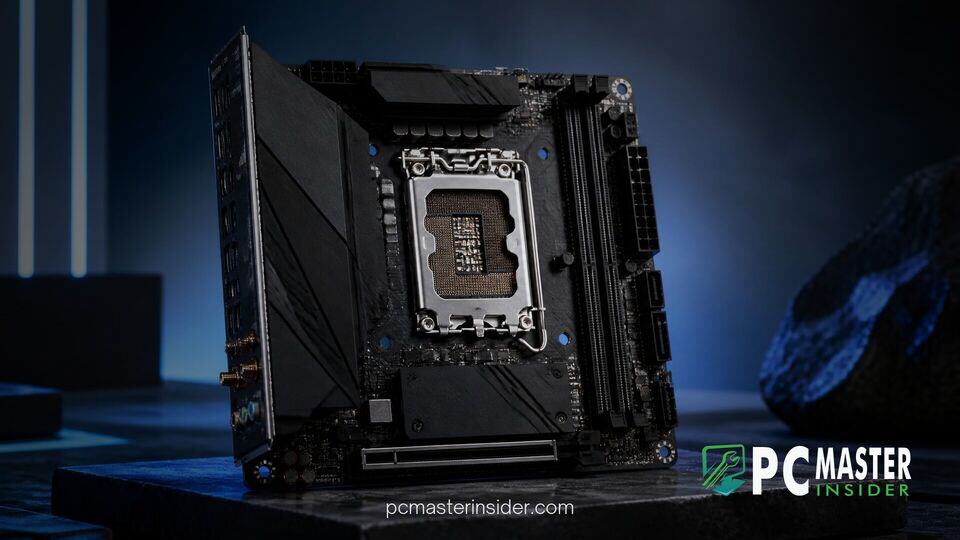
Biostar has announced the BIPTL-IHT, a new Thin Mini-ITX industrial motherboard powered by Intel Core Ultra Series 3 processors based on the Panther Lake-H platform. Built for edge computing, automation, and commercial integrations, the compact 170 mm by 170 mm board delivers localized artificial intelligence processing, high-speed memory support, and broad legacy connectivity.
The hardware launch marks one of the earliest retail-ready desktop motherboard designs utilizing Intel's next-generation Panther Lake architecture. Designed primarily for system integrators, edge gateways, and automated commercial deployments, the platform provides substantial computing density within a low-profile footprint.
Biostar Panther Lake Mini ITX Motherboard Overview
The newly unveiled Biostar Panther Lake mini ITX motherboard targets demanding edge computing applications, smart retail systems, industrial automation platforms, and embedded AI workloads. Featuring an integrated BGA-socketed processor, the BIPTL-IHT allows system builders to equip the board with Intel Core Ultra 5, Core Ultra 7, or top-tier Core Ultra 9 386H chips. Memory capabilities are extensive for its size class, supporting up to 128GB of dual-channel DDR5-7200 SO-DIMM RAM across two physical slots.
By leveraging Intel's embedded Neural Processing Unit (NPU) inside the Panther Lake-H silicon, the motherboard executes local AI inference tasks efficiently without relying on bulky add-in acceleration cards. This design choice allows industrial automation operators to deploy smart data pipelines, machine vision models, and customer analytics directly at the physical edge while maintaining minimal thermal and power profiles.
Biostar Unveils BIPTL-IHT Thin Mini-ITX Board
Form Factor and Targeted Industrial Workloads
The Thin Mini-ITX standard maintains the traditional 170 x 170 mm dimensions of standard Mini-ITX motherboards but significantly restricts the height of rear I/O connectors and internal heatsinks. This reduced vertical profile enables integration into ultra-slim enclosures, space-constrained panel PCs, self-service kiosks, and digital signage enclosures.
To support deployment in tough environments, Biostar built the board with a wide-range DC input supporting 9V to 24V power sources. The PCB layout includes essential enterprise features such as onboard TPM 2.0 security, six physical serial COM ports (including RS-232/422/485 interfaces) for legacy equipment control, 8-bit digital I/O header connections, and operational resilience across ambient temperatures ranging from 0°C to 60°C.
Similar to recent industry trends where hardware makers adapt mobile and low-power architectures for compact systems like the ACEMAGIC Starship M2A Mini PC, Biostar relies on optimized mobile silicon to hit extreme efficiency targets in embedded form factors.
Intel Panther Lake-H Hardware and Xe3 Graphics
Integrated Processing Limits for Compact PCs
The integrated Panther Lake-H processors on the BIPTL-IHT incorporate Intel's latest Xe3 graphics architecture. Configurations offered on this motherboard come with four Xe GPU cores, providing solid visual capabilities suitable for driving multi-monitor commercial terminals or media playback setups. However, these SKUs lack the higher-end integrated GPUs featuring 12 Xe3 cores found on select mobile consumer chips, making the board unsuited for heavy gaming.
Despite its focus on industrial workloads, the built-in GPU engine fully supports hardware-accelerated AV1 video encoding and decoding. This capability makes the motherboard a potential candidate for compact media ingestion nodes, digital video recorders, or home server projects. Hardware monitoring and visual outputs are well catered for, with integrated display controllers capable of outputting to up to four independent displays simultaneously through dual HDMI ports, dual DisplayPort 1.4 connections, and an internal LVDS connector.
This release joins a series of architectural updates across the computing industry, contrasting with desktop news such as Intel Nova Lake desktop CPU thermal frequency caps, as mobile-derived architectures continue to dominate high-density, low-power edge designs.
Expansion Options and Connectivity Features
Storage and expansion capabilities on the BIPTL-IHT are designed to accommodate high-speed data transmission and flexible network configurations. For solid-state drives, the motherboard includes two M.2 Key-M slots. One slot operates over a high-speed PCIe 5.0 x4 interface, while the second runs over PCIe 4.0 x2, ensuring fast throughput for local data logging and system boot drives.
Network connectivity relies on dual Intel I226 2.5GbE LAN controllers, providing redundant high-bandwidth ethernet connections for industrial networks. Additional wireless connectivity can be expanded via an M.2 Key-E slot for Wi-Fi and Bluetooth modules, alongside an M.2 Key-B slot supporting 4G or 5G cellular communication cards. On select processor models, Biostar also includes a single physical PCIe 5.0 x4 slot to accommodate specialized expansion hardware or additional networking interfaces.
As semiconductor providers continue to advance specialized computing chips across server, consumer, and embedded sectors—reflected in developments such as leaked Intel Razor Lake CPU die details and broader market shifts outlined in Intel desktop CPU market share reports—compact industrial designs remain critical for deploying real-time intelligence outside traditional data centers.
While Biostar has confirmed the complete specification sheet for the BIPTL-IHT motherboard, official pricing details and widespread retail release schedules have not yet been announced. System integrators and commercial builders are expected to receive availability details through authorized channel distributors in the coming months.