
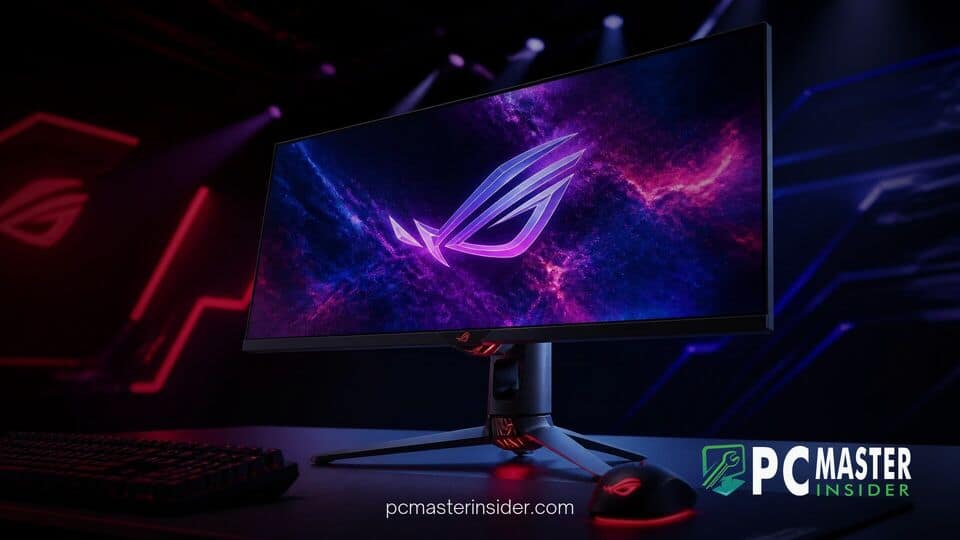
ASUS has officially announced its groundbreaking 720Hz ROG Swift OLED gaming monitor at Gamescom 2026, pushing competitive display performance to unprecedented heights. Designed explicitly for professional esports competitors, the panel combines extreme refresh speeds with self-emissive OLED technology for near-instant response times.
The announcement highlights a major engineering milestone for high-speed gaming displays, shattering previous refresh rate limitations while maintaining vibrant color accuracy and contrast. The device aims to give competitive gamers an absolute motion-clarity advantage in fast-paced first-person shooters and real-time strategy titles.
ASUS ROG 720Hz OLED Gaming Monitor Shatters Display Speed Records
The newly revealed monitor represents a massive leap forward for competitive esports hardware. By pairing an incredible 720Hz refresh rate with self-lit pixels, ASUS eliminates motion blur and Ghosting effects that traditionally plagued high-speed gaming panels. Gamers attending Gamescom 2026 were treated to live demonstrations of fast-moving game titles running at fluid frame rates that make input latency nearly imperceptible.
Hardware enthusiasts and pro players at the event noted that the jump to 720Hz provides exceptionally fluid tracking. While high-refresh displays were historically tied to TN or fast IPS panels with visual tradeoffs, the self-lit nature of OLED ensures deep black levels and stunning contrast without sacrificing speed.
ASUS ROG Swift OLED PG259QWS Ace Specs and Display Features
The ASUS ROG Swift OLED PG259QWS Ace centerpieces the company's esports showcase, sporting a 24.5-inch panel tailored specifically for tournament play standards. Utilizing a specialized 1080p resolution optimized for maximum frame generation on top-tier graphics cards, the monitor ensures that modern GPUs can push hardware output close to the target 720 frames per second limit.
720Hz Refresh Rate and Ultra-Fast Pixel Response
At the core of the monitor is its exceptional 720Hz native refresh rate coupled with an ultra-fast 0.03ms gray-to-gray (GTG) pixel response time. Because OLED pixels turn on and off individually without relying on a LED backlight array, transition times are essentially instantaneous. This allows frame transitions to resolve without visual artifacts, rendering fast target acquisition seamless during intense tactical firefights.
To support this high-bandwidth video throughput, ASUS incorporated DisplayPort 2.1 and HDMI 2.1 connections. The display also features full VESA DisplayHDR True Black compliance, anti-reflection surface treatments, and variable refresh rate (VRR) support across both NVIDIA G-Sync and AMD FreeSync ecosystems.
Panel Cooling and OLED Care Safeguards
Pushing OLED pixels to a unprecedented 720Hz frequency generates thermal challenges that require advanced engineering solutions. To prevent image retention and extend panel longevity, ASUS implemented an upgraded custom heatsink layout paired with a dedicated internal airflow mechanism.
Additionally, the monitor incorporates ASUS ROG OLED Care software protections. These background features automatically adjust pixel brightness in static areas, run periodic pixel-cleaning cycles, and monitor operating temperatures in real time without interrupting active gameplay sessions. Hardware cooling innovations like these are becoming increasingly standard across premium components, mirroring active monitoring advances seen in hardware like high-end ASUS ROG graphics card power telemetry systems.
Full Gamescom 2026 Monitor Lineup and Market Outlook
Beyond the flagship 720Hz display, ASUS showcased several complementary monitors aimed at broader consumer segments. The lineup includes high-resolution 4K 240Hz OLED options for immersive single-player gaming alongside ultra-wide curved options intended for simulation enthusiasts. However, the 720Hz ROG Swift display undeniably stole the spotlight among competitive gamers demanding raw visual responsiveness.
Industry analysts at Gamescom noted that while pushing frame rates above 500Hz was once considered a niche pursuit, competitive gaming communities continue to demand lower system latency. Display innovations continue to push boundary limits across form factors, similar to recent announcements where Samsung unveiled high-refresh rate OLED panels for laptops, underscoring the industry-wide shift toward high-speed OLED manufacturing.
However, driving consistent 720fps performance requires immense computational power. Gamers looking to leverage this monitor will need top-tier CPU and GPU configurations, as well as ample memory bandwidth. With recent market shifts showing that DDR5 memory prices have surged significantly due to global hardware demand, building a top-tier platform capable of pushing maxed-out frame rates remains an investment reserved for dedicated esports competitors.
ASUS confirmed that the ROG Swift OLED 720Hz monitor is scheduled for release late in the fourth quarter, with official pricing details expected closer to launch. As competitive gaming continue to evolve, ASUS has set a new benchmark for speed and visual clarity that rivals will likely spend years trying to match.