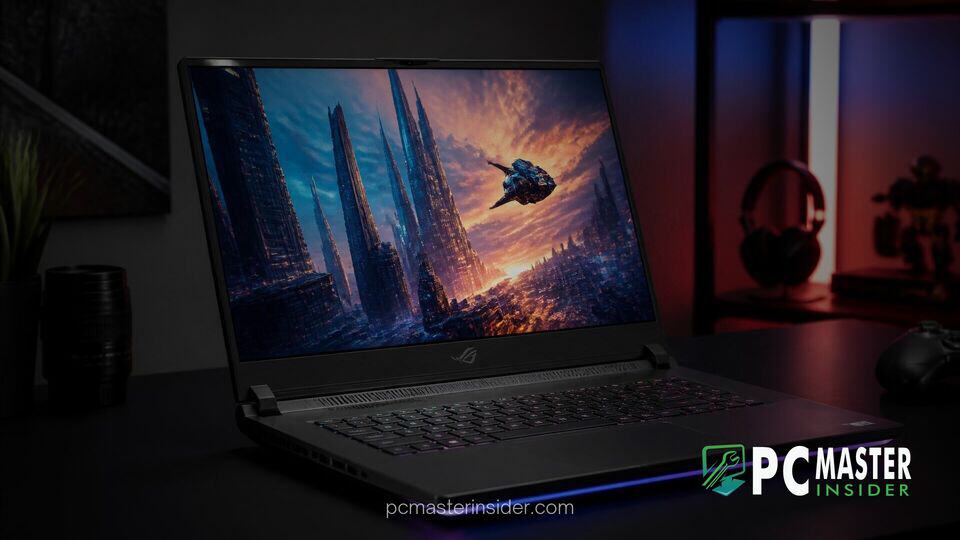
Samsung Display has unveiled the world's first 300Hz OLED panel engineered specifically for laptops, pushing self-emissive display technology into uncharted territory for high-speed gaming. Introduced during the International Meeting on Information Display (IMID) 2026 exhibition held at BEXCO in Busan, South Korea, the milestone display effectively breaks the previous 240Hz refresh rate limit that had defined high-end laptop OLED screens for years.
The breakthrough development marks a pivotal shift in the ongoing competition between traditional Liquid Crystal Displays (LCDs) and Organic Light-Emitting Diode (OLED) technology. While IPS and TN LCD panels have long offered ultra-high refresh rates reaching up to 360Hz or higher in portable form factors, OLED panels previously lagged behind in raw frequency. Samsung's latest innovation closes that performance gap while retaining the unmatched contrast, per-pixel dimming, and instantaneous response times inherent to organic light-emissive displays.
Samsung Displays 300Hz OLED Laptop Panel at IMID 2026
The showcase at IMID 2026 positioned Samsung Display at the forefront of mobile hardware innovation. Designed explicitly to target premier gaming laptops, the newly unveiled Samsung 300Hz OLED laptop display panel aims to redefine competitive gaming standards on portable machines. By achieving 300 refresh cycles per second, the display provides ultra-smooth motion rendering, significantly reducing motion blur and rendering visual artifacts during fast-paced eSports scenarios.
Industry observers at the Busan expo noted that Samsung's technological leap directly addresses the demands of modern competitive gamers who require instantaneous visual feedback. While previous generations of laptop displays forced users to choose between the ultra-fast refresh rates of high-end LCDs and the superior color fidelity and contrast of lower-refresh OLEDs, this new design seeks to eliminate that compromise entirely.
Key Technical Specifications and Resolution
The standard configuration showcased at the exhibition features a 16-inch diagonal form factor, which has rapidly become the sweet spot for modern performance laptops. The panel boasts a 2.5K resolution (typically 2560x1600 or 2560x1440 depending on exact aspect ratios, configured here in a standard widescreen layout), balancing high pixel density with manageable graphical overhead for laptop GPUs.
While official peak brightness numbers and exact power consumption metrics have not been fully published, the panel supports variable refresh rate (VRR) technologies to minimize screen tearing and smooth out framerate fluctuations. Furthermore, because every pixel on an OLED matrix generates its own light, the panel delivers an infinite contrast ratio, true pitch-black levels, and full dynamic range color accuracy that LCD monitors with LED backlights struggle to match.
Advancements in Laptop OLED Refresh Rates
Over the past half-decade, laptop screen technology has evolved at a rapid cadence. Early mobile OLED panels were restricted to 60Hz or 90Hz, rendering them suitable primarily for creative professionals and multimedia consumption rather than gaming. Subsequent generations raised the ceiling to 120Hz and eventually 240Hz, establishing OLED as a viable choice for casual and enthusiast gamers.
Reaching 300Hz in a mobile OLED form factor required solving significant engineering challenges regarding heat dissipation, power efficiency, and signal processing. High refresh rates demand rapid pixel switching, and while OLED pixels naturally boast near-instantaneous sub-millisecond response times, driving the underlying display controller circuitry at 300Hz within a thin laptop chassis presents substantial thermal and electrical power constraints.
Tandem OLED Technology and Panel Innovations
To achieve this milestone, display manufacturers have increasingly relied on structural advancements in panel design, such as multi-stack or tandem OLED architectures. By layering organic emissive materials, panels can achieve higher brightness and faster operation without driving individual layers to operational limits that cause premature degradation or excessive heat output.
Additionally, refined backplane technologies, such as Low-Temperature Polycrystalline Oxide (LTPO), allow for precise dynamic refresh rate scaling. This capability ensures that while the laptop panel can ramp up to 300Hz during intensive gaming sessions, it can downshift when displaying static desktop content, preserving battery power during mundane tasks.
Future Gaming Laptop Availability and OEM Adoption
While Samsung Display has successfully demonstrated operational prototypes, commercial availability in off-the-shelf laptops typically follows display announcements by one or two product cycles. Industry analysts anticipate that major gaming hardware manufacturers, including ASUS, Lenovo, Razer, and MSI, will evaluate the panel for integration into their flagship laptop lines.
Given the premium nature of a 16-inch 300Hz OLED display, initial adoption will almost certainly be concentrated in top-tier, enthusiast-level gaming systems paired with high-end discrete graphics processing units. These high-powered graphics chips are necessary to push popular eSports and triple-A titles to the frame rates required to fully utilize a 300Hz refresh rate.
Alongside the laptop panel, Samsung Display also highlighted its expanded QD-OLED ecosystem for desktop setups at IMID 2026, showcasing high-refresh 4K and ultrawide monitor options. Together, these developments signal a broader push across the semiconductor and display industries to establish OLED as the dominant standard for all gaming form factors.
As production yields mature and integration details are finalized with laptop original equipment manufacturers, official consumer hardware announcements featuring Samsung's 300Hz panel are expected in upcoming product cycles, ushering in a new era for portable visual performance.