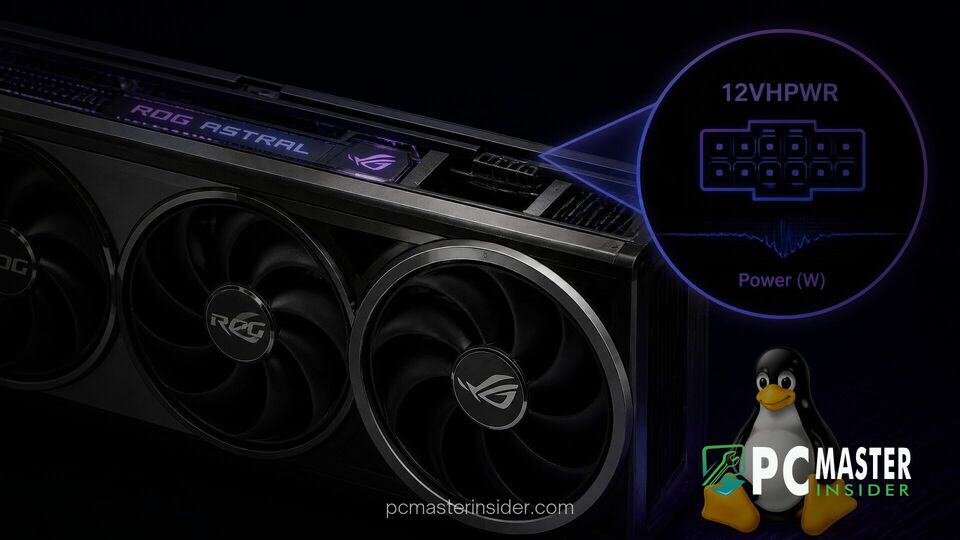
A new open-source Linux kernel hardware monitoring driver has been developed to bring native 12VHPWR connector telemetry to ASUS ROG Astral series graphics cards. The driver exposes per-pin power data directly through standard system interfaces, providing Linux enthusiasts with critical diagnostic visibility.
ASUS ROG Astral 12VHPWR Linux driver brings native power tracking
The newly created astral-hwmon driver exposes real-time electrical metrics for each pin of the 12VHPWR power connector on supported graphics cards. Built specifically for high-end GPUs carrying specialized monitoring hardware, the driver translates raw telemetry into Linux's standardized Hardware Monitoring (HWMON) subsystem. This allows existing open-source monitoring utilities, system widgets, and custom scripts to read voltage and current metrics without relying on proprietary software environments.
Understanding the astral-hwmon Driver
Why 12VHPWR Monitoring Matters for Enthusiasts
Modern flagship graphics cards draw substantial amounts of power through high-density connectors. While the 12VHPWR standard allows for sleek power delivery, uneven contact or loose connections can lead to localized resistance and localized thermal spikes. On Windows, proprietary tools such as ASUS GPU Tweak III offer telemetry via features like Power Detector+, but Linux users previously lacked native kernel-level visibility into these individual power pins.
By bringing this data directly to the Linux HWMON layer, system administrators and desktop users can track current draw balance in real time. Identifying a pin drawing excessive current early allows users to re-seat cables or adjust power targets before thermal stress causes operational instability.
How the Driver Works with ASUS ROG Astral Cards
Technical Implementation via ITE IT8915FN ASIC
The driver targets the onboard ITE IT8915FN monitoring chip found on ASUS ROG Astral printed circuit boards. This dedicated micro-controller interfaces with the graphics card's internal I2C bus to measure individual current and voltage levels across all six main power pins. The astral-hwmon driver communicates directly over the native Linux I2C subsystem, translating those raw sensor values into standardized HWMON sysfs attributes.
Designers of the project deliberately separated raw hardware polling from automated intervention. The core driver focuses strictly on accurate, read-only data reporting to preserve system stability and kernel cleanliness. For users seeking active protection, an accompanying user-space utility called astral-guard can evaluate current thresholds and trigger desktop warnings or automated power adjustments if imbalance exceeds safe operating limits.
Compatibility and Installation for Linux Users
Supported GPU Models and System Requirements
Because the driver relies on hardware-level pin sensing provided by the onboard ITE ASIC, compatibility is centered on ASUS's top-tier lineup. Primary target hardware includes the ASUS ROG Astral GeForce RTX 5090 OC and RTX 5080 OC series cards. Additional models utilizing the same PCB architecture, including specialized variants like the ROG Astral LC and ROG Matrix series, are also supported by the driver's underlying I2C communication protocol.
Installing the out-of-tree driver requires standard DKMS build tools and a modern Linux kernel with I2C bus driver support enabled. Standard command-line monitoring applications, such as lm_sensors, immediately recognize the device once loaded, exposing six distinct current readings and matching voltage channels for complete power transparency.
The release of astral-hwmon bridges a major feature gap for high-end graphics cards operating in Linux environments. By offering open, standardized access to complex connector telemetry, the driver empowers enthusiasts to monitor power health and maintain system safety without compromising on their operating system of choice.