At IFA 2026 in Berlin, ASUS announced its latest refresh of the creator-focused ProArt ecosystem, integrating updated silicon designed to handle heavy generative computing workflows locally. The hardware lineup features dedicated mobile workstations and compact desktop systems leveraging new machine learning software stacks and neural processing frameworks.
By pairing high-resolution displays with high-bandwidth hardware architectures, ASUS aims to provide digital artists, video editors, and 3D animators with portable computing platforms capable of executing complex AI tasks without relying on cloud services.
ASUS ProArt AI PC Launch at IFA 2026
The updated lineup debuted at the Messe Berlin exhibition grounds, where hardware manufacturers traditionally show off their late-year PC portfolios alongside consumer electronics. The showcase highlighted how workstation configurations are evolving to meet the demands of rapid generative rendering and real-time ray tracing.
ASUS emphasized that as localized neural processing models grow in complexity, creator laptops require hardware that balances thermal capacity, memory throughput, and GPU compute density. The new ProArt range incorporates refreshed cooling designs, including redesigned vapor chambers and multi-fan exhausts, ensuring high performance during extended rendering runs.
ProArt P16, P14 Laptops and GR1X Mini PC Specifications
The laptop lineup is anchored by the flagship ProArt P16 and the portable ProArt P14. Both models sport 4K OLED HDR Touch displays covering 100% of the DCI-P3 color gamut, factory-calibrated to maintain color accuracy for professional colorists. Underneath the chassis, these laptops feature multi-core host processors paired with high-capacity unified memory configurations to prevent bottlenecks during heavy multitasking.
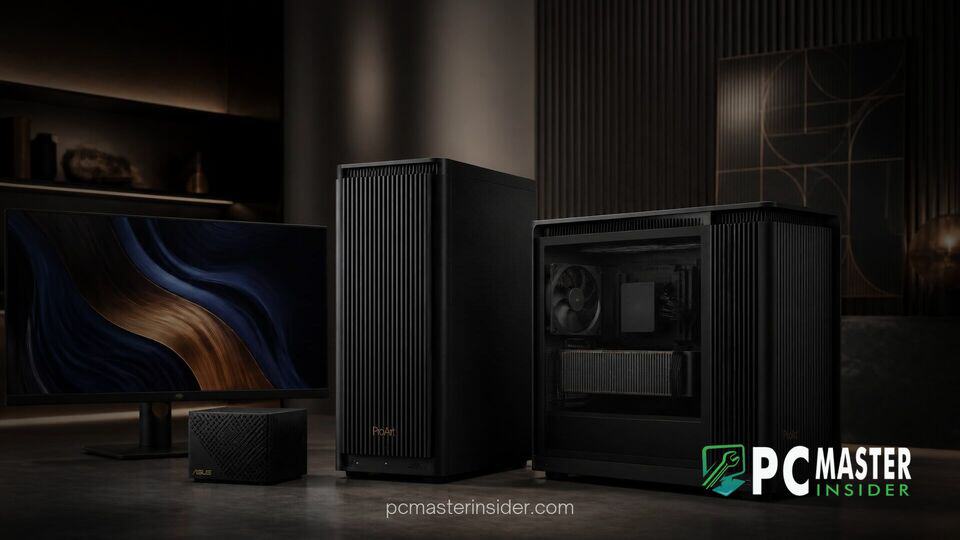
For desktop users seeking a small form factor, ASUS unveiled the ProArt GR1X Mini PC. Despite its compact chassis volume under five liters, the GR1X houses high-performance desktop-class components and robust I/O options, including dual Thunderbolt 4 ports, 10Gb Ethernet, and full-sized DisplayPort connectors for multi-monitor studio setups.
ASUS ProArt NVIDIA RTX Spark Integration and AI Capabilities
A central feature of the hardware announcement is the deep integration of the NVIDIA RTX platform acceleration architecture, specifically designed to optimize local workflow execution. The system leverages optimized Tensor Cores alongside software frameworks tailored for creator applications, allowing tools like Adobe Premiere Pro, Blender, and DaVinci Resolve to run complex automation tasks efficiently.
These graphics components deliver high TOPS (Tera Operations Per Second) capability, accelerating real-time video upscaling, generative image synthesis, and automated masking. Creators can run LLMs (Large Language Models) and image generation pipelines locally without network latency or cloud subscription fees.
Hardware-accelerated neural networks complement these workloads by managing light transport simulations and view synthesis. Similar neural technology has expanded into rendering engines across industries, as seen in recent developments where modders integrated neural rendering binaries into existing interactive engines.
ASUS also demonstrated custom creator utilities built into the ProArt Creator Hub software. These features work directly alongside on-device accelerator pipelines to manage dynamic power allocation between the CPU and GPU, ensuring maximum compute power is routed to active rendering windows while keeping system noise to a minimum.
Target Audience, Pricing, and Availability Timeline
The new ProArt series targets media professionals, 3D artists, software developers, and architects who require consistent hardware performance for production work. Demand for localized computing power continues to climb as studios adopt generative asset pipelines that require security and high hardware uptime.
Industry analysts note that enterprise and creative hardware investments are increasing alongside broader market trends. According to hardware forecasts, global AI capital expenditure and infrastructure spending continue to hit record totals, reflecting strong commercial demand for hardware capable of executing complex AI tasks on-device.
Simultaneously, memory constraints remain a key consideration for workstation buyers. With global component supply chains impacted by elevated enterprise memory costs—driven by record DRAM export prices due to enterprise AI hardware adoption—high-spec laptops with pre-installed unified memory pools represent an appealing all-in-one hardware package for independent creators.
ASUS confirmed that the ProArt P16, ProArt P14, and ProArt GR1X Mini PC will begin rolling out to retail partners and direct distribution channels late in the fourth quarter. Detailed regional pricing and specific component configurations will be announced closer to the shipping date.
With this launch, ASUS expands its creative PC catalog, demonstrating how hardware manufacturers are adapting system designs to support local AI workloads while maintaining color precision and portability.