NVIDIA has officially confirmed that its next-generation Deep Learning Super Sampling technology, DLSS 5, will launch on September 3, 2026. The milestone update officially debuts alongside Visual Concepts and 2K's NBA 2K27, introducing real-time 3D-guided neural rendering to consumer gaming PCs for the first time.
The announcement comes following months of technical teasers and early community discussions surrounding AI integration in modern graphics pipelines. NVIDIA's latest iteration expands beyond conventional upscaling and frame generation, shifting toward neural generative techniques designed to drastically elevate visual fidelity.
NVIDIA Announces September Launch for DLSS 5 Tech
According to the official release schedule, DLSS 5 will become available globally on September 3, integrated directly via an updated GeForce Game Ready driver. The release provides support across all desktop and laptop graphics processors within the GeForce RTX 50 Series lineup, alongside instant availability on NVIDIA's GeForce NOW cloud streaming platform.
First previewed earlier in the year, DLSS 5 represents a fundamental shift in how scene lighting, skin diffusion, and complex surface materials are calculated during real-time gameplay. By shifting heavy lighting calculations to specialized neural models, NVIDIA aims to bring real-time rasterized and ray-traced visuals significantly closer to offline pre-rendered graphics.
First Title to Support DLSS 5 Neural Rendering
Visual Concepts' annual basketball title, NBA 2K27, serves as the launch platform for the new feature set. The developers have leveraged DLSS 5 to fine-tune sub-surface scattering on player models, realistic light refraction through translucent tissues like ears, and detailed sweat dynamics on court athletes.
Peter Kavic, Senior Producer at Visual Concepts, noted that the close partnership with NVIDIA granted the studio granular control over visual output. Rather than allowing generative models free reign over artist intent, the pipeline incorporates per-pixel uplift control masks and structural intensity toggles, ensuring character likenesses remain faithful to real-world scans.
What DLSS 5 Brings to PC Gaming Performance
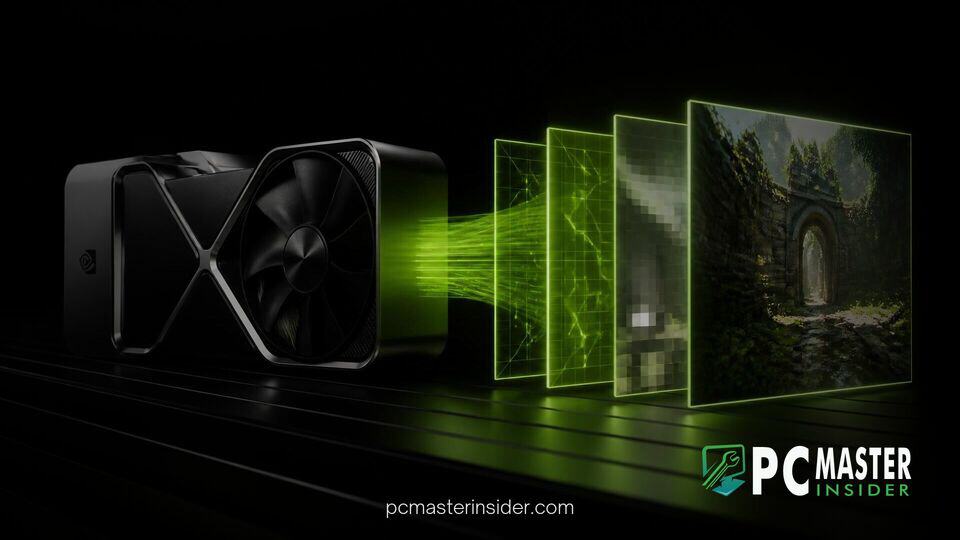
At its core, DLSS 5 introduces 3D-Guided Neural Rendering, an architecture that uses engine data such as depth buffers, motion vectors, and surface normals to infer high-frequency surface details. Unlike traditional post-processing filters, the neural network processes incoming geometry deterministically to prevent temporal shimmering or visual drift during camera movement.
However, this level of image enhancement requires substantial computational power. NVIDIA clarified that enabling pure DLSS 5 neural rendering imposes a raw base frame rate penalty ranging between 50% and 60% before applying performance-oriented upscaling modes. To offset this compute cost, the company recommends pairing neural rendering with Multi-Frame Generation and DLSS Super Resolution to maintain fluid motion standard to high-end enthusiast play.
Hardware Requirements and GPU Compatibility
At launch, full hardware acceleration for DLSS 5 is restricted exclusively to the GeForce RTX 50 Series stack. NVIDIA credits the specialized low-precision FP4 Tensor Cores found within the new architecture for enabling real-time execution of complex neural models at 4K resolution.
While community modders recently managed to extract early DLSS 5 binaries to run on older hardware, official driver support remains tied to current-generation silicon. Enthusiasts monitoring market trends may note that GPU availability continues to face broader industry pressure, especially given ongoing memory supply constraints affecting overall graphics card manufacturing production across several tiers.
Launch Timeline and Future Game Integration
Following its debut in NBA 2K27, additional third-party studios are scheduled to deploy DLSS 5 patches throughout the remainder of the year. Major publishing partners including Capcom, Bethesda, NetEase, and Ubisoft have confirmed upcoming implementations across several flagship franchises scheduled through late 2026 and early 2027.
NVIDIA has also emphasized developer choice, providing robust masking tools so studios can apply neural rendering exclusively to environmental geometry while preserving authored character models intact. As adoption spreads across multi-platform titles, PC gamers will gain unprecedented control over balancing artistic fidelity against raw rendering performance.
With September 3 marking the initial public rollout, DLSS 5 represents one of NVIDIA's most ambitious software updates to date. The combination of generative neural rendering and fine-grained artist controls signals a transformative chapter for real-time graphics technology across the PC gaming industry.