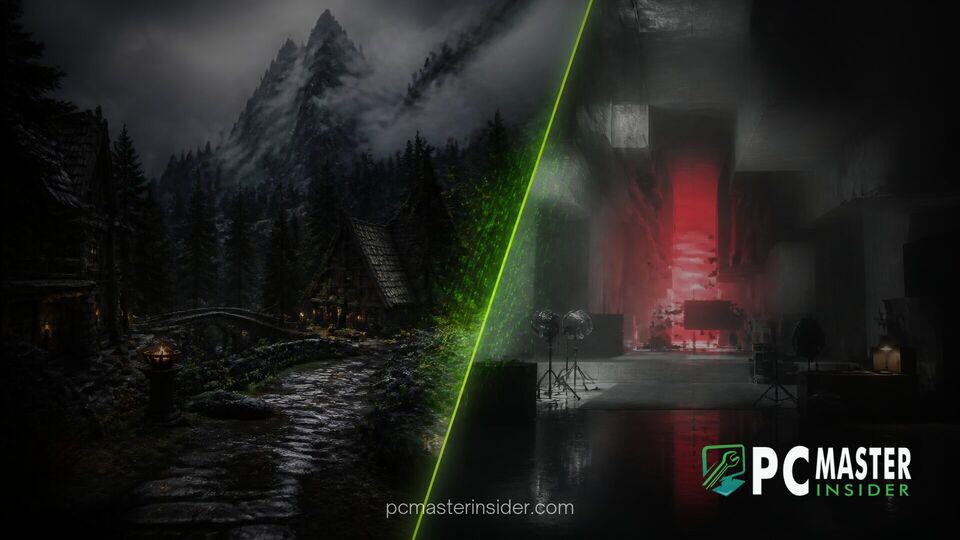
Unreleased dynamic dynamic link library files associated with NVIDIA's upcoming Deep Learning Super Sampling 5 technology have leaked online, prompting community modders to inject the experimental binaries into existing games. Early implementations in PC titles like The Elder Scrolls V: Skyrim and Remedy Entertainment's Control offer a first glimpse into next-generation neural rendering, though significant technical hurdles remain.
The unauthorized release features advanced generative AI lighting and real-time reconstruction capabilities, expanding well beyond current upscaling and frame generation techniques. While the experimental code demonstrates impressive visual upgrades, early benchmarks show severe performance trade-offs on existing consumer hardware.
Unreleased NVIDIA DLSS 5 Files Leak Online
The leak originated late Tuesday night when a package containing pre-release SDK components and dynamic link libraries surfaced on an open-source development repository. The archive included internal references to DLSS 5, alongside confidential documentation detailing a modular architecture designed to handle complex neural rendering workloads.
Early Access File Discovery
Engineers and software enthusiasts quickly analyzed the leaked files, confirming the presence of new neural network models tailored for real-time asset generation and dynamic lighting reconstruction. Unlike previous iterations, which focused primarily on spatial upscaling and optical flow frame interpolation, these new binaries appear designed to replace traditional rasterized shaders with full generative inference pipelines. Following previous instances where leaked DLSS 4.5 files sparked early community testing, modders moved rapidly to test the software package in real-world environments.
Initial Injections in Control and Skyrim
Within hours of the leak, prominent modders modified display wrapper files to force the unreleased libraries into DirectX 11 and DirectX 12 titles. Control and Skyrim were chosen as primary testing grounds due to their robust modding frameworks and contrasting engine architectures. By replacing existing graphics dynamic link libraries with the leaked binaries, researchers successfully executed early neural rendering passes inside these aging engines.
Visual Enhancements and Performance Cost
Initial screenshots and video captures posted across enthusiast forums showcase striking visual differences compared to standard render pipelines. The experimental software bypasses traditional screen-space ambient occlusion and screen-space reflections, substituting them with neural approximations driven by deep learning models trained on path-traced offline assets.
Generative AI Lighting and Face Rendering
In Control, the modded DLL replaces conventional ray-traced reflections with a generative lighting model that dynamically infers off-screen geometry. Surfaces display sub-surface scattering and complex bouncing light without requiring heavy path-tracing bounces. In Skyrim, testing focused heavily on character models. The neural rendering pipeline reconstructs skin textures, facial geometry, and hair strands in real time, dramatically softening the game's decade-old polygonal edges. The visual impact is particularly noticeable on facial animations, where the neural model smoothly interpolates lighting shifts across skin folds.
Hardware Impact and Frame Rate Drops
However, these visual gains come with a massive computational cost. Because current graphics drivers and GPU architectures are not fully optimized for the unreleased DLSS 5 instruction set, hardware overhead is exceptionally high. On top-tier graphics cards, enabling the modded neural rendering pipeline caused native frame rates in Control to drop by nearly 50 percent before upscaling was applied. Enthusiasts who tested the utility alongside new performance tools like the mVolt tool bypassing VBIOS power limits noted that current silicon rapidly hits thermal and power boundaries when processing these experimental tensor operations.
Leaked DLSS 5 Mod Skyrim Control Integration and Results
The integration of the leaked DLSS 5 mod in Skyrim and Control offers a rare, candid look at how hardware vendors plan to evolve graphics technology over the coming years. By moving away from brute-force geometry processing and toward real-time generative inference, future graphics pipelines may soon rely on AI models to draw complex scenes rather than rendering every individual polygon manually.
Despite the promising visual output, stability issues plague both modded titles. Users report frequent driver crashes, memory leaks, and severe artifacting when rapidly panning cameras. In Skyrim, the neural light reconstruction frequently misinterprets fog and volumetric weather effects, resulting in flickering bright patches across outdoor landscapes. Similarly, Control suffers from temporal ghosting around fast-moving objects, indicating that the neural model requires precise vector data that older engine hooks cannot reliably provide.
Community Reaction and NVIDIA's Official Stance
The modding community remains divided over the leak. While graphics researchers celebrate the opportunity to inspect bleeding-edge software ahead of an official announcement, others warn that executing unstable, unverified code poses security risks and potential system instability. Hardware enthusiasts have noted similarities between these high-overhead workloads and recent OS-level experiments, such as when Windows 11 tested unified memory controls for heavy graphics and AI workloads.
The broader PC ecosystem is currently seeing rapid competition in machine learning image reconstruction, especially as rival vendors advance their own solutions, such as AMD RDNA 4m firmware featuring native support for FSR 4. Observers suggest NVIDIA's next step will focus heavily on specialized hardware acceleration to offset the high compute cost seen in these early tests.
NVIDIA has not issued an official press release regarding the leak. However, copyright takedown notices have already begun targeting repository hosts and file-sharing networks hosting the raw DLL files. System developers strongly advise against installing third-party binaries from unverified sources, citing security risks associated with modified system-level files.
As modders continue to analyze the leaked code, these early experiments in Control and Skyrim confirm that the future of rendering lies heavily in generative AI. However, until official driver integration and dedicated hardware support arrive, DLSS 5 remains a fascinating but impractical preview of what lies ahead for PC graphics.