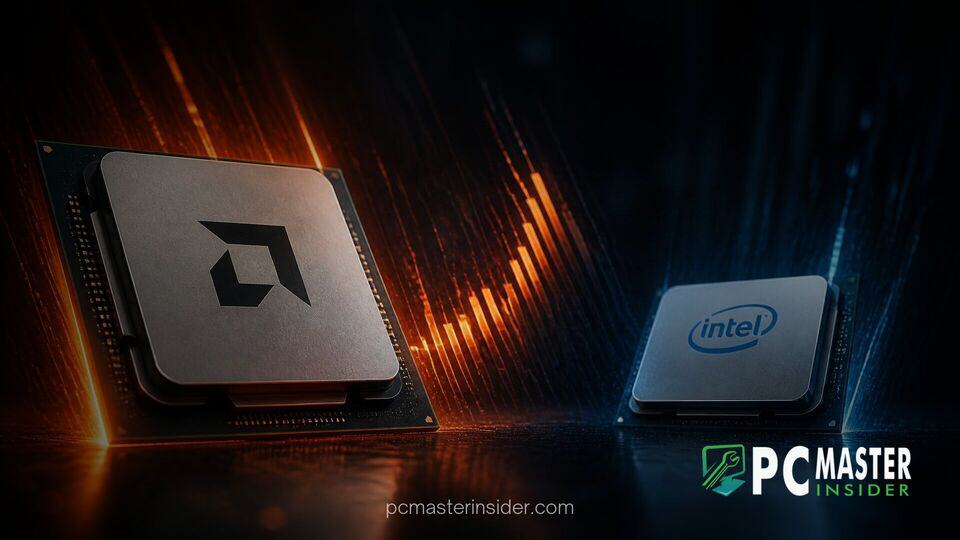
In an unprecedented milestone for the semiconductor industry, Advanced Micro Devices has issued a fourth-quarter financial outlook that exceeds the projected revenue of its legacy competitor Intel. Driven by massive enterprise spending on artificial intelligence infrastructure and server processors, AMD projects sales that mark a pivotal shift in chip market leadership.
amd q4 revenue forecast intel comparison signals seismic industry shift
AMD announced a fourth-quarter revenue guidance of approximately $17 billion, plus or minus 3 percent, representing a 66 percent increase year-over-year. This projected figure comfortably tops Intel's Q4 guidance of $15 billion to $16 billion, setting up the first instance in history where AMD is poised to generate more quarterly revenue than Intel. The milestone reflects a fundamental changing of the guard in x86 processing and data center compute platforms.
AMD Projects Historic Q4 Financial Milestone
The financial guidance follows a record-breaking third quarter where AMD achieved $13.38 billion in total revenue, rising 45 percent from $9.25 billion in the same period last year. Net income nearly doubled, supported by expanded operating margins and aggressive scaling across core commercial units. Analysts noted that AMD's Q4 revenue guidance floor of $16.5 billion sits above the top end of Intel's official outlook ceiling.
This financial momentum has been build on sequential acceleration across enterprise platforms. While broader economic headwinds continue to impact select segments of the consumer supply chain, AMD's enterprise portfolio has shielded the company from larger market contractions. Financial markets responded positively to the announcement, pushing AMD stock higher in late trading while reinforcing investor confidence in ongoing enterprise capital expenditures.
Data Center and AI Accelerator Revenue Growth
The primary driver behind AMD's financial surge is its Data Center business segment, which generated $8.5 billion in Q3, up 97 percent year-over-year. Enterprise hardware deployments involving EPYC server processors and Instinct AI accelerators now account for roughly 64 percent of AMD's total revenues. Management confirmed that fourth-quarter data center AI revenue will surpass traditional server CPU sales by a significant margin.
Extensive deployments of Instinct MI450 series GPUs and Helios rack-scale architectures by hyperscalers including Meta, OpenAI, Anthropic, and Microsoft have accelerated top-line expansion. Industry developments, such as an open-source tool that unlocks Nvidia FP16 AI limiters on RTX graphics cards, highlight the broader demand for high-performance AI computational models that AMD continues to target with enterprise hardware. CEO Lisa Su noted during the earnings call that overall company revenue is projected to grow by more than 80 percent heading into 2027, propelled by sustained data center demand.
Intel and AMD Market Dynamics
The stark contrast between both chipmakers stems largely from their exposure to different hardware sectors. Intel issued a softer Q4 guidance due to lingering weakness in consumer personal computers, high memory prices, and inventory adjustments across global retail channels. Furthermore, ongoing manufacturing constraints have slowed its expansion, similar to how an organic substrate shortage limiting CPU supply can restrict scaling across advanced packaging networks.
In response to shifting market conditions, Intel shifts CPU production capacity to server chips to defend its remaining data center market share. Despite these internal reallocation efforts, AMD has steadily captured server CPU market share over consecutive quarters, while rapidly scaling its rack-level AI solutions to challenge incumbent systems.
Impact on Client Systems and PC Hardware
Despite record-setting total revenues, both chipmakers reported sequential contractions in client consumer PC hardware. AMD guided its Client and Gaming revenue down by more than 20 percent sequentially for Q4, reflecting a broader consumer market pullback caused by rising system component costs. However, software-side optimizations remain active across ecosystem platforms; for instance, Microsoft recently released Windows 11 KB5127936 to fix app launch bottlenecks, improving efficiency across x86 consumer architectures.
Graphics software ecosystems also continue to evolve alongside hardware iterations. Community projects like OptiScaler, which enables AMD FSR on Intel Arc GPUs via XMX hardware, demonstrate how cross-platform image reconstruction technologies are adapting across diverse hardware architectures even as client silicon shipments face quarter-over-quarter declines.
Future Outlook for CPU Market Competition
The semiconductor landscape remains fiercely competitive across both consumer and enterprise tiers. Intel continues working on architectural refinements, having confirmed its high-end Nova Lake desktop CPUs to challenge AMD's market-leading Ryzen X3D chips in upcoming cycles. Nevertheless, AMD's operational agility and reliance on foundry partner TSMC have allowed it to adjust wafer allocations flexibly toward high-margin data center silicon.
Looking ahead, AMD's strategic supply chain preparation for substrates, memory, and advanced packaging positions the company to sustain its data center expansion. While client PC sales remain susceptible to broader economic trends, AMD's Q4 guidance marks an essential historical turning point that cements its status as a leading heavyweight in modern high-performance computing.