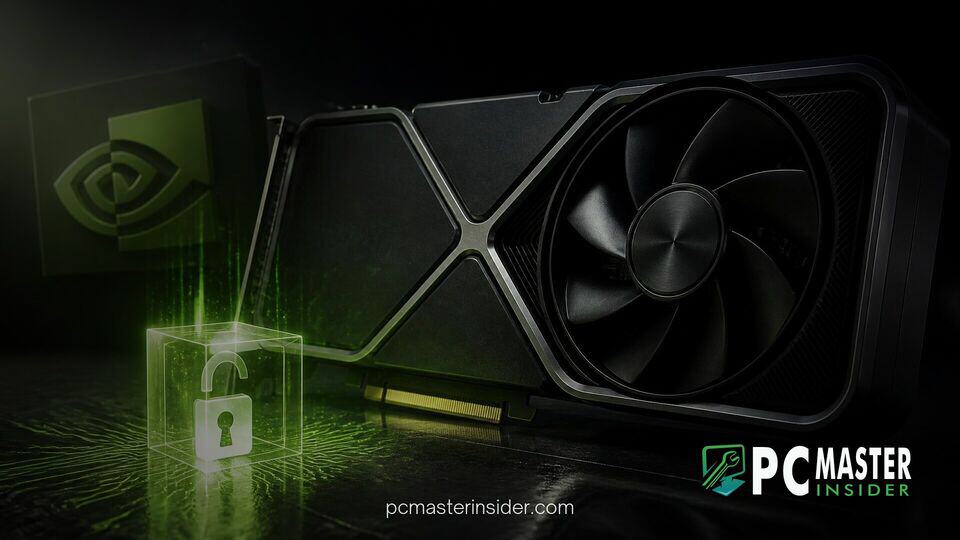
Open-source developers have released a tool that removes artificial performance caps on Nvidia GeForce graphics cards. By modifying internal GPU registers prior to driver initialization, the utility unlocks hidden compute capabilities for half-precision floating-point operations.
The modification targets half-speed limitations imposed on consumer hardware, allowing desktop and laptop GPUs to operate closer to enterprise-grade silicon during heavy artificial intelligence matrix math. The process requires no VBIOS flashing or driver patching, making it accessible through temporary bootable environments.
Open-Source Utility Bypasses Hardware FP16 AI Cap
The software modification addresses an intentional firmware restriction where consumer GeForce graphics cards execute 16-bit floating-point (FP16) and bfloat16 (BF16) operations with 32-bit accumulation at half their theoretical instruction issue rate. While enterprise accelerators such as the Nvidia RTX A-series run these calculations at full rate, consumer graphics cards are restricted via internal firmware speed selectors. The new open-source tools write directly to these speed-selection registers during early boot sequences before the main operating system driver binds to the GPU. Earlier technical efforts, like modders unlocking hidden compute performance on Nvidia RTX GPUs, paved the way for these streamlined utilities.
By executing before the display driver initializes, the project tricks Nvidia's signed bootloader firmware into opening write locks on restricted speed registers. Because the utility alters configuration registers dynamically during memory initialization rather than permanently flashing the card's VBIOS, all modifications clear when the system experiences a full power-off cycle.
Affected Desktop and Laptop RTX GPU Generations
The unlocking mechanism spans three major generations of Nvidia graphics architectures, including Turing (RTX 20 series), Ampere (RTX 30 series), and Ada Lovelace (RTX 40 series). Both desktop cards and mobile laptop form factors utilizing these architectures are capable of removing the half-precision limiter.
- GeForce RTX 20 Series: Covers Turing-based silicon including RTX 2060 Super, 2070, and 2080 Ti variants.
- GeForce RTX 30 Series: Full compatibility across GA102, GA103, GA104, and GA106 dies, ranging from the RTX 3060 12GB up to the RTX 3090 Ti.
- GeForce RTX 40 Series: Supports Ada Lovelace GPUs such as the RTX 4060 laptop GPU, RTX 4070 Ti, and RTX 4090.
Performance Gains in AI Inference Workloads
Synthetic matrix multiplication benchmarks demonstrate noticeable throughput increases once the throttle is removed. In controlled GEMM (General Matrix Multiply) tests, unconstrained Tensor Cores report substantial performance leaps across various precision formats. For instance, testing on an RTX 3090 Ti showed raw BF16 compute climbing from a stock 87.5 TFLOPS up to 157.4 TFLOPS, while TF32 operations nearly doubled from 42.58 to 82.61 TFLOPS. Synthetic tests on laptop variants, such as an RTX 4060 Mobile, logged FP16 throughput jumps of up to 65 percent.
Real-world gains vary depending on the bottleneck of the specific application. In local Large Language Model (LLM) execution, performance improvements concentrate heavily in the prompt prefill phase, where the GPU reads and processes input tokens using dense matrix math. Token generation speed remains largely bound by VRAM memory bandwidth rather than raw Tensor Core issue rates. Meanwhile, image generation workloads using Stable Diffusion and unquantized AI model training show measurable speedups.
However, traditional PC gaming workloads show zero benefit from the modification. Graphics engines rely on different computational pipelines and CUDA core structures, meaning frame rates and technologies like modded DLSS implementations on Radeon hardware or native rasterization remain completely unaffected by removing the FP16 limiter.
Technical Risks and UEFI Modification Requirements
While early iterations of the unlock required complex Linux kernel module installations, recent community developments have packaged the unlock sequence into pre-driver UEFI executables. Users can boot from a FAT32-formatted USB drive, which runs the payload script, verifies register states, and hands control back to Windows or Linux boot managers.
Despite the ease of execution, developers warn that running silicon beyond manufacturer specifications carries inherent operational risks. Bypassing issue-rate limiters increases power draw and thermal output under sustained compute tasks. The project documentation explicitly warns that system instability, host hangs, or hardware stress may occur if operating near maximum thermal limits. Developers recommend robust cooling setups for users testing these unlocked states.
Driver Compatibility and System Stability Considerations
Because the tool acts before the operating system boots, standard display drivers load normally without triggering signature verification failures. Recent official graphics releases, such as the Nvidia GeForce driver 621.01 update, continue to operate alongside the early-boot payload without requiring software patches.
Hardware enthusiasts and local AI practitioners have responded enthusiastically to the tool, as secondary-market consumer GPUs offer large VRAM buffers at a fraction of workstation pricing. However, industry analysts note that software updates from hardware vendors could eventually patch the bootloader exploit used to access these registers.
The open-source utility represents a significant milestone for consumer AI research, proving that consumer graphics hardware harbors untapped compute capacity. While real-world speedups depend on memory bandwidth constraints, local AI creators now possess accessible methods to extract higher matrix throughput from their existing desktop and laptop graphics cards.