
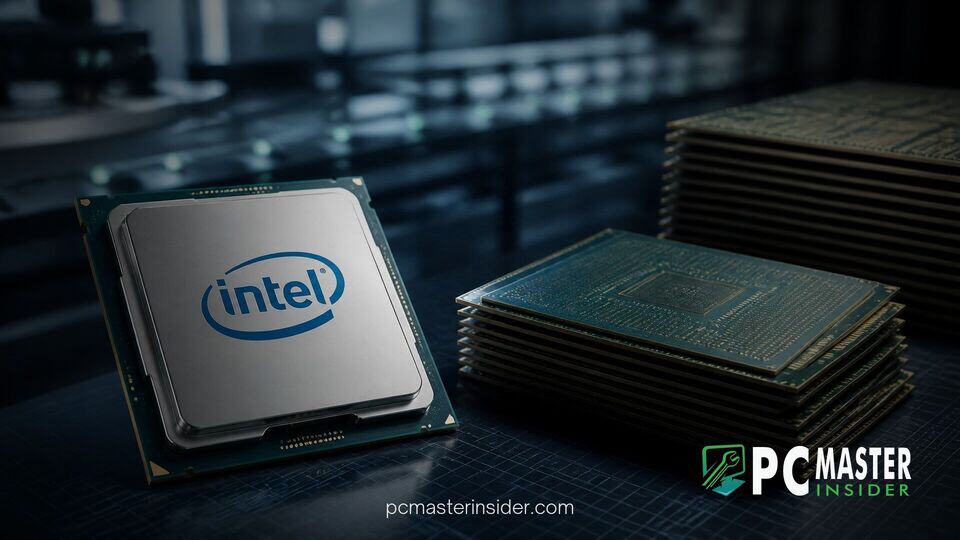
Intel has confirmed that an industry-wide shortage of advanced organic substrates is restricting its ability to scale output for high-demand server processors. The company revealed that while wafer manufacturing output has met targets, packaging material bottlenecks continue to constrain total processor deliveries.
Intel Organic Substrate Shortage CPU Supply Constraints
During its third-quarter financial updates, Intel leadership highlighted that supply chain friction has shifted from silicon wafer fabrication to package-level assembly. An acute supply deficit in high-density organic laminate substrates, combined with complex interconnect requirements, has created an operational bottleneck. This deficit directly impacts the delivery of server-grade processors destined for data center deployment, where market demand currently outstrips production volume.
Advanced processors no longer rely on single monolithic silicon dies mounted directly onto simple circuit boards. Modern multi-tile processor architectures require specialized build-up substrates to route thousands of microscopic electrical connections between computing tiles and memory interfaces. When supply shortages affect these substrate materials, completed silicon wafers cannot be turned into shipping chips, leaving inventory trapped in intermediate manufacturing stages.
Intel Identifies Packaging Substrate Shortage as Key Bottleneck
The core bottleneck centers on Ajinomoto Build-up Film (ABF) substrates and multi-layer organic laminates capable of supporting high-density interconnect routing. As processing nodes grow denser, package substrates must accommodate higher thermal design power (TDP) thresholds and intricate circuit layouts. Intel Chief Executive Officer Lip-Bu Tan stated during an investor call that despite rapid progress on silicon manufacturing nodes, material scarcity at the packaging level prevents full utilization of fab output.
This structural challenge comes at a time when global demand for enterprise hardware remains high. Broader macroeconomic trends, including the widespread deployment of AI infrastructure and capacity expansion efforts, have placed unprecedented pressure on advanced substrate suppliers across Asia. These specialized material fabricators are struggling to expand capacity quickly enough to match the simultaneous demand from multiple leading chip designers.
Impact on EMIB Packaging and Server CPU Yields
The substrate deficit hits Intel's proprietary Embedded Multi-die Interconnect Bridge (EMIB) packaging technology particularly hard. EMIB utilizes tiny silicon bridges embedded directly inside the organic substrate cavity to link adjacent compute and I/O tiles. This design eliminates the need for large silicon interposers, but it drastically increases the manufacturing complexity of the substrate itself.
Substrate suppliers face precise engineering tolerances when embedding these bridges. Differences in thermal expansion rates between silicon bridges and organic substrate layers can cause alignment shifting or package warping during high-temperature bonding processes. Yield challenges associated with complex EMIB-T substrate production have slowed down the volume ramp for flagship enterprise platforms, including the Xeon 6 processor line. While assembly yields have shown steady quarter-over-quarter improvement, output volume still falls short of meeting immediate order volumes from cloud service providers and enterprise clients.
Implications for System Builders and PC Component Availability
While the organic substrate shortage primary affects complex server processors, the ripple effects extend across the broader system building ecosystem. To maximize revenue under strict substrate allocations, semiconductor manufacturers often prioritize high-margin server chips over consumer client processors, leading to shifting inventory levels in retail channels.
System integrators are forced to navigate fluctuating supply timelines for both enterprise server systems and workstation hardware. Similar substrate and component constraints have already triggered broader price volatility throughout the hardware industry, matching trends seen where AI infrastructure demand triggers PCB component shortages and affects motherboard availability. Furthermore, mounting costs across the primary memory and substrate supply chains have added upward price pressure on system builds, reminiscent of ongoing market shifts where desktop RAM prices climb as supply tightens.
Hardware partners are adjusting their procurement strategies to mitigate potential delays. Laptop and desktop OEMs are evaluating platform schedules closely, especially as rumors linger regarding potential wholesale price adjustments, similar to recent reports that Intel raised Panther Lake CPU prices for major notebook manufacturers.
Intel's Roadmap to Expand Packaging Capacity
Intel is actively working on multiple fronts to alleviate packaging constraints and secure long-term substrate allocations. Chief Financial Officer Dave Zinsner noted that the company has secured commitments for 40 percent more substrate capacity, though the bulk of this expansion is expected to come online in the second half of 2027. Executive management projected that industry-wide supply limits will likely persist through 2027 before fully stabilizing.
To reduce dependence on traditional laminate suppliers, Intel is expanding its internal packaging facilities in New Mexico and Malaysia, while co-developing advanced substrate solutions with key materials partners. Additionally, research initiatives into glass substrates offer a potential long-term replacement for organic materials in next-generation architectures like Diamond Rapids and Coral Rapids. Glass substrates provide superior mechanical stability, lower pattern distortion, and higher thermal tolerance, which could eliminate structural warping risks associated with organic layers.
In the near term, Intel continues to refine its software and platform integrations. Updates to ecosystem software, such as the Windows 11 Intel APX integration, aim to optimize architectural performance on existing chip deployments, ensuring customers maximize processing efficiency while hardware supply catches up with demand.
The organic substrate shortage emphasizes how modern processor availability hinges as much on advanced material science and packaging ecosystems as it does on raw wafer fabrication. Intel's ongoing investments in substrate partnerships and packaging capacity will serve as critical benchmarks for its enterprise supply stability over the coming quarters.