
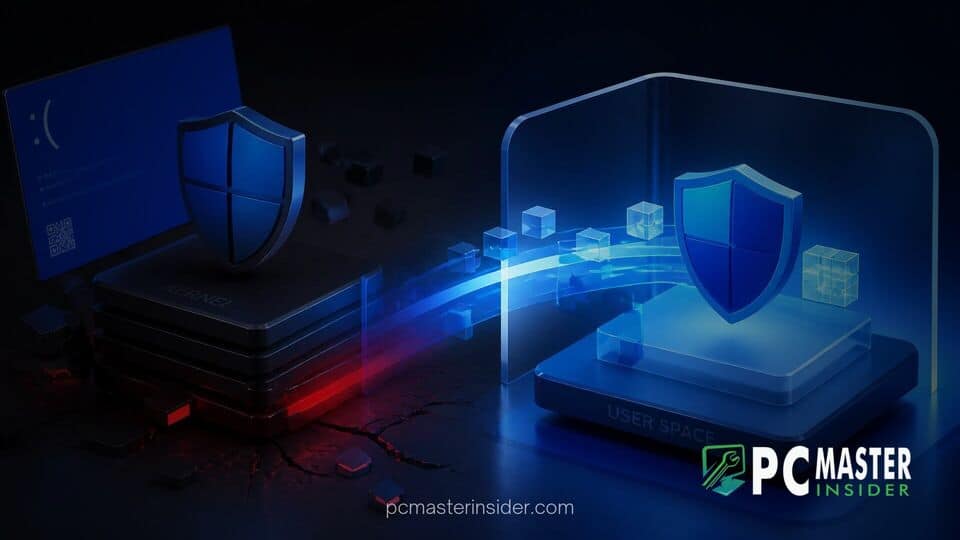
Microsoft has officially launched its Windows Endpoint Security Platform (WESP), fundamentally altering how third-party antivirus and endpoint security tools interface with the operating system. By establishing new user-mode application programming interfaces (APIs), the software giant allows security software to monitor, detect, and block malicious activity without deploying custom code deep inside the Windows kernel.
This architectural evolution aims to eliminate the single point of failure that has historically allowed flawed security updates to trigger wide-scale Blue Screen of Death (BSOD) system crashes. Under the new model, security agents execute within isolated application memory space, ensuring that a software flaw or bad definition file within an antivirus engine crashes only its own background process rather than taking down the entire operating system.
windows 11 out of kernel antivirus protection explained
The core objective behind windows 11 out of kernel antivirus protection is to decouple low-level system stability from third-party security software while preserving real-time threat detection. In traditional Windows security deployments, Endpoint Detection and Response (EDR) agents rely heavily on kernel-mode drivers running at Ring 0, the most privileged execution tier of the processor. While kernel-level access offers broad visibility into hardware memory and system processes, any unhandled exception or null pointer error in Ring 0 triggers an immediate kernel panic, causing a complete system failure.
With the general availability of WESP, Microsoft provides structured user-mode interfaces that deliver real-time telemetry directly from the operating system core. Security tools operating in user mode (Ring 3) can observe critical OS operations, filter events, and enforce security policies through system-managed calls across four primary domains:
- File System Monitoring: Intercepting file creation, modification, and execution requests before data is committed to storage.
- Process and Thread Creation: Tracking process spawning, dynamic library loads, and binary execution flows.
- Registry Modification: Inspecting system configuration changes, startup entries, and registry persistence mechanisms.
- Object Manager Interactions: Controlling access to system handles, shared memory sections, and core IPC mechanisms.
Microsoft Architecture Update Moves Security Software Out of Kernel
Historically, security vendors argued that running code inside kernel space was mandatory to prevent sophisticated malware from tampering with antivirus processes or bypassing file system hooks. However, maintaining third-party kernel drivers introduced immense operational risk. When a kernel driver encounters an unrecoverable runtime error, Windows has no mechanism to isolate the fault, resulting in a mandatory reboot and the familiar blue diagnostic screen.
The new architecture redistributes responsibility between the operating system and external security software. Windows itself handles low-level event collection at the kernel level and passes sanitized signals to user-mode security agents via safe, high-speed channels. If an external security application encounters a memory corrupting error or infinite loop, Windows simply terminates and restarts the user-mode security process without disturbing running enterprise workloads or operating system components.
Additionally, Microsoft is building tighter integration with specialized virtualization and process isolation tools. Much like how Execution Containers guard enterprise PCs from untrusted processes, running security services in isolated user-mode boundaries ensures high operational resilience without sacrificing threat intelligence gathering.
Enhanced Startup Recovery Mechanisms for Windows 11
Beyond shifting day-to-day scanning activities into user mode, Microsoft is introducing enhanced boot protection and automatic recovery frameworks inside Windows 11. Security agents often load early in the boot sequence to prevent bootkits and early-stage rootkits from establishing persistence. To prevent bad updates from trapping devices in infinite recovery loops, Microsoft has updated its Early Launch Antimalware (ELAM) architecture and boot driver verification standards.
Under the revised resilience framework, if a security component or configuration rule prevents the operating system from completing its boot cycle successfully, Windows can automatically roll back the problematic security payload to a last-known-good state. IT administrators no longer need to manually boot affected endpoint fleets into Safe Mode or BitLocker recovery environments to rename faulty driver binaries.
Lessons Learned from Past Kernel Security Crashes
The move to transition endpoint protection out of the kernel follows extensive industry collaboration following major IT infrastructure disruptions. A notable global incident in July 2024 demonstrated the vulnerability of modern enterprise networks when a single faulty configuration file pushed to a kernel-level security driver paralyzed millions of Windows systems across airports, hospitals, financial institutions, and retail terminals worldwide.
That incident sparked broad discussions between Microsoft, global government cybersecurity agencies, and independent security software developers during the Windows Endpoint Security Ecosystem Summit. The consensus reached at the summit emphasized that kernel access must be minimized in favor of robust OS-level APIs.
Organizations managing enterprise fleets have increasingly demanded stronger reliability controls alongside security features. System stability issues can arise from multiple layers, whether caused by third-party drivers, unverified updates, or software bugs like the Windows 11 hotpatch issue causing application launch failures. Moving complex security logic into user space dramatically reduces the attack surface for system-wide outages.
Implementation Timeline and Developer Guidelines for Security Vendors
Microsoft is rolling out the platform through a phased ecosystem onboarding plan to ensure third-party security vendors can adapt their software stacks smoothly. Major endpoint protection vendors, including Bitdefender, Sophos, ESET, CrowdStrike, SentinelOne, Trellix, and Trend Micro, have participated in the development of the framework through the Microsoft Virus Initiative.
Security software providers are actively updating their agent architectures to leverage WESP interfaces:
- Late 2026: Initial enterprise security builds from early-adopting vendors begin transitioning standard file and process filtering modules to user-mode APIs.
- Early 2027: Broader commercial availability across major EDR suites, with Microsoft Defender deploying its own user-mode platform updates in preview.
- Future Windows Releases: Progressive deprecation of legacy third-party kernel file system filter drivers in favor of mandatory user-mode security APIs.
To assist enterprise IT teams during this transition, tools like Microsoft Intune third-party update deferral controls allow administrators to validate new user-mode security builds in staging environments before rolling them out globally. Furthermore, security dashboards such as the Emerging Risks section in Windows 11 Security will provide admins with visibility into driver health and API compatibility status.
By establishing a standardized user-mode security architecture, Microsoft is addressing one of the most critical structural vulnerabilities in modern desktop computing. Moving security agents out of Ring 0 ensures that enterprise endpoints maintain robust protection against sophisticated threats while safeguarding system uptime and preventing widespread infrastructure outages.