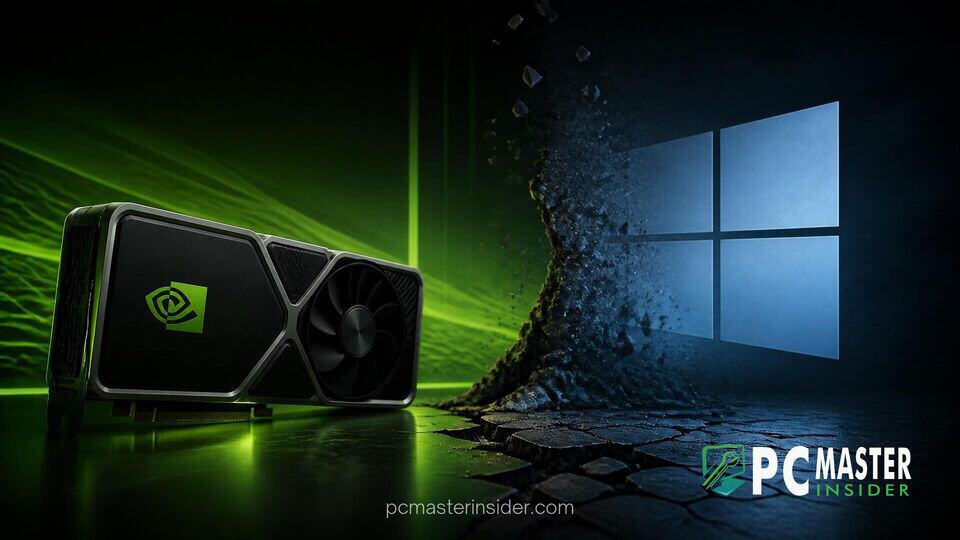
Graphics hardware giant NVIDIA has officially confirmed that it will cease regular Game Ready Driver support for Windows 10 starting in October 2026. The decision marks a significant milestone in the gradual retirement of the decade-old operating system, pushing PC gamers toward modern platforms like Windows 11.
According to updated technical support documentation published by NVIDIA, the final fully featured Game Ready Driver and Studio Driver releases for Windows 10 will roll out in October 2026. Beyond that cutoff, GeForce graphics cards running on Windows 10 will no longer receive day-one optimizations for new game releases, feature updates, or game-specific bug fixes.
NVIDIA End Windows 10 Game Ready Driver Support
NVIDIA is shifting its primary software development resources exclusively to Windows 11 to focus on modern display pipelines, advanced direct memory architecture, and fresh platform optimizations. While regular feature drivers will stop in October 2026, NVIDIA is not abandoning Windows 10 users entirely. The company plans to maintain a quarterly security update schedule for supported GeForce hardware running Windows 10 through October 2029, delivering critical vulnerability patches and essential system stability maintenance.
NVIDIA Shifts Game Ready Driver Focus Exclusively to Windows 11
For nearly ten years, NVIDIA has delivered frequent Game Ready Driver packages engineered to optimize GPU performance for major PC game launches. These driver packages deliver tailored profile adjustments, fix game-breaking rendering bugs, and introduce performance extensions for technologies such as Deep Learning Super Sampling (DLSS).
By restricting future feature drivers to Windows 11, NVIDIA aims to streamline its quality assurance and driver testing workflows. Developing and validating massive software updates across multiple operating system branches requires significant engineering overhead. Shifting attention fully to Windows 11 allows engineers to maximize performance gains on newer architecture standards, such as Memory Integrity security features and accelerated hardware scheduling.
Transition Timeline and Security Maintenance Plan
The timeline outlined by NVIDIA closely aligns with Microsoft's own lifecycle announcements for Windows 10. Microsoft officially retired standard support for Windows 10 in late 2025 while offering extended maintenance options for enterprise and consumer systems. NVIDIA previously extended its driver availability to accommodate the millions of gamers who remained on the older operating system.
Under the finalized support schedule:
- October 2026: NVIDIA releases the final Windows 10 Game Ready Driver and Studio Driver containing new game optimizations and feature updates.
- November 2026: The first Windows 11-exclusive Game Ready Driver arrives. Windows 10 branches enter legacy maintenance.
- November 2026 to October 2029: NVIDIA provides quarterly security updates containing critical safety fixes and security maintenance for supported GeForce GPUs.
- October 2029: All driver updates and security maintenance for Windows 10 officially reach end-of-life status.
What the Driver Policy Change Means for PC Gamers
The practical impact of this policy shift will depend largely on individual gaming habits. Gamers who stick primarily to older titles, esports games, or lightweight indie games will experience minimal immediate disruption. Existing titles will continue to function normally using the final October 2026 driver build, and fundamental system stability will remain intact through quarterly security patches.
However, players who regularly buy newly released AAA titles will face growing friction. Modern blockbusters increasingly rely on targeted graphics driver optimizations to resolve launch-day stutters, memory allocation issues, and visual artifacts. Without ongoing Game Ready support on Windows 10, gamers running older software may encounter degraded frame rates or compatibility issues in future releases. Furthermore, new graphics technologies developed for upcoming hardware, such as potential updates for future GeForce graphics cards, will likely require Windows 11 to operate.
Long-Term Compatibility and System Upgrade Options
Hardware industry analysts expect rival chipmakers to follow a similar trajectory as platform adoption continues to lean heavily toward modern operating systems. While competitors like AMD continue issuing updates such as the recent Adrenalin driver releases for Radeon GPUs, GPU manufacturers are collectively shifting engineering focus to support newer operating system frameworks.
For PC builders planning future hardware upgrades or system modifications, upgrading to Windows 11 is increasingly becoming a necessity rather than an option. Microsoft has continued refining the platform by offering performance tweaks, such as work to achieve faster boot times on mainstream devices and new system options like skipping pending updates in the power menu.
NVIDIA's clear, multi-year sunset schedule gives gamers ample time to prepare. Players currently running GeForce graphics cards on Windows 10 can comfortably continue using their rigs through late 2026, but planning an OS migration will be essential for anyone who wants to stay on the cutting edge of PC gaming performance.