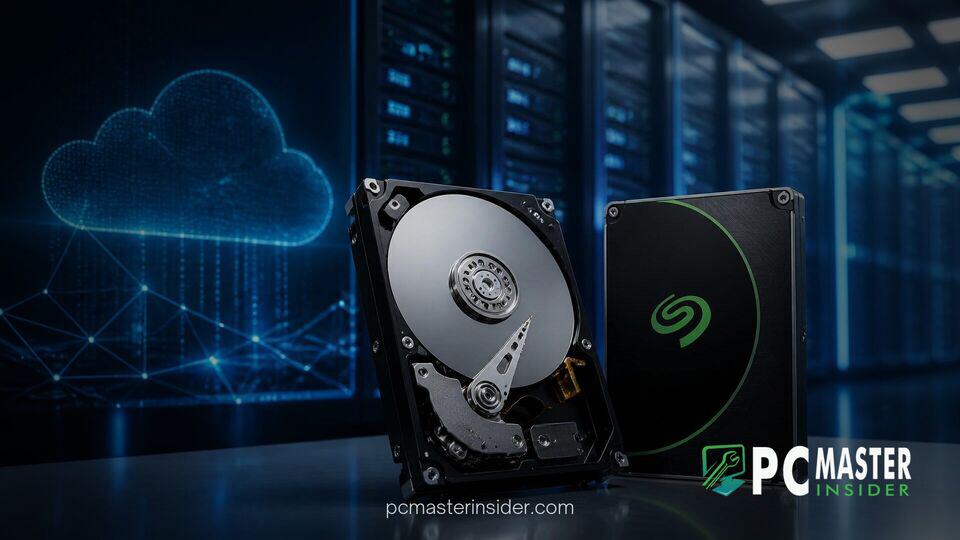
Microsoft Azure Storage has completed qualification testing for Broadcom host bus adapters paired with Seagate's high-capacity Mozaic hard drives. This joint validation marks a significant hyperscale proof point for Heat-Assisted Magnetic Recording (HAMR) and Shingled Magnetic Recording (SMR) storage configurations operating in enterprise data centers.
By pairing Seagate's flagship recording technologies with Broadcom's connectivity controllers, enterprise operators gain a simplified path to scale storage density. The milestone directly addresses the immense data demands driven by cloud computing expansion and artificial intelligence models across worldwide infrastructure.
Microsoft Azure Seagate HAMR Hard Drive Qualification
The milestone represents the first time SMR-configured drives built on Seagate's Mozaic platform have earned placement on Broadcom's approved vendor list for host bus adapters (HBAs). Broadcom HBAs function as critical host connectivity components, bridging system servers with vast arrays of storage devices. By completing the qualification, Microsoft Azure Storage establishes a real-world validation point for deploying these high-density disk architectures at true hyperscale volumes.
Data center operators continuously search for methods to expand raw storage capacity without proportionally increasing physical rack space or power distribution demands. While Microsoft tests Project Pantheon AI memory features and other software capabilities locally, cloud backends require scalable physical hardware to store massive datasets. The qualification of Broadcom HBAs with Seagate HAMR drives creates an operational blueprint for cloud providers looking to manage growing disk fleets cleanly.
Microsoft Azure Validates High-Capacity Seagate HAMR Hard Drives
As enterprise storage requirements surge, raw mechanical limits hit physical barriers under older perpendicular magnetic recording techniques. Seagate's Mozaic platform leverages HAMR technology to overcome those physical limits by utilizing a tiny laser diode attached to each recording head. The laser briefly heats the disk platter surface to make the magnetic media more receptive to writing tiny data bits, dramatically elevating the disk's areal density.
Combining HAMR with SMR allows tracks to be written in overlapping layers similar to roof shingles, squeezing maximum capacity out of each platter. High-density hard disk drives remain vital to cloud giants even as system components evolve. While hardware enthusiasts track innovations like how an OptiScaler mod enables AMD FSR on Intel Arc GPUs or how Windows 11 integrates Intel APX support, the backbone of enterprise cloud computing relies heavily on mechanical nearline storage efficiency.
Executive leaders across all three organizations emphasized the necessity of streamlined integration. Jason Feist, Senior Vice President of Cloud Business at Seagate, highlighted that high-capacity storage delivers maximum real-world value when enterprise clients can deploy it without friction. Feist noted that pairing HAMR and SMR drives with Broadcom's connectivity ecosystem makes ultra-dense storage far more accessible to hyperscalers.
Broadcom HBA Integration and Thermal Storage Architecture
The host bus adapter provides the core communication interface between host computing systems and physical storage arrays. Jas Tremblay, Vice President and General Manager of the Data Center Solutions Group at Broadcom, stated that extending HBA support to Seagate's SMR technology gives cloud customers a straightforward method to integrate and maintain extensive hard drive deployments.
From the cloud provider perspective, ensuring absolute stability across hardware layers is essential before rolling out new drive architectures. Pablo Ziperovich, General Manager of the Azure Memory and Storage Center of Excellence at Microsoft, confirmed that the joint qualification proves how HAMR, SMR, and Broadcom connectivity technologies operate cohesively within complex hyperscale data environments.
Operating high-density hardware requires rigorous validation because hyperscale environments run continuously under intense heavy thermal and read-write stress. Enterprise storage networks must maintain precise integrity alongside security controls, much like how cloud services like Microsoft Teams integrate third-party scanning tools to secure user communications. A failure in drive-controller communication at scale could disrupt key infrastructure services, making Azure's qualification a critical benchmark.
Cloud Storage Density and Enterprise Reliability Impacts
The validation comes at a moment when global data generation is accelerating due to machine learning training runs, deep learning dataset storage, and expanded cloud backup needs. Hyperscale data centers require infrastructure that expands total petabyte capacity per rack while controlling total cost of ownership (TCO) and operational overhead.
Higher drive capacities translate directly into lower energy consumption per terabyte, reduced floor space usage, and simplified system management. While specialized software updates resolve unique bugs such as Universal Print outages on Konica Minolta printers, core infrastructure reliance on robust physical hardware remains unchanged. The successful qualification of HAMR drives combined with Broadcom HBAs offers data center operators an established roadmap for scaling mass storage efficiently.
With Microsoft Azure completing its validation, additional enterprise cloud vendors and data center operators are expected to accelerate their adoption of HAMR-based high-capacity SMR hard drives throughout their global infrastructure.