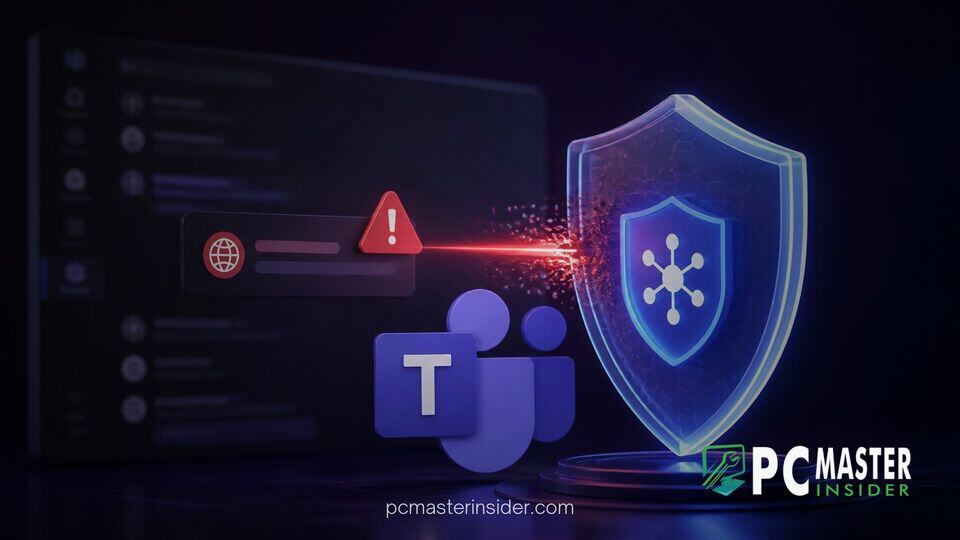
Microsoft has announced the rollout of a new artificial intelligence engine designed to detect and block phishing attempts inside Microsoft Teams conversations in real time. The context-aware security feature analyzes communication dynamics during chat interactions, allowing the platform to identify social engineering schemes, credential harvesting, and impersonation tactics before enterprise users fall victim to fraudulent requests.
The system operates actively across one-on-one and group messaging windows, delivering actionable warnings when potential security risks are spotted. By focusing heavily on high-risk vectors such as initial contacts from external users, the security engine evaluates conversational intent without requiring manual security scans or relying strictly on static blocklists.
AI-Powered Phishing Defense Arrives in Microsoft Teams
The introduction of microsoft teams ai phishing detection marks a major structural evolution in how collaboration platforms safeguard enterprise end-users against modern cyber threats. Traditional security controls historically depended on static signature matching, file reputation checks, and known bad URL database lookups. While those defenses remain critical for catching technical payloads, modern social engineering techniques often rely purely on text-driven deception, urgency cues, and identity spoofing that bypass conventional filters.
Microsoft's latest protection engine addresses this vulnerability by using contextual artificial intelligence models trained on broad conversational dynamics and historical attack patterns. When an external domain or unfamiliar user initiates contact inside Teams, the system analyzes the language structure, request type, and operational tone in real time. If a message contains indicators of fraudulent intent, such as pressing requests for multi-factor authentication passcodes, executive impersonation, or unexpected payment details, the chat interface displays an prominent contextual security banner warning the user of potential risk.
Crucially, Microsoft has clarified that this real-time safety layer respects enterprise compliance and data protection boundaries. The underlying AI models process message signals purely for immediate threat evaluation, and customer conversation text is not retained or utilized to train general generative models, generate productivity summaries, or support targeted advertising.
How Real-Time Contextual Analysis Blocks Social Engineering
Social engineering attacks launched through instant messaging services have surged significantly in recent years as organizations expanded hybrid work infrastructure. Threat actors frequently compromise external tenant accounts or register deceptive lookalike domains to bypass initial perimeter controls. Once inside a chat window, bad actors construct conversational trust far more quickly than via traditional email, exploiting the informal, immediate nature of real-time messaging apps.
The real-time context engine works by scrutinizing subtle contextual anomalies that point toward malicious intent. Key operational triggers evaluated during chat exchanges include:
- External First-Contact Scenarios: Conversations started by external senders who have no prior communication history with the recipient receive heightened algorithmic inspection.
- Credential and Secret Requests: Language patterns demanding immediate sharing of enterprise login information, reset links, or secondary verification codes are flagged instantly.
- Urgency and Manipulation Tactics: Phrasing that simulates urgent operational emergencies, fake IT helpdesk intervention, or executive authority is cross-referenced against known manipulation profiles.
- Anomalous Link Behavior: Direct links sent in conjunction with suspicious language prompts undergo parallel reputation checks via existing automated inspection engines.
When high-risk behaviors are detected, Teams presents clear actionable options within the warning notification. End-users can immediately block and report the suspicious sender, flag the message for security operations center review, or confirm the message as trusted if the interaction was triggered by a legitimate business partner.
Enterprise Rollout and Security Configuration Options
The security enhancement is rolling out natively across mobile, desktop, and web clients for Microsoft 365 environments. For most enterprise tenants, the core contextual safeguards for external first-contact messaging require no complex administrative setup, enabling immediate protection out of the box. IT departments maintain centralized oversight through existing management hubs, letting security teams monitor flagged interactions across the workplace ecosystem.
This messaging enhancement builds upon a broader suite of platform security upgrades rolled out across the Microsoft ecosystem. Previous security updates have introduced native controls like third-party deepfake scanning in Teams meetings and emergency system updates such as the recent patch addressing critical Brotli memory vulnerabilities in .NET. Integrating real-time chat evaluation directly alongside these system defenses ensures multi-layered protection across infrastructure, media streams, and text communications.
Licensing Requirements and Defender Integration
While basic context-aware chat alerts provide immediate frontline defense for end-users, deep administrative analytics and automated threat remediation integrate directly into the enterprise Microsoft Defender ecosystem. Security operations teams using Microsoft Defender for Office 365 can access consolidated incident telemetry, track cross-channel attack chains, and manage quarantine actions when chat threats intersect with broader phishing campaigns.
Organizations managing high-security environments can also leverage granular policies within the Microsoft Defender portal. Security administrators can configure automated Zero-Hour Auto Purge actions to isolate malicious chat messages retroactively if subsequent threat intelligence updates reclassify a delivered message as harmful. Furthermore, security operators can coordinate chat protections with identity monitoring tools, ensuring that compromised accounts are automatically restricted before adversaries can pivot laterally through trusted collaboration channels.
As collaboration tools remain a primary target for sophisticated threat actors, embedded contextual AI serves as a critical defense against modern social engineering techniques. By catching manipulative language patterns in real time within Teams, Microsoft offers enterprises an essential safeguard that closes the gap between standard network perimeter filters and human decision-making.