
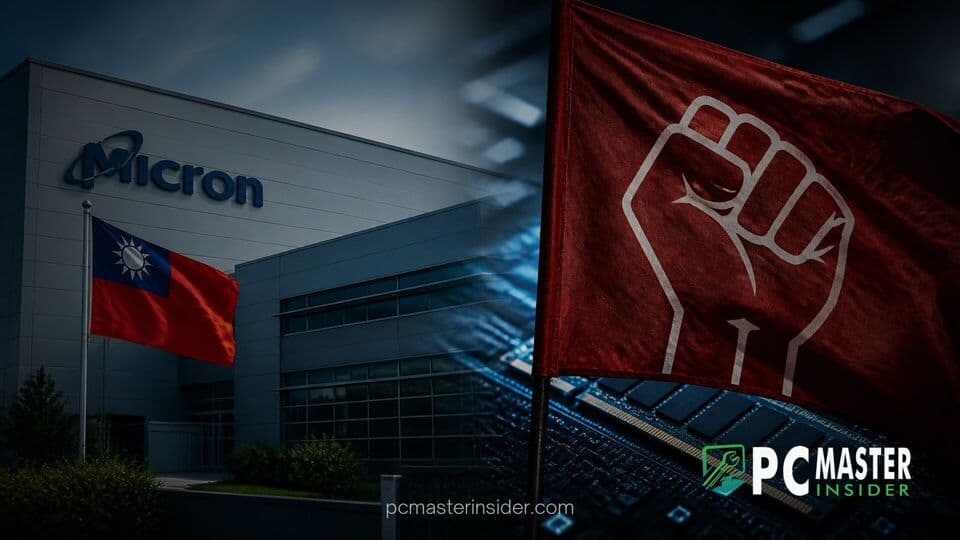
Members of the Micron Technology union in Taiwan have voted overwhelmingly in favor of authorizing strike action as labor negotiations over annual bonuses and profit-sharing schemes reach an impasse. The dispute highlights growing tension between high-tech manufacturing workers and memory chipmakers enjoying massive financial windfalls from the global artificial intelligence boom.
As demand for advanced memory hardware accelerates across enterprise systems, workers argue that executive compensation and corporate revenues have surged while baseline profit-sharing distributions have failed to reflect the extraordinary operational load placed on production line engineers and technicians.
micron taiwan union strike bonus pay
The decision by the union to prepare for a potential strike stems from prolonged contract negotiations regarding baseline compensation, annual performance bonuses, and direct profit allocation. Union representatives contend that Micron Taiwan personnel have delivered record output under intense scheduling demands to meet global memory shortages, yet the financial compensation structure has not kept pace with regional competitors or corporate revenue growth.
Taiwan serves as one of Micron's primary manufacturing and advanced packaging hubs, particularly for standard DRAM and high-speed memory modules integrated into modern enterprise servers. With major enterprise hardware vendors reporting that Nvidia AI server prices are set to jump over 15% due to memory shortages, line workers feel their critical role in maintaining high-yield manufacturing lines entitles them to a more transparent profit-sharing model.
Micron Taiwan Employees Vote In Favor of Potential Strike Action
Following weeks of mediated dialogue that failed to yield an agreement, the labor union conducted a formal strike authorization vote. An overwhelming majority of voting members supported legal strike action should management fail to offer a revised bonus package during upcoming state-brokered conciliation sessions.
Under local labor legislation, the union must complete formal administrative steps and statutory mediation before initiating work stoppages. However, the union leadership confirmed that procedural preparations are already underway, establishing the legal framework for coordinated walkouts across major production facilities in Taichung and Taoyuan if internal negotiations remain stalled.
Labor organizers emphasized that while work stoppage remains a measure of last resort, employees feel increasingly alienated by corporate messaging that highlights record demand for AI infrastructure without translating those gains into equitable worker compensation. The escalation mirrors broader global labor movements in technology sectors where specialized manufacturing personnel demand direct participation in company profits during peak market cycles.
Demands for SK Hynix and Samsung Style Profit Sharing
Central to the union's grievances is a comparison with compensation structures implemented by major South Korean memory manufacturers. Both SK Hynix and Samsung Electronics maintain structured, target-driven profit-sharing frameworks that trigger substantial performance bonuses during memory upcycles. In recent quarters, rival memory manufacturers have distributed performance bonuses representing several months of base salary following strong quarterly earnings in their dynamic random-access memory divisions.
Micron Taiwan employees argue that current corporate policies leave annual bonus payouts to management discretion rather than tying them directly to standardized operational metrics. Workers are seeking a formalized profit-sharing formula that guarantees predictable payouts during industry booms, bringing overall compensation in line with international competitors competing for the same specialized engineering talent.
Industry analysts note that memory fabrication requires highly technical labor, where line stability and yield rates directly govern profit margins. As global component supplies face strain from automated buy orders and consumer hoarders, seen recently when DDR5 scalper bots overwhelmed PC retail sites as memory supply shrank, maintaining an experienced workforce on semiconductor fabrication lines is critical to keeping global tech supply chains stable.
Impact of the AI Memory Boom on Tech Workforce Demands
The rapid adoption of generative artificial intelligence model training and inference workloads has transformed the memory market landscape. High Bandwidth Memory (HBM) and specialized high-density DDR5 modules have transitioned from niche enterprise products to core drivers of semiconductor profitability. This rapid market expansion has placed immense operational pressure on manufacturing infrastructure worldwide.
The current labor dispute reflects a growing friction point across the tech supply chain, where rapid market expansion creates intense operational pressure on fabrication plants. Executive commentary across the semiconductor ecosystem has continually highlighted the strategic importance of memory integration. Even key technology leaders are re-evaluating architectural strategies, demonstrated when Intel's CEO hinted at a return to memory business and CPU memory stacking to address data transfer bottlenecks.
Fab line engineers report extended shifts, tighter maintenance windows, and accelerated yield targets designed to satisfy contract commitments for cloud providers and server original equipment manufacturers (OEMs). Rising production targets without corresponding updates to profit-sharing agreements have fueled dissatisfaction across Taiwan's technical workforce.
Upcoming Mediation and Potential Semiconductor Supply Chain Effects
Local government labor bureaus have scheduled formal conciliation meetings between Micron management and union representatives in an effort to reach a mutually acceptable resolution before any physical disruption occurs on the shop floor. Management at Micron has stated its commitment to ongoing dialogue with employees and maintaining competitive overall compensation packages that align with local market conditions.
If mediation fails and union leadership calls for operational walkouts or targeted work-to-rule actions, the disruption could send ripple effects across the global technology market. Modern chip production lines operate on continuous schedules where even minor interruptions can cause weeks of processing delays and lost silicon wafers.
With global hardware pricing already sensitive to component supply limitations and corporate expenditures, any prolonged labor action at Micron's Taiwanese facilities would further restrict global memory supply. Supply chain managers across the enterprise computing and consumer hardware sectors are monitoring the mediation process closely, as contract negotiations over the coming weeks will determine whether production remains uninterrupted or faces operational delays.