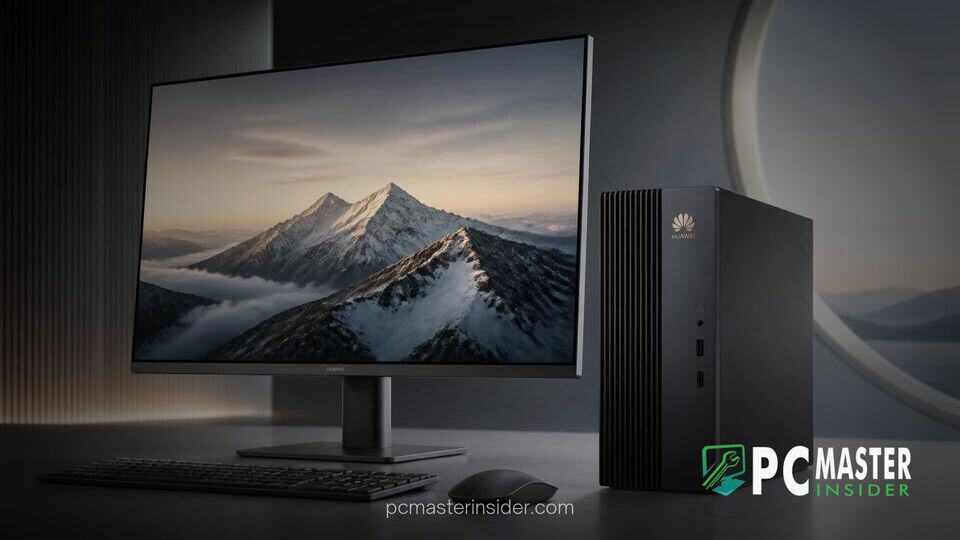
Huawei has officially unveiled the Qingyun HM650 desktop PC, marking the company's first commercial enterprise desktop powered by its proprietary Kirin X90 processor and HarmonyOS platform. Built specifically for Chinese government agencies and corporate clients, the machine has received official domestic certification verifying that its hardware components, system architecture, and operating software are entirely manufactured within China.
huawei qingyun hm650 desktop kirin x90: Redefining Sovereign Desktop Computing
The launch of the huawei qingyun hm650 desktop kirin x90 system represents a significant shift in enterprise hardware design. By replacing standard x86 processors from Intel and AMD alongside Microsoft Windows, Huawei has engineered a complete desktop platform optimized for native enterprise applications and local security compliance. The workstation delivers efficient multithreaded performance while maintaining a low thermal envelope, catering directly to public sector and enterprise office environments.
Huawei Enters Enterprise PC Market with HarmonyOS Desktop
Following export restrictions that severed access to core Western hardware components and software licenses, Huawei intensified its efforts to develop an independent personal computing ecosystem. While the company previously deployed HarmonyOS across mobile devices, tablets, and select consumer laptops, the Qingyun HM650 represents its formal expansion into fixed enterprise workstations.
Running on HarmonyOS PC edition, the system completely removes reliance on legacy software layers. Enterprise customers gain access to centralized administrative policies, dual boot spaces for isolating work and personal environments, and native hardware-level encryption protocols. This approach aligns with broader industry movements toward isolated workplace architectures, such as how defense contractors prioritize secure hardware builds seen in US-made rugged laptops.
Key Specifications and Kirin X90 Architecture
At the core of the desktop lies the Kirin X90 system-on-chip, designed by Huawei's HiSilicon division and manufactured domestically using a 7nm-class process node. The processor utilizes an Arm-based architecture featuring 10 CPU cores operating in a 4+4+2 layout. Thanks to simultaneous multithreading technology, the chip handles up to 20 concurrent threads.
Unlike traditional desktop chips operating between 65W and 125W, the Kirin X90 operates at a conservative 40W Thermal Design Power (TDP). Integrated within the silicon is Huawei's Maleoon graphics unit and a dedicated Neural Processing Unit (NPU) rated for local artificial intelligence tasks. Thermal management is handled by a dual-sided cooling system designed for near-silent operation during sustained workloads.
System memory consists of 16GB of LPDDR5 RAM paired with standard storage options of 256GB or 512GB solid-state drives. Hardware security features include the Star Shield 2.0 framework, incorporating AI-driven fraud protection and real-time biometric verification. The bundled keyboard features a physical button linked directly to Huawei's Celia AI assistant for document processing and multi-device file distribution.
Domestic Component Sourcing and Market Availability
According to certification documents issued by national testing authorities, the Qingyun HM650 achieves full localization across its physical build. Key components including memory modules, storage controllers, power supply units, motherboards, and wireless networking hardware are sourced from domestic suppliers. Industry analysts note that memory chips are supplied by domestic fabricators like CXMT, while solid-state storage relies on flash memory from manufacturers such as YMTC.
While global PC makers manage localized component shifts, such as silicon production reallocation or integrating specialized hardware like dedicated local AI accelerators, Huawei's complete hardware supply chain isolation remains unique. However, analysts point out that underlying chip architectures still originate from earlier global licensing agreements, such as Armv8 instruction sets.
The desktop system targets government agencies, financial institutions, energy providers, and state-owned enterprises. Pricing starts at approximately 6,899 yuan (around $1,018 USD) for baseline 8-core configurations, rising to 7,199 yuan ($1,078 USD) for the full 10-core tier. Mass market deployment and fleet shipments to enterprise partners are scheduled to begin in December.
With the release of the Qingyun HM650, Huawei has established a fully localized desktop computing platform tailored to strict domestic procurement standards. The long-term impact on global supply chain dynamics will depend on developer adoption of native HarmonyOS applications and the ongoing evolution of domestic semiconductor fabrication capabilities.