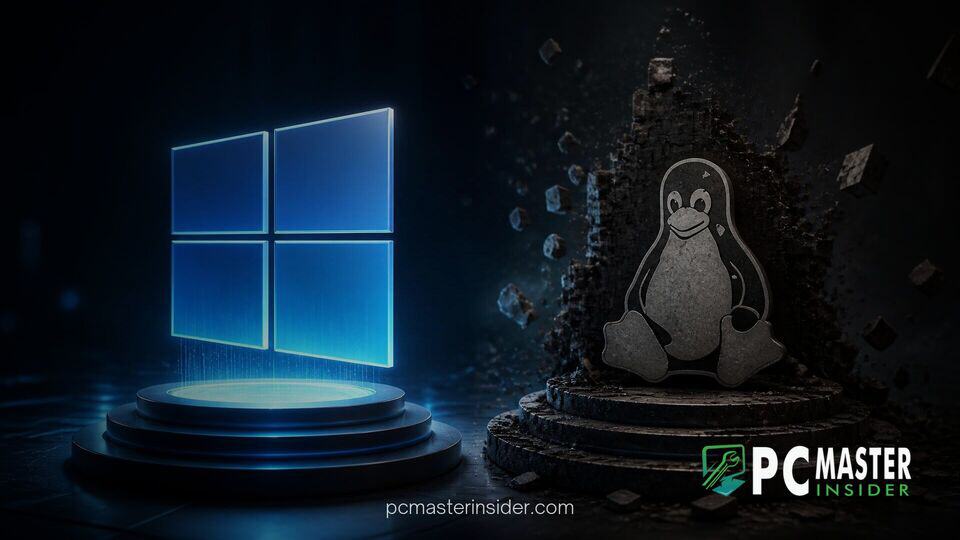
A Google security researcher has reignited a classic debate in low-level systems architecture by arguing that the core design of Microsoft Windows NT outclasses the Linux kernel. The assertion has drawn widespread attention across social platforms and developer communities, forcing engineers to reconsider foundational assumptions about modern operating system security and permission models.
Laurie Kirk, a security researcher at Google and former reverse engineer at Microsoft, shared her technical assessment regarding the structural advantages of the NT architecture. Her analysis focuses explicitly on underlying kernel mechanics, distinguishing systemic architectural choices from upper-layer consumer elements like user interfaces or bundled software.
Google Researcher Windows NT Kernel vs Linux Debate Explained
The discussion around the google researcher windows nt kernel vs linux comparison centers on how each operating system structures access control, handles system resources, and manages execution permissions. Kirk described the NT kernel as an engineering marvel, highlighting its unified object-oriented abstractions as fundamentally cleaner and safer than the traditional POSIX model relied upon by Linux.
While consumer sentiment often favors Linux for its lightweight nature and open-source flexibility, core security engineering tells a different story regarding resource representation. Under Windows NT, every system resource, including files, memory sections, processes, and synchronization primitives, is treated as an object managed by an integrated Object Manager. This unified approach allows fine-grained Access Control Lists (ACLs) to be applied consistently across all system operations.
Architecture Comparison and Resource Permission Design
The core distinction lies in how security descriptors and handles are assigned within the kernel environment. In Windows NT, user applications interact with handles granted by the kernel, which enforces explicit rights checks whenever a handle is requested or duplicated. This design stems from the late 1980s work led by Dave Cutler, who joined Microsoft after leading VMS development at Digital Equipment Corporation.
In contrast, Linux relies heavily on the Unix philosophy of treating resources as files or file descriptors. Over the decades, security on Linux has evolved through added layers like SELinux, AppArmor, cgroups, and seccomp filters. While these mechanisms provide robust isolation, critics contend they function as retrospective additions to an older monolithic architecture rather than native primitives engineered from day one.
Recent developments in enterprise software show that systems management relies heavily on stable virtualization capabilities. For example, issues like the recent Hyper-V Linux folder sharing bug fix demonstrate the complex interoperability layer required when running non-native guest operating systems alongside hypervisors.
Community Backlash and Open-Source Counterarguments
The claims produced immediate pushback from prominent open-source maintainers and systems developers. Critics pointed out that theoretical architectural elegance does not always translate into real-world efficiency or operational security. Over time, the NT kernel accrued legacy overhead, including historical decisions to move graphics drivers into kernel space during the NT 4.0 era for performance reasons.
Linux kernel developers counter that modularity and continuous community peer review offer practical advantages that outweigh formal object-oriented kernel structures. Open-source projects maintain complete transparency, allowing rapid patching of memory safety bugs and performance bottlenecks. Furthermore, lightweight process creation via native fork and exec semantics makes Linux significantly faster for web-scale workloads and containerized deployments.
The broader ecosystem context reveals that user preference depends heavily on workload demands. Recent analysis shows how desktop market share fluctuates, highlighted by reports indicating low primary Windows 11 adoption among developers who frequently favor Linux or Unix-like environments for software engineering tasks.
Future Implications for AI Agent Permissions and OS Design
A primary driver behind Kirk's timing is the rapid emergence of automated AI agents that operate directly within consumer operating systems. As software shifts toward autonomous execution models, local agents require granular, dynamically scoped permissions to read files, manage processes, and handle network traffic securely.
The structured handle system and unified security model of Windows NT offer a predictable framework for constraining autonomous agents. Standardized security tokens allow administrators to restrict process privilege levels far more precisely than simple user-group permissions. Projects like local AI agent platforms for PC hardware highlight the growing necessity for strict host-level sandbox controls as background processing tasks become standard.
At the same time, Microsoft continues to update its operating system core, balancing security mandates against system reliability. The company recently expanded enterprise safeguards through Secure Boot certificate deployments in Windows 11, reflecting ongoing efforts to modernize boot trust anchors. Meanwhile, Linux maintainers continue adding hardware capabilities, as seen when AMD added GDDR7 support to open-source drivers ahead of next-generation GPU hardware launches.
Ultimately, the discussion underscores a fundamental divide in systems design philosophy. Windows NT stands as an example of deliberate, top-down object design focused on complete resource abstraction. Linux showcases the strengths of evolutionary, pragmatic development that prioritizes performance, adaptability, and open auditing. As AI workloads demand tighter access controls, both architectures will face new pressures to adapt their permission models.