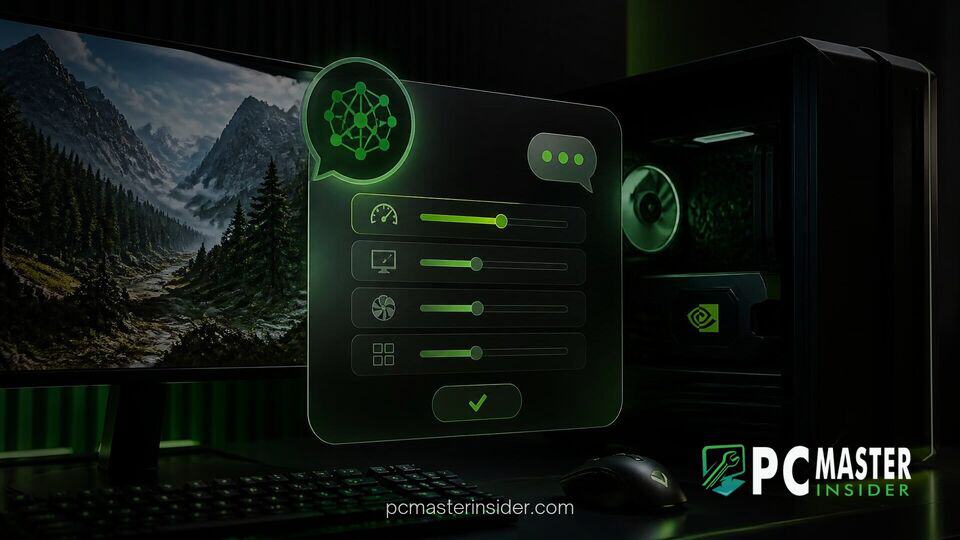
A recently published patent application reveals that Nvidia is exploring a specialized artificial intelligence assistant to help developers pinpoint PC game performance bottlenecks. By converting plain-English questions into live GPU profiling code, the proposed technology aims to simplify debugging and accelerate the game optimization workflow.
Nvidia Files Patent for AI-Powered Game Optimization
According to patent application US 2026/0277953 A1, Nvidia is developing a large language model (LLM) system connected directly to graphics hardware and performance profiling software. The filing outlines an interactive chat agent that translates developer queries into targeted diagnostic code, allowing creators to inspect frame drops, shader delays, and memory bandwidth issues. Rather than replacing manual development, the tool serves as a diagnostic bridge between complex GPU metrics and studio engineering teams.
While the market has seen rising desktop GPU shipments and high Nvidia market share, game optimization remains one of the most resource-intensive stages of PC game development. Complex graphics pipelines often require specialized engineers to write bespoke scripts for profilers like Nvidia Nsight or RenderDoc. Nvidia's proposal suggests that an conversational interface could drastically cut down the time required to locate performance regressions prior to a title's launch.
How the Interactive Chatbot Analyzes Performance Data
The patented technology functions by using a routing mechanism that categorizes incoming developer prompts. Queries are divided between general architectural questions and specific telemetry reports. When an issue is identified, the system consults internal GPU documentation and extracts performance counters directly from the hardware.
It then automatically generates a execution script, typically written in Python, to run isolated diagnostic routines. Once executed on the graphics card, the AI compiles the telemetry into accessible, plain-language reports. This structure operates similarly to agentic workflow standards, where an LLM is given direct execution access to external profiling utilities rather than relying solely on static training data.
Key Features of Nvidia’s Game Tuning Assistant
The patent outlines several operational capabilities designed to streamline graphics debugging:
- Automated Script Generation: Translates plain text prompts into custom diagnostic scripts without requiring hand-coded profiling queries.
- Query Routing Architecture: Uses intent classification to handle both general GPU hardware queries and detailed scene profiling logs.
- Direct Hardware Integration: Interfaces directly with GPU performance counters to gather real-time telemetry.
- Comparative Profiling: Evaluates performance differences between multiple builds or code revisions to spot newly introduced slowdowns.
Natural Language Prompts and Automated Diagnostics
In practice, developers would no longer need to manually navigate complex diagnostic menus to find hardware bottlenecks. The patent includes explicit examples of plain-English prompts that the AI assistant is designed to process. Creators can submit queries such as, "What is causing the micro-stutter during camera cuts?" or "Why is frame time spiking when ray-traced reflections enter the viewport?".
In response, the system generates diagnostic scripts that run locally on developer test hardware. It isolates specific rendering passes, memory allocation spikes, or CPU-to-GPU sync delays before returning actionable feedback. This natural language approach ensures that even small independent studios without dedicated optimization specialists can navigate advanced GPU telemetry.
Impact on Game Developers and PC Hardware Performance
This developer-facing concept builds upon Nvidia's consumer AI initiatives, such as Project G-Assist, which allows gamers to adjust system settings using text prompts. However, where Project G-Assist focuses on user-end tweaks, this newly patented system operates deeper within the engine code during active game creation.
The filing emphasizes that the AI does not automatically rewrite game code or apply unverified patches. Because generated scripts run strictly on internal developer test rigs, there is no risk of faulty diagnostic routines being pushed to consumer PCs. Industry analysts note that while patent applications do not guarantee a commercial product launch, this development highlights how hardware vendors are leveraging local AI to refine software ecosystems.
As developer environments become increasingly complex alongside developments like SteamOS adding native Nvidia GPU driver support and expanded software platforms, tools that reduce testing overhead are becoming essential. AI-assisted diagnostic assistants could prove crucial in eliminating release-day frame rate issues and stuttering in upcoming PC titles.
Nvidia's patent demonstrates a clear interest in using conversational AI to solve complex technical challenges in software development. If implemented into official developer tools, this diagnostic assistant could significantly lower the barrier to thorough PC game optimization.