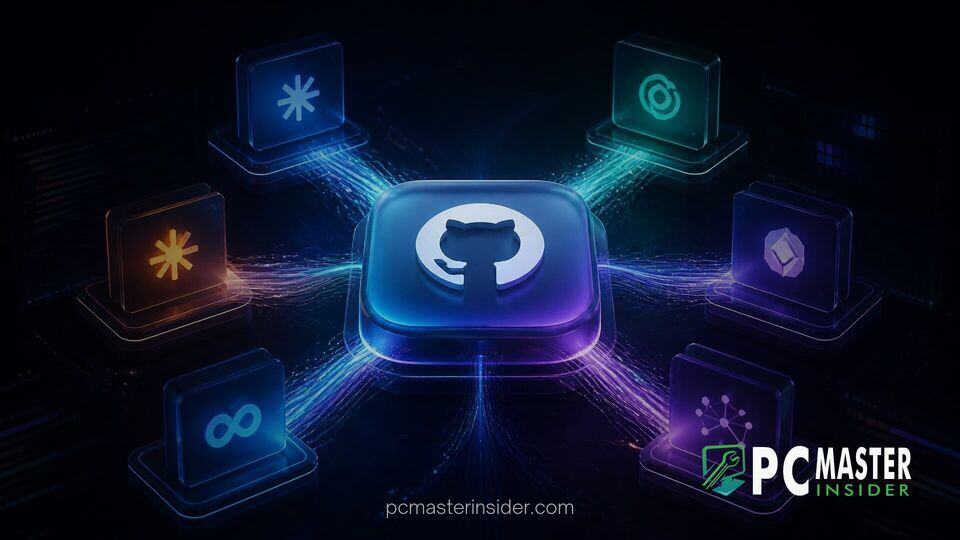
Microsoft and GitHub have officially launched Project HydraFusion, a research preview in GitHub Copilot designed to deliver frontier-level intelligence through dynamic multi-model orchestration. Instead of relying on a single large language model or simple static model picker, HydraFusion automatically evaluates each developer task in real time and routes execution across multiple AI models to optimize performance, latency, and operational expense.
The system builds on Microsoft's earlier research into Hybrid Dynamic Routing Architecture (HyDRA) and is now available to all GitHub Copilot users through the experimental flag in the GitHub Copilot Command Line Interface (CLI). In controlled benchmarks, GitHub demonstrated that HydraFusion matched or exceeded the baseline capabilities of single flagship frontier models like Claude Opus 5 while reducing estimated workflow costs by up to 67 percent.
github copilot hydrafusion multi model orchestration
The introduction of github copilot hydrafusion multi model orchestration marks a significant leap from traditional AI model selection toward intelligent workflow execution. In previous iterations of software generation tools, developers had to manually switch between vendors or rely on basic session-level auto-selection. Project HydraFusion fundamentally changes this paradigm by decomposing complex coding problems into individual subtasks and selecting the most efficient orchestration pattern behind the scenes.
Rather than treating model routing as a simple choice between Model A or Model B, HydraFusion treats workflow construction as a real-time optimization problem. It analyzes capability signals across reasoning, code drafting, refactoring, and tool execution to assign tasks dynamically. This systemic shift aligns with Microsoft's broader enterprise strategies, such as when Microsoft updates its Responsible AI Standard to address autonomous AI agents, ensuring that multi-step autonomous loops operate under structured boundaries.
GitHub Copilot HydraFusion Multi-Model Engine
Under the hood, the HydraFusion runtime acts as an intelligent intermediary layer positioned between the primary Copilot agent framework and external model inference APIs. The core objective of the engine is to break away from the brute-force approach of routing every small file edit or routine refactor to expensive, high-parameter AI models.
When a developer submits a request in the Copilot CLI, HydraFusion evaluates the intent, diff size, abstract syntax tree complexity, and context size required. Based on these telemetry signals, the routing layer selects one of three distinct execution strategies to complete the prompt:
- Single Pattern: Directs straightforward requests straight to a single optimal model when further validation or cascading is unnecessary.
- Cascade Pattern: Uses a lightweight, fast model to generate an initial draft solution before passing the output through a quality gate, escalating to a stronger frontier model only if the draft fails verification.
- Critique Pattern: Employs one primary model to draft the initial solution, followed by an independent read-only critic model from a separate vendor family to review the code and suggest targeted revisions before final delivery.
How the Plan-Build-Critique Pipeline Operates
The Critique workflow pattern highlights the unique power of multi-vendor model orchestration. Industry benchmarks have shown that having an AI model evaluate its own output often leads to confirmation bias, whereas cross-model reviews between competing families catch subtle logical errors and syntax oversights. By pairing a fast generator model with a specialized critic model, HydraFusion mimics the real-world software engineering process of code review and peer feedback.
This automated plan-build-critique pipeline allows developers to achieve high-tier code verification without needing to spend minutes crafting separate prompt templates or manually copy-pasting code into distinct chat sessions. The entire chain executes programmatically, surfacing only the final refined code to the developer's terminal or editor interface.
Reducing Developer AI Compute Costs
The economic impact of Project HydraFusion is central to Microsoft and GitHub's strategy. Standard agentic workflows that perform continuous tool calls, file indexing, and unit test executions quickly consume millions of input and output tokens. When every step runs on top-tier frontier models, enterprise AI budgets scale rapidly.
By routing lower-complexity tasks to smaller, highly optimized models and reserving frontier reasoning models for complex architectural decisions or failure recovery, HydraFusion dramatically lowers token overhead. During evaluations on Terminal-Bench 2.1, HydraFusion delivered verified task quality that was 4.9 percentage points higher than single-model baselines while cutting total estimated compute costs by 67 percent.
The Shift from Model Selection to Model Orchestration
Industry leaders see HydraFusion as part of a wider industry movement toward compound AI systems and automated semantic routing. In an interview regarding the announcement, Mario Rodriguez, Chief Product Officer at GitHub, emphasized that picking a model is no longer enough for modern engineering teams.
"Routing to the right model is quickly becoming table stakes, but where HydraFusion is different is that it is addressing 'what's the best way to solve this task' rather than 'which model should handle this task?'" Rodriguez stated. "HydraFusion doesn't just prompt a model, it dynamically constructs an execution strategy whether a task is best handled by a single model, should start with a faster model and escalate, or if the work would benefit from an independent model reviewing and improving the result."
This initiative dovetails with Microsoft's focus on enterprise-grade developer productivity across all platforms. As seen when Microsoft announces Project Zenith for developer-class Windows 11 PCs, the tech giant is consistently refining both hardware environments and software tooling to streamline developer workflows. Furthermore, by managing model interactions at the orchestrator level, Microsoft offers developers an extra layer of stability, much like how Microsoft shares key milestones in its Driver Quality Initiative to keep systems reliable under high computational loads.
Availability and Research Preview Access
Project HydraFusion is available immediately as a research preview to subscribers across all GitHub Copilot plans, including Individual, Business, and Enterprise tiers. Users can test the feature directly inside the GitHub Copilot CLI by running the update command, enabling experimental features, and choosing HydraFusion from the available model list.
Token usage during the research preview is billed transparently at the standard token rates of the underlying models consumed during each session. As developers provide feedback in the GitHub Community forums, Microsoft and GitHub plan to refine the underlying dynamic heuristics and expand HydraFusion's multi-model orchestration layer into Visual Studio Code and full cloud-based Copilot Workspace environments.
The release of Project HydraFusion underscores a pivotal turn in artificial intelligence engineering, proving that smart orchestration across diverse model architectures can deliver frontier quality while drastically cutting resource expenditure.