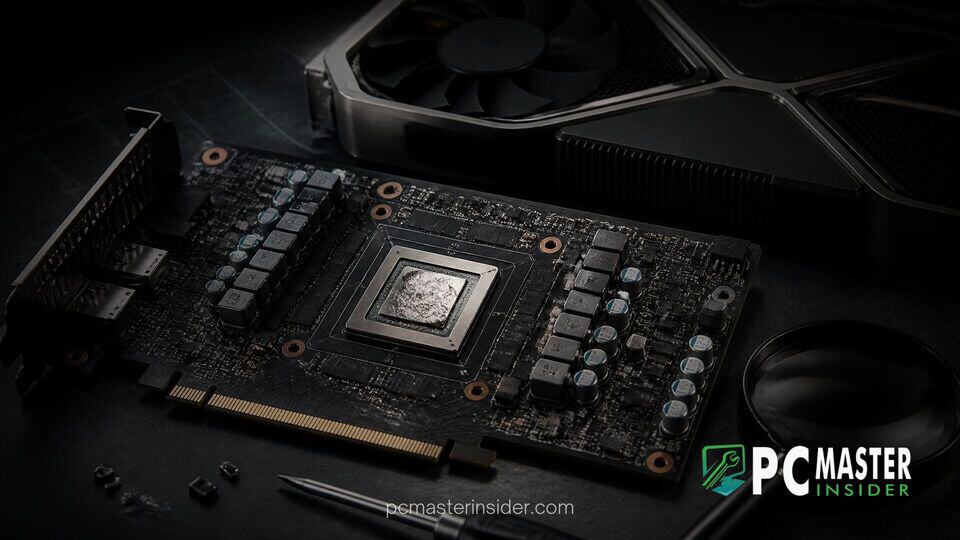
A prominent GPU repair specialist has exposed a sophisticated hardware scam involving a counterfeit Nvidia GeForce RTX 4090 graphics card that contained dummy silicon and fake memory modules. The discovery highlights a troubling trend in the second-hand PC components market, where fraudsters are going to extreme lengths to create non-functional duplicates.
The victim bought the card as a broken board for roughly $350 (30,000 rubles), intending to use it as a restoration project or for spare components. However, detailed diagnostic work revealed that the printed circuit board was completely unrepairable due to fake components permanently soldered in place.
fake rtx 4090 dummy gpu die scam EXPOSED BY REPAIR SPECIALIST
The incident came to light after Russian hardware technician Viktor Veklich, known online as Vik-Off, published a detailed teardown video examining the faulty board. The customer purchased the product as a bare printed circuit board without any cooling assembly attached. Without a heatsink or fans mounted, testing the card prior to payment was virtually impossible. Upon initial visual inspection, the board appeared remarkably convincing, featuring authentic-looking chip markings, precise laser etching, and proper black underfill compound surrounding the main processor package.
When Veklich removed the main graphics processor package from the circuit board using professional rework equipment, he discovered that the silicon die was entirely non-functional. Instead of an authentic AD102 graphics processor, the scammers had soldered down a dummy substrate with no active computational logic inside. The contact area beneath the package did not match a real processor, and the protective solder mask deteriorated during standard thermal cleaning.
Further inspection of the memory configuration revealed additional deception. While the onboard video memory chips were stamped with markings imitating genuine Micron parts, desoldering the packages revealed lower-grade GDDR6 modules rather than the high-speed GDDR6X chips specified for official RTX 4090 graphics cards. This meticulous level of modification meant that the board could never be brought back to life.
Growing Risks in the Second-Hand Graphics Card Market
The high retail price of premium graphics hardware has turned flagship cards into primary targets for marketplace scams. With legitimate GeForce RTX 4090 units routinely selling for upwards of $1,500 to $2,000 on secondary outlets, discounted listing prices frequently attract enthusiasts looking for bargains or repair opportunities.
This is not the first time technicians have encountered fraudulent flagship GPUs. Similar cases have involved older silicon from previous-generation graphics cards. In some instances, scammers have shaved down and re-engraved older processors, like the GA102 core from an RTX 3080 Ti or RTX 3090, to pass them off as top-tier AD102 chips. In extreme cases, repair channels have even uncovered plastic blocks mounted onto circuit boards to simulate physical GPU weight.
Hardware security issues extend across multiple PC product categories. Scams involving storage drives, memory kits, and processors have become increasingly common online. For instance, Raspberry Pi confirmed firmware locks memory upgrades to prevent scams, demonstrating how hardware manufacturers are taking steps to combat component tampering. Similarly, buyers routinely encounter fake software downloads and malicious tools, such as when a fake 113GB GTA VI download targets PC gamers to disable Windows Defender on compromise-seeking machines.
How PC Builders Can Spot Fraudulent Hardware Sales
Detecting counterfeit hardware without specialized repair gear can be extremely difficult because external branding often looks identical to factory components. Scammers frequently use specialized ball grid array (BGA) soldering tools to mount fake chips directly onto PCBs, mimicking genuine factory assembly lines. However, several precautions can help buyers avoid falling victim to hardware fraud:
- Avoid bare board sales without proof of life: Purchasing bare PCBs missing coolers, serial number stickers, or backplates carries massive risk. Always request a live video demonstration showing the card booting into an operating system.
- Verify system detection tools: When buying complete used cards, insist on seeing real-time diagnostic screenshots or video recordings from software like GPU-Z, rendering benchmarks, or driver control panels.
- Examine substrate colors and text alignment: Counterfeit packages often exhibit subtle discrepancies in substrate coloration, surface reflectivity, and font alignment compared to official Nvidia designs.
- Buy through protected platforms: Always complete transactions on platforms offering comprehensive buyer protection and reasonable return policies. Avoid non-refundable payment methods or local cash deals on unverified hardware.
System stability issues can sometimes arise from software corruption rather than physical hardware fraud. Gamers experiencing sudden system crashes or driver errors should verify system integrity before assuming a physical defect exists. For instance, knowing how to repair corrupted system files on Windows 11 or understanding how to run SFC command on Windows 11 can help rule out OS-level glitches. Additionally, learning how to fix black screen crashes when launching games in Windows 11 offers effective software troubleshooting steps.
As counterfeiting operations become more advanced, buyers must remain vigilant. While purchasing broken hardware for repair can be an engaging hobby, the presence of factory-level fake chips means that even experienced technicians can end up with unfixable electronic waste. Checking seller history, insisting on hardware validation, and sticking to reputable secondary marketplaces remain the best defenses against modern hardware scams.