Modders in the PC hardware community have developed a custom solution that offloads NVIDIA DLSS 5 Neural Rendering to a secondary GPU. By distributing the heavy AI workload across two graphics cards, the technique restores native frame rates and delivers substantial performance gains in demanding games.
DLSS 5 Secondary GPU Mod Performance Boost Explained
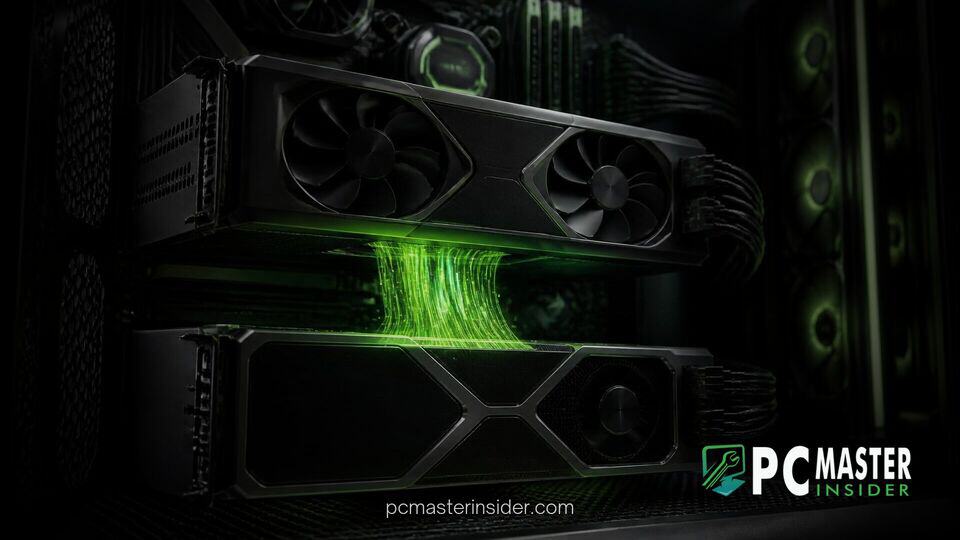
The new community modification uses a custom ReShade add-on to decouple the core game rendering process from the AI neural pass. While the primary graphics card handles geometry, lighting, and rasterization, the secondary card executes NVIDIA's DLSS 5 Neural Rendering algorithm on the completed frame. This dual-card pipeline significantly reduces the heavy performance hit traditionally associated with real-time neural processing on a single card.
Community Mod Offloads DLSS 5 Processing to Secondary GPU
Following the recent arrival of NVIDIA's next-generation upscaling technology, enthusiasts quickly noticed that running full neural post-processing on a single card could cause heavy frame rate drops. To address this bottleneck, developer Marcelo Guibout released a open-source project featuring a specialized ReShade add-on called MGPU Bridge.
Because DLSS 5 Neural Rendering operates post-rasterization, it processes fully generated frames rather than intermediary render passes. Taking advantage of this design, the mod captures the finished frame from the primary GPU, transfers the image buffer over PCIe to a second installed graphics card, and lets the secondary hardware execute the neural pass. The second GPU then outputs the final image directly to a display connected to its own port.
This approach mirrors the legacy era of dedicated PhysX cards, where a secondary graphics processor took on heavy physics simulations to leave the primary GPU unencumbered. Community members previously experimented with neural rendering after leaked DLSS 5 neural rendering files were modded into Skyrim and Control, but this latest tool marks the first time the processing burden has been split across multiple physical expansion slots.
Technical Implementation of DLSS 5 Autopilot and ReShade
The technical architecture relies on Direct3D 12 device creation on the secondary card. When a game generates a frame, the primary GPU completes its traditional render loop. ReShade intercepts the output buffer and transfers the uncompressed image data via PCIe 5.0 lanes. The secondary GPU receives the frame, applies the DLSS 5 Neural Rendering filter, and sends the updated image to the user's secondary monitor or display input.
By eliminating the requirement to copy the post-processed frame back across the system bus to the primary card, bandwidth bottlenecks are kept to a minimum. Furthermore, because the primary card performs zero AI calculations during this sequence, operating temperatures and power draw on the main card drop notably compared to single-card execution.
This development follows earlier software updates in the NVIDIA ecosystem, such as when the official NVIDIA App update added DLSS 4.5 overrides and Resizable BAR controls to give PC gamers finer control over frame parameters. However, community-led projects like MGPU Bridge push hardware flexibility beyond factory driver specifications.
Benchmark Results and Framerate Improvements
Early testing demonstrates dramatic framerate recoveries when running demanding titles. Demonstrations published by Guibout evaluated a test bench equipped with an AMD Ryzen 7 7800X3D processor, 32GB of DDR5 memory, and twin NVIDIA GeForce RTX 5060 Ti 16GB graphics cards operating on PCIe 5.0 x8 slots.
In tests featuring The Blood of Dawnwalker at 1080p, activating DLSS 5 Neural Rendering on a single RTX 5060 Ti dropped baseline frame rates from 70 FPS down to 44 FPS in DLAA mode. Offloading the neural pass to the second RTX 5060 Ti restored performance entirely, returning frame rates back to the 67 to 70 FPS range.
In aggressive DLSS Super Resolution Ultra Performance modes, where frame generation targets higher total frame outputs, shifting neural calculations to the second GPU netted up to a 127 percent framerate increase compared to running both rendering and AI models on a single graphics card. Similar efficiency gains were documented in Cyberpunk 2077, confirming that secondary hardware offloading successfully recovers lost raster performance.
Hardware Requirements and Display Latency Trade-Offs
While the multi-GPU modification yields impressive raw frame rates, it introduces specific hardware constraints and trade-offs. Users require a motherboard with sufficient PCIe bandwidth to run two cards at high speeds, alongside a power supply capable of sustaining dual GPUs. Furthermore, because the frame must pass to the secondary card before outputting to a display connected to that card, display latency roughly doubles during gameplay.
The extra input lag makes the current version of the mod better suited for narrative single-player titles or cinematic visual showcases rather than competitive esports. Nevertheless, as NVIDIA confirms DLSS 5 release details across debut titles, community developers continue to refine frame transfer speeds and sync pipelines to reduce the latency penalty.
Closing Remarks
The community mod offloading DLSS 5 processing to a secondary GPU shows how inventive software workarounds can breathing new life into multi-card gaming setups. Although high input latency and display wiring requirements remain notable hurdles, the project highlights the flexibility of post-process neural rendering and offers a promising glimpse into how dedicated AI coprocessors might shape the future of PC gaming hardware.