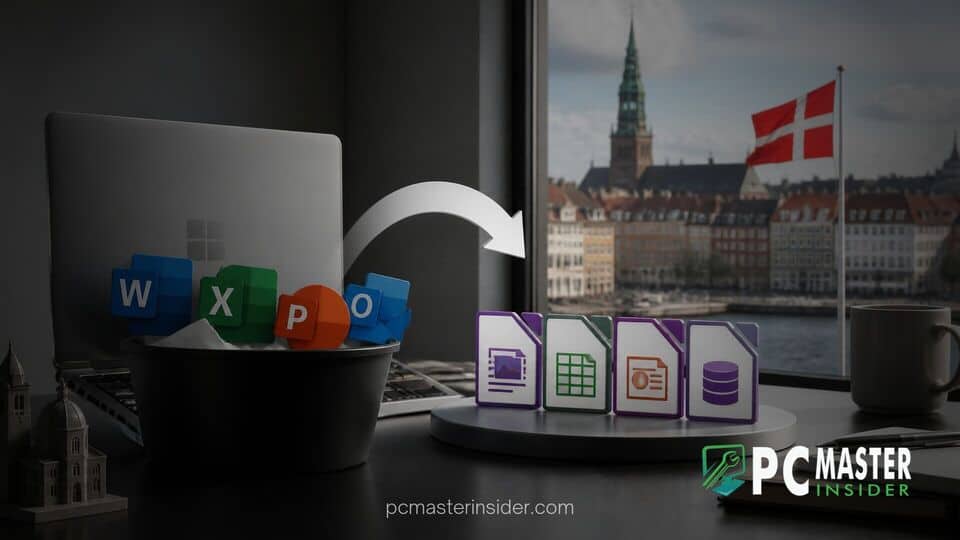
Denmark has quietly ended a government trial aimed at replacing Microsoft Office software with open source alternatives across its public sector. The initiative was designed to bolster European digital sovereignty and curb reliance on foreign software vendors, but officials have concluded the trial without plans to resume it.
The decision marks a notable pause in public sector open source migrations across Europe. It highlights the complex technical hurdles local administrations face when attempting to move away from entrenched proprietary ecosystems like Microsoft 365.
denmark drops microsoft office replacement collabora pilot
The Ministry of Digitalisation confirmed that the experimental phase testing UK-developed Collabora software has officially concluded. Started in mid-2025 with nearly 40 ministry employees, the pilot aimed to assess whether open source tools could serve as a viable full-scale alternative to Microsoft Office inside government departments. Danish software firm cBrain assisted with integration, linking Collabora directly to state case-management workflows. However, project momentum stalled early in 2026, and government representatives confirmed that no formal comparative benchmarking or performance evaluation was completed prior to shutting down the effort.
Termination of Denmark Government Open Source Pilot
The government initiative was originally launched under a broader mandate to strengthen national control over critical software infrastructure and reduce ongoing exposure to foreign licensing policy shifts. Former Digitalisation Minister Caroline Stage Olsen had signaled plans to transition a substantial portion of ministry personnel to open source suites like LibreOffice and Collabora, contingent on operational viability.
The pilot program hit a temporary pause when national general elections were called in early 2026. Following the election, government technology leadership elected not to reactivate the program. Staff members who participated in the trial have since transitioned back to their standard Microsoft Office environment, bringing an unannounced end to the ministry's direct testing of the open source alternative.
Document Formatting Issues Between ODF and OOXML
While the ministry did not publish an official post-mortem, reports indicate that technical friction during document exchanges played a significant role during the active testing period. Civil servants encountered recurring issues with file interoperability when collaborating with internal colleagues and outside partners who remained on standard Microsoft tools.
The root cause stems from structural differences in file standards. Collabora relies heavily on the Open Document Format (ODF), whereas Microsoft software uses the Office Open XML (OOXML) standard. During file conversions, users reported missing text, broken typography, displaced formatting, and corrupted change-tracking data. In extreme instances, importing complex spreadsheets and documents resulted in blank pages.
Similar challenges often occur when modifying default system mechanisms. For instance, administrative work on desktop environments requires seamless backend behavior, much like how clearing Windows 11 Prefetch harms PC performance by interrupting optimized caching routines.
Impact on Government IT Infrastructure and Vendor Lock-In
The cancellation underscores the persistent challenge of vendor lock-in within public administration. Government entities across Europe process millions of historical documents, complex macro-enabled spreadsheets, and standardized templates explicitly crafted for Microsoft applications. Overcoming these legacy dependencies requires dedicated resource allocations for document remediation and user retraining.
For IT administrators, replacing core productivity applications involves deep integration with existing directory structures, security tools, and case management systems. Enterprise platforms like Microsoft Teams continue to expand administrative oversight, including recent updates where Microsoft Teams supports third-party deepfake scanning for corporate security.
When open source platforms fail to provide seamless feature parity or immediate document fidelity, productivity drops can create internal resistance among staff accustomed to established workflows.
Future Outlook for Open Source Desktop Deployments
Denmark's decision to drop the pilot without a final performance score creates uncertainty for other Scandinavian and European public agencies weighing open source migrations. While regional authorities such as the German state of Schleswig-Holstein continue their multi-year push toward Linux and LibreOffice, Denmark's pragmatic pause demonstrates that software independence moves slowly when legacy compatibility remains a daily requirement.
Meanwhile, commercial operating system vendors continue refining enterprise deployments across public and private sectors. Microsoft regularly pushes platform revisions, such as expanding rollout schedules as Windows 11 26H2 reaches full availability, alongside testing desktop shell features where Windows 11 Insider preview adds Start menu size options.
As government organizations continue evaluating software strategies, the balance between strategic software autonomy and day-to-day administrative productivity remains a central debate for IT decision-makers.