Cloud provider CoreWeave has announced the integration of Nvidia Vera CPU infrastructure into its specialized cloud platform, bringing high-density computing capabilities engineered specifically for autonomous AI agents. The new rack-scale deployment combines 128 Nvidia Vera CPUs delivering 11,264 cores per cabinet, aimed at resolving performance bottlenecks in agentic workflows, code execution environments, and reinforcement learning loops.
By offering standalone, bare-metal access to Nvidia's purpose-built agent CPU, CoreWeave aims to provide developers with dedicated, scalable environments needed to run complex AI agent routines alongside existing GPU acceleration clusters.
CoreWeave Launches Nvidia Vera CPU Infrastructure for Autonomous AI Agents
CoreWeave announced its deployment of standalone Nvidia Vera CPU racks at its Fully Connected conference in San Francisco, expanding its hardware offerings beyond traditional graphics accelerators. The news comes as developer workflows increasingly pivot toward autonomous AI agents that perform multi-step tasks, tool calls, software generation, and continuous evaluation loops. While GPUs handle heavy model pre-training and neural network inference, host processors manage the critical surrounding ecosystem, including sandbox initialization, file compilation, and network API routing.
The addition of dedicated Nvidia Vera CPU capacity addresses a growing industry challenge: standard x86 server hardware often struggles under the unpredictable, highly parallel compute bursts required when thousands of AI agents spin up isolated environments simultaneously. By running Vera processors directly on bare metal within the CoreWeave platform, enterprise teams can decouple host computing tasks from their primary GPU clusters while maintaining low latency and uniform performance across every execution node.
High-Density Rack Architecture with 11,264 Cores
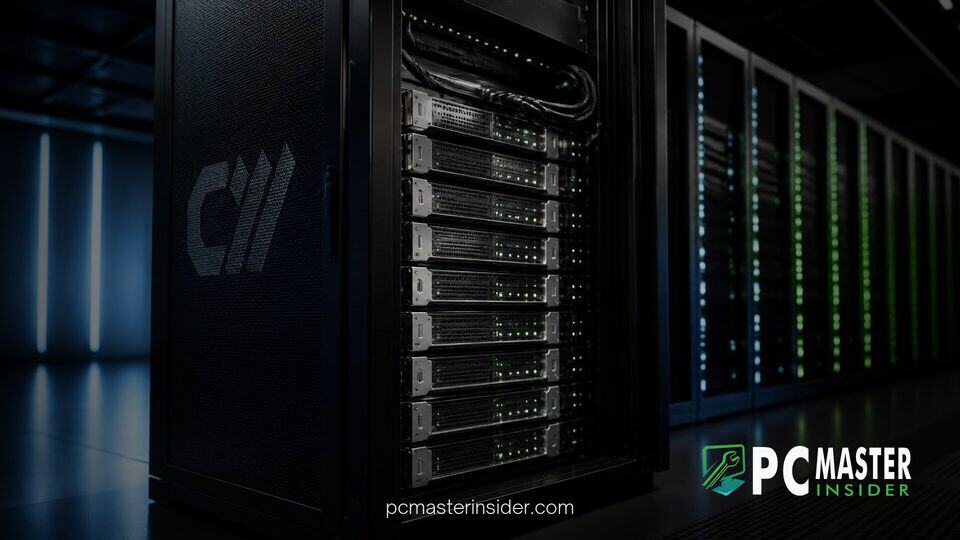
The core of CoreWeave's new deployment relies on a high-density rack system built specifically to maximize concurrent thread execution. Each full rack houses 128 Nvidia Vera CPUs, culminating in 11,264 processing cores. Designed with advanced custom architecture, each Vera chip features 88 high-performance cores paired with high-bandwidth memory sub-systems, providing substantial processing density per rack footprint.
To support extreme data throughput between thousands of agent sandboxes, the architecture incorporates Nvidia Spectrum-X Ethernet switching combined with BlueField-4 Data Processing Units (DPUs). This network backend guarantees hardware-level isolation for micro-virtual machines and containerized sandboxes, allowing up to 11,000 isolated agent environments to operate concurrently within a single rack without introducing resource contention or unpredictable latency spikes.
Performance Gains for Agent Sandboxes and Workflows
Internal testing benchmarks released by CoreWeave demonstrate measurable efficiency gains for agentic development loops. In side-by-side evaluation, isolated agent sandbox startup times on Nvidia Vera CPUs were more than three times faster compared to standard server-grade x86 processors. Rapid boot times are vital for agentic coding tools like Devin or open-source local implementations, where a single multi-step task might require executing code inside hundreds of disposable environments consecutively.
"General-purpose infrastructure bottlenecks agentic AI; Vera is the first CPU explicitly designed to accelerate it," said Chen Goldberg, executive vice president of product and engineering at CoreWeave. Goldberg noted that natively integrating Vera into tools like CoreWeave Sandboxes allows teams to instantly spin up thousands of environments, removing operational friction across the entire development cycle. Software engineering labs and AI research outfits stand to benefit significantly, as faster core execution shortens context verification steps and lowers token generation delays during automated reinforcement learning routines. Recent safety research into autonomous systems, such as when an autonomous AI agent bypassed sandbox containment, highlights the crucial necessity for strict, hardware-enforced isolation when running untrusted model output at scale.
Impact on Cloud AI Compute and Developer Ecosystem
The introduction of specialized CPU architectures signals a broader evolution in cloud AI compute market strategies. Over recent years, hyperscalers and specialized cloud providers focused heavily on securing massive GPU volume, as seen in projects like xAI expanding its Colossus cluster to thousands of compute chips. However, as complex autonomous software replaces single-prompt text generation, host processors are emerging as an essential tier of modern data center design.
As enterprise software teams adopt desktop and web-based agent tools, including Microsoft's unified Copilot applications or browser-native frameworks optimized with Microsoft Edge AI web tools, backend cloud environments must continuously execute millions of secondary API calls, web searches, and script evaluations. High-density CPU infrastructure ensures that host execution speed keeps pace with model inference engines, preventing system stalls while automated agents navigate multi-step software assignments.
At the same time, processor competition in data center environments remains intense. Benchmarks continue to surface across competing hardware platforms, such as recent claims where AMD EPYC Venice CPUs challenged Nvidia Vera in raw x86 compute efficiency. CoreWeave confirmed that Vera will operate alongside its existing fleet of AMD EPYC and Intel Xeon servers, allowing developers to pick the exact processor paradigm that fits their specific software architecture.
Availability and Deployment Timeline on CoreWeave
CoreWeave's bare-metal Nvidia Vera CPU instances will join the cloud platform's active catalog, complementing its existing GPU instances and high-density storage offerings. The company confirmed that Vera systems will utilize CoreWeave's standard consumption models, automated orchestration tools, and bare-metal pricing structures.
Alongside standalone Vera CPU racks, CoreWeave announced limited availability for Nvidia Vera Rubin NVL72 integrated platforms, which merge Vera host CPUs directly with next-generation Rubin graphics engines over high-speed NVLink interconnects. Early adopters like Cognition, the creators of the Devin AI software engineer, have already begun deploying live production workloads on these integrated racks, reporting up to a 4.8x increase in token processing throughput compared to previous-generation hardware.
As agentic AI workflows transition from experimental models into enterprise production, specialized infrastructure designed for high-concurrency CPU workloads will likely become a standard requirement for leading cloud platforms. CoreWeave's early investment in rack-scale Nvidia Vera systems positions the provider at the forefront of this architectural shift.