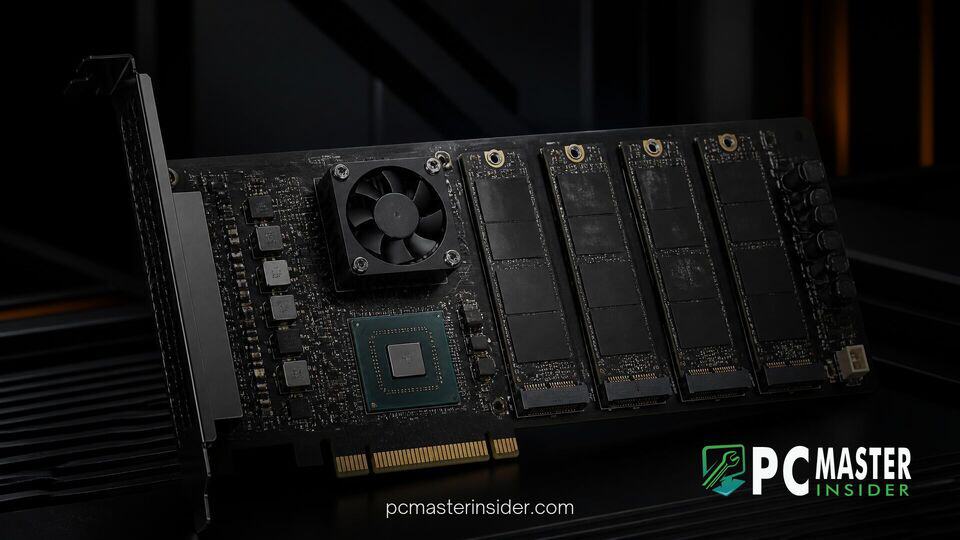
Hardware manufacturer JGINYUE has launched a low-cost PCIe add-in card powered by AMD's B650 motherboard chipset, available for 388 RMB (approximately $58 USD). The versatile card expands a single PCIe Gen4 x4 connection into four M.2 NVMe storage slots alongside high-speed USB ports and 2.5 GbE wired networking.
By leveraging an active motherboard chipset directly on an add-in card, JGINYUE enables extensive connectivity upgrades for desktop systems without relying on motherboard PCIe lane bifurcation. This makes the card an appealing option for custom home server builders, media workstations, and budget-conscious enthusiasts who require high storage density.
b650 pcie expansion card m2 slots
The core innovation behind the new JGINYUE release lies in using AMD's Promontory 21 silicon (commonly known as the B650 chipset) as a standalone peripheral controller. Rather than relying on simple passive trace routing or expensive PCIe switch chips, the board operates as a full secondary controller hub attached directly to the host system via a physical PCIe 4.0 x4 slot.
Because the B650 chipset manages its own downstream links internally, the host system sees a standard PCIe bridge rather than multiple independent drives requiring slot splitting. As a result, users can add up to four M.2 NVMe solid-state drives even on entry-level motherboards that lack native PCIe lane bifurcation support in their BIOS settings.
JGINYUE Adapts B650 Motherboard Chipset for PCIe Storage Card
Modern desktop processors integrate primary system functions like memory controllers and direct PCIe lanes directly onto the CPU die. In AM5 desktop designs, motherboard chipsets essentially act as PCIe-connected input/output multiplexers that generate extra SATA ports, USB headers, and peripheral lanes. JGINYUE takes advantage of this architecture by removing the chipset from its traditional motherboard location and embedding it onto an add-in card.
This design philosophy allows PC builders to bypass the physical storage constraints of compact micro-ATX or Mini-ITX motherboards. Users who want to expand their storage pools no longer need to upgrade their primary system board or purchase expensive enterprise-grade Redundant Array of Independent Disks controller cards.
PCIe Multiplexing and Slot Configuration
The expansion card communicates with the main system via a PCIe 4.0 x4 interface, providing a total uplink bandwidth ceiling of around 8 GB/s. To maximize space on the PCB layout, JGINYUE positioned two M.2 slots on the front face of the expansion board and two additional M.2 slots on the rear.
When running all four storage slots simultaneously, available bandwidth is dynamically distributed among the drives. While peak concurrent throughput across all drives will ultimately be bound by the primary PCIe 4.0 x4 host connection, real-world random read and write performance remains highly responsive for everyday desktop and server workloads.
Expansion Capabilities and Connectivity Options
Beyond its four M.2 drive slots, the card includes an array of peripheral ports accessible from the back panel bracket. The standard $58 configuration includes a 10 Gbps USB Type-C port, two USB 3.0 Type-A ports, and an integrated 2.5 Gigabit Ethernet network controller.
JGINYUE has confirmed plans to expand the lineup with additional product variants. Upcoming iterations are expected to offer 20 Gbps USB Type-C connectivity, an upgraded 10 Gigabit Ethernet network option, a white PCB design, and a low-profile half-height bracket version tailored for slim rackmount chassis.
Performance Considerations and Thermal Requirements
Operating an active B650 chipset along with four high-performance NVMe drives produces noticeable heat and requires stable power delivery. To maintain stability under sustained write workloads, JGINYUE equipped the retail board with a dedicated 6-pin PCIe auxiliary power input. While light drive configurations can draw sufficient power directly from the PCIe slot, connecting the extra 6-pin cable is strongly recommended when populating all four M.2 slots or running power-hungry USB devices.
Thermal management is another critical factor. Users looking to prevent thermal throttling on high-speed solid-state drives can check out our guide on how to monitor and prevent thermal throttling on PCIe 5.0 SSDs. To assist with cooling, JGINYUE added mounting standoffs and an unthrottled 4-pin fan header to the final retail design. This allows builders to attach an optional 40mm cooling fan directly over the chipset heatsink to sustain optimal airflow.
Market Positioning and Practical Storage Upgrade Use Cases
At $58, JGINYUE's offering undercuts competing B650 add-in solutions that previously reached market at significantly higher price points. The lower barrier to entry makes chipset-based expansion cards an attractive alternative to standard NVMe adapter cards that rely on complex BIOS settings.
System builders setting up Network Attached Storage servers, home lab virtualization nodes, or media editing rigs now have a budget-friendly way to scale storage capacity. As memory manufacturers like Kioxia and Sandisk plan massive flash memory expansions to boost flash production, cheap storage expansion cards like this B650 model will help PC builders easily integrate high-capacity drives into aging or compact desktop platforms.
JGINYUE's $58 B650 card offers an innovative, budget-conscious solution for users needing extra M.2 slots and I/O options without replacing their primary motherboard. Its broad motherboard compatibility and flexible expansion capabilities set a compelling precedent for future PC storage accessories.