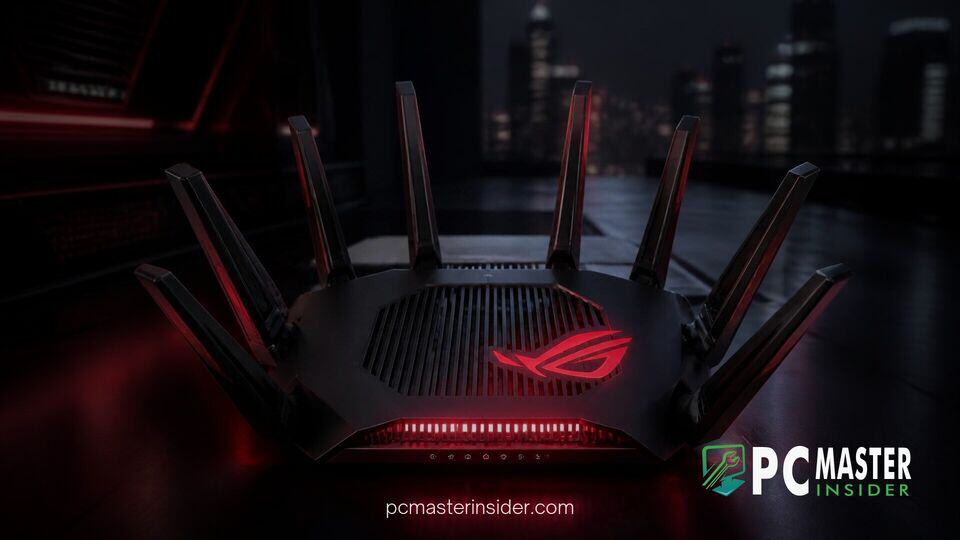
ASUS has officially started shipping the ROG Rapture GT-BN98, marking the commercial release of its newest flagship quad-band networking platform built around next-generation wireless architectures. Designed specifically for high-demand competitive gaming, heavy local network traffic, and real-time streaming, the router combines massive wireless capacity with extensive high-speed wired connectivity.
Equipped with native support for the emerging Wi-Fi 8 standard (IEEE 802.11bn), multi-gigabit Ethernet backhaul options, and dedicated game acceleration suites, the new GT-BN98 targets enthusiast users requiring maximum bandwidth stability under dense multi-device workloads.
ASUS ROG Launches Next-Gen Rapture GT-BN98 Gaming Router
The arrival of the ASUS ROG Rapture GT-BN98 WiFi 8 gaming router represents a major hardware step forward for high-end home networking, expanding beyond the capabilities of previous Wi-Fi 7 flagships. Built on a massive quad-band architectural chassis, the router is engineered to manage extreme client density while maintaining minimal signal congestion and deterministic, low-latency delivery across simultaneously connected devices.
As modern gaming setups increasingly rely on high-bandwidth network pipelines for cloud gaming, high-framerate local streaming, and massive file downloads, network infrastructure requirements have shifted rapidly. The GT-BN98 addresses these heavy bandwidth demands directly by incorporating high-throughput processing hardware and expanded channel allocations that ensure localized wireless traffic rarely suffers from packet jitter or unexpected latency spikes.
Key Innovations Behind WiFi 8 Architecture
While Wi-Fi 7 introduced 320 MHz channel widths and 4K-QAM modulation, the Wi-Fi 8 framework deployed in the GT-BN98 prioritizes Ultra High Reliability (UHR) alongside refined physical layer efficiencies. By leveraging dynamic multi-link operations (MLO) and multi-access point coordination, the router can dynamically shift traffic across its four operational bands (2.4 GHz, dual 5 GHz bands, and 6 GHz) to bypass physical obstacles and RF interference in real time.
These architectural refinements ensure that high-priority gaming streams maintain uninterrupted transmission packets, even when background devices conduct heavy operations such as downloading 4K video streams or processing local network backups. For users deploying high-bandwidth streaming configurations like the Steam Beta Pyrowave codec for Remote Play, the GT-BN98 provides the sustained throughput needed to eliminate frame drops and transmission delays.
Hardware Specifications and Wired Multi-Gigabit Ports
Under the hood, the ROG Rapture GT-BN98 is powered by a high-performance quad-core 2.6 GHz 64-bit processor paired with 2GB of DDR4 RAM and ample flash memory to handle advanced routing tables, deep packet inspection, and localized security suites. The physical chassis retains the aggressive Republic of Gamers styling with custom external antenna arrays designed to maximize spatial beamforming and signal range across multi-story environments.
The physical port layout is equally focused on high-bandwidth wired infrastructure. The router features dual 10 Gigabit Ethernet (10GbE) ports capable of functioning as WAN or LAN interfaces, alongside four 2.5 Gigabit Ethernet ports and standard 1 Gigabit LAN connectors. This comprehensive port topology allows power users to connect high-speed network-attached storage (NAS) devices, workstation PCs, and next-generation gaming rigs with full 10G wired backhaul speed.
With hardware specs expanding across all desktop categories, such as systems requiring high memory allocations as documented in recent reports where 32GB system RAM overtakes 16GB on Steam, the router ensures that local network pipelines never act as a bottleneck for modern data-heavy installations.
Adaptive QoE and GTNet Traffic Management Features
To ensure competitive advantage during online multiplayer matches, ASUS has integrated its updated ROG Gaming Network (GTNet) acceleration engine. The firmware automatically detects connected gaming hardware, prioritizing network packets originating from recognized consoles, handheld gaming PCs, and primary desktop systems over standard web browsing or smart home background chatter.
The router also features Adaptive Quality of Experience (QoE) protocols that dynamically allocate bandwidth based on application signatures. Multi-level game acceleration operates across three distinct tiers: device-level port prioritization, software-level application packet tagging, and direct routing optimizations that connect users to short-path server routes to reduce ping times to online game hosts.
Availability and Market Impact for High-Performance Gaming
The ASUS ROG Rapture GT-BN98 has officially entered full regional shipping through authorized retail partners, online hardware distributors, and the official ASUS store network. While initial availability may be limited by region due to high enthusiast demand, global distribution is expected to expand rapidly over the coming weeks.
Industry reaction highlights the router as a critical bridge for enthusiasts preparing their home networks for next-generation hardware deployments. As cloud streaming services like Xbox Cloud Gaming face changing platform access rules, including recent service adjustments where Xbox imposes monthly playtime hour limits on cloud gaming, having reliable and low-latency home Wi-Fi infrastructure becomes paramount for gamers utilizing direct local game streaming and hybrid remote playback platforms.
Furthermore, early hardware deployments showcase how enterprise-grade wireless standards are making their way into consumer products faster than ever before. With chipmakers rolling out advanced Wi-Fi 8 gateway chips across broadband infrastructure, as seen with MaxLinear's Puma 9 DOCSIS platform featuring Wi-Fi 8 support, flagship routers like the GT-BN98 set a high bar for home networking performance.
In summary, the commercial release of the ASUS ROG Rapture GT-BN98 sets a high watermark for enthusiast networking hardware, providing extreme wireless bandwidth, robust wired connectivity, and targeted software optimizations designed to satisfy the strict performance demands of modern gaming environments.