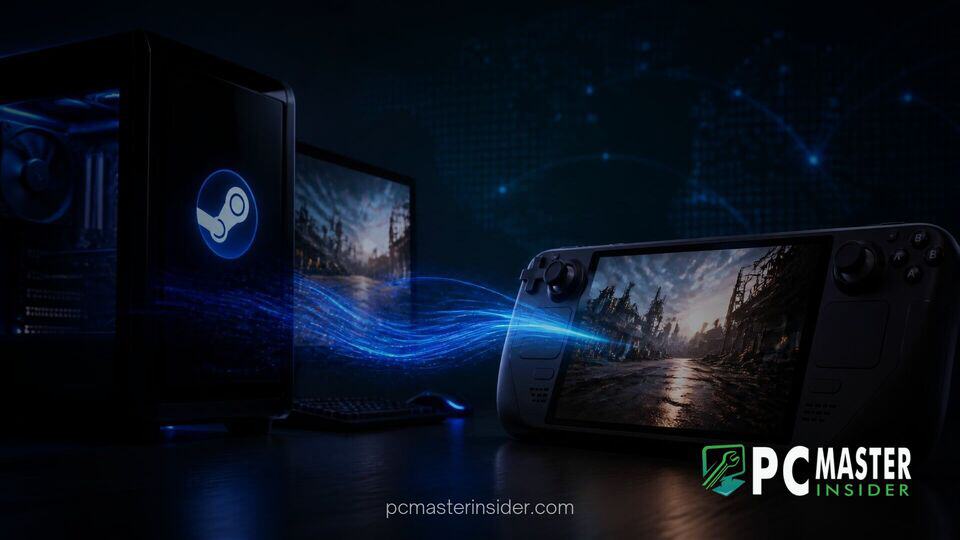
Valve has updated the Steam Beta client with an experimental video codec designed to significantly reduce latency during local game streaming. The newly integrated Pyrowave codec prioritizes instantaneous response times and crisp visual fidelity by utilizing significantly more local network bandwidth than standard streaming codecs.
Engineered for high-throughput local area networks, Pyrowave trades transmission efficiency for minimal frame processing delay. The opt-in feature is available for desktop users participating in the Steam Client Beta on Windows, macOS, and Linux.
Steam Remote Play Gains Experimental Pyrowave Video Codec
Valve introduced the Pyrowave codec to the Steam Beta channel as a dedicated solution for local game streaming latency. Developed by graphics programmer Hans-Kristian Arntzen, known for his work on the VKD3D-Proton translation layer, the codec operates on a fundamentally different principle than mainstream video compression formats like H.264, HEVC, or AV1 video decoding solutions.
Traditional streaming codecs compress video by calculating motion prediction vectors across a sequence of frames. While this approach keeps network traffic light, computing inter-frame dependencies introduces measurable encoding and decoding overhead. Pyrowave bypasses motion prediction entirely, treating every video frame as an independent image through an intra-only wavelet transform. By offloading lightweight compression work directly to Vulkan compute shaders, GPU encoding latency can drop to less than 0.1 milliseconds.
How Pyrowave Reduces Streaming Latency
By eliminating temporal inter-frame dependencies, Pyrowave removes the primary computational bottleneck found in remote play pipelines. The host graphics card renders and compresses each frame in a single, parallelized pass before firing it directly across the local network. The client system decodes the stream using similarly lightweight GPU pipelines, eliminating inter-frame buffers.
This architecture results in end-to-end input response times that closely mirror native gameplay. In addition to lower latency, the codec maintains exceptional image clarity. Pyrowave supports uncompressed YUV 4:4:4 color precision, eliminating the color bleeding and soft text artifacts commonly seen in 4:2:0 chroma-subsampled video streams. High Dynamic Range (HDR) passthrough is also fully supported when both the host PC and receiving display support HDR output.
Hardware and Network Requirements
The primary compromise of Pyrowave is its heavy network footprint. Valve notes that the codec can consume anywhere from five to ten times more bandwidth than traditional streaming methods, with configurable throughput settings ranging from 100 Mbps up to 500 Mbps.
Because of these high data rates, Valve strongly advises running Pyrowave over a full Gigabit Ethernet wired network. Conventional Wi-Fi connections, including older 5 GHz wireless setups, may struggle with packet loss or congestion under such heavy traffic. If the underlying network infrastructure lacks the necessary throughput, users will likely experience frame drops rather than latency improvements.
How to Enable Pyrowave Codec in Steam Beta Settings
Gamers interested in testing the feature must first opt into the Steam Client Beta on both the host and client computers. This can be configured by navigating to Steam Settings, selecting the Interface tab, and changing the Client Beta Participation option.
Once the client updates and restarts, users can access the new option inside the Steam Remote Play menu:
- Open Steam Settings on the client system.
- Navigate to the Remote Play section.
- Select Advanced Client Options.
- Locate the video codec selection dropdown and choose Pyrowave.
- Adjust the target bandwidth slider according to your local network capacity, up to 500 Mbps.
Linux users must additionally enable the experimental SteamRT3 runtime within their system settings to access Pyrowave rendering pipelines. On platforms like macOS and Windows, the feature is functional directly within the standard beta branch.
Impact on Local Game Streaming and Future Rollout
For PC gaming enthusiasts, input lag has historically been the biggest barrier to adopting in-home game streaming. While platforms like Moonlight and Sunshine have gained popularity by optimizing traditional codecs, Valve’s inclusion of Pyrowave offers an alternative built around raw network capacity rather than compression efficiency.
This technical direction mirrors wider hardware trends across the PC ecosystem, where high-speed local networking is becoming standard while local processing components face tight market conditions. As hardware costs fluctuate, including surging DDR5 RAM prices affecting system upgrades, leveraging existing high-performance host PCs to stream to lightweight client devices remains a compelling setup.
Valve confirmed that while Pyrowave is currently limited to desktop clients on Windows, macOS, and Linux, support for the standalone Steam Link mobile app and other client platforms is currently in development. As testing continues in the beta channel, further adjustments to bandwidth management and codec efficiency are expected prior to a full public release.