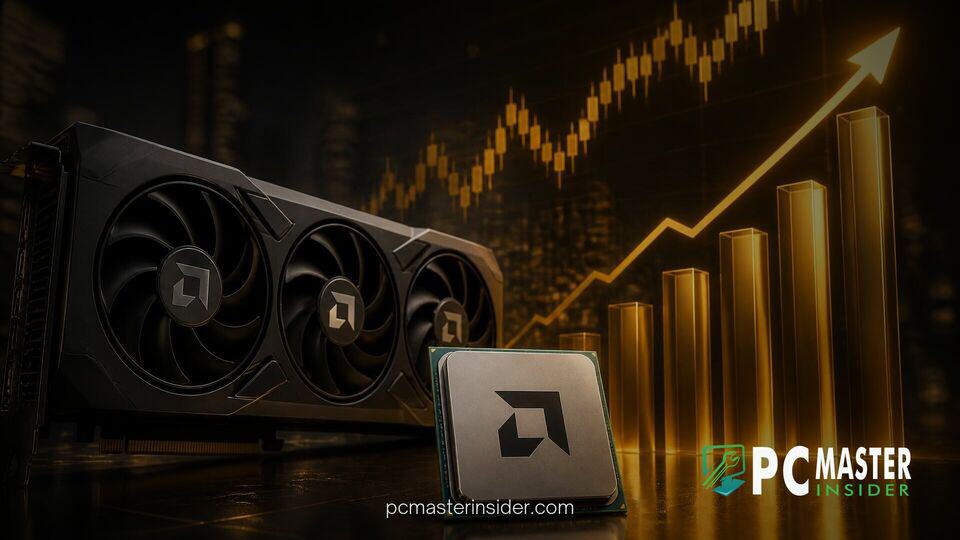
Semiconductor giant Advanced Micro Devices (AMD) officially crossed the $1 trillion market capitalization threshold on Monday as its stock price surged past $600. The historic rally came during a multi-session winning streak that saw shares climb nearly 10 percent in a single day, briefly touching an intraday high of $615.52.
The milestone places AMD in an exclusive tier of global semiconductor leaders alongside companies like NVIDIA, Broadcom, and TSMC. Driven by record-breaking adoption of enterprise server hardware and hardware for artificial intelligence, AMD's stock has surged over 180 percent in 2026 alone.
AMD Reaches Historic $1 Trillion Market Capitalization
The achievement marks a dramatic multi-year turnaround for the Santa Clara, California-based chip manufacturer. Over the course of the year, strong institutional interest in high-performance computing and enterprise data center components has propelled AMD out of its traditional challenger role into an industry juggernaut. The company's recent rally was further ignited by accelerating demand for server computing power capable of hosting continuous, autonomous AI agent workflows.
Wall Street analysts point to booming quarterly revenue as a major structural driver of the valuation. AMD reported second-quarter revenue of $11.54 billion, representing a 50 percent increase compared to the same period in the prior year. Its Data Center business unit led the charge, generating $6.7 billion in revenue and marking a 107 percent year-over-year expansion. As tech infrastructure providers expand their physical computing capability, global AI spending is projected to exceed $1 trillion in 2026, giving top hardware vendors continuous momentum.
Data Center Demand and Hardware Growth Drive Stock Rally
At the heart of AMD's recent share momentum is the enterprise adoption of its EPYC server CPUs and Instinct series hardware. While graphics processing units have dominated AI headlines, enterprise infrastructure managers have increasingly focused on the vital role central processors play in orchestrating and managing large-scale node deployments.
Recent market reports indicate that the computing architecture ratio in next-generation inference systems is shifting heavily back toward robust central processors. Wall Street investment firms recently revised their long-term central processing unit market estimates upward to account for autonomous agent systems, which operate around the clock executing background processes like code execution and database queries.
This massive infrastructure ramp-up comes despite broader hardware cost pressures across the supply chain. High demand and tight supply have led to price adjustments across the industry. For instance, AMD announced selective price increases across GPUs and chipsets in late 2026 while keeping consumer desktop processor prices steady, signaling strong pricing power in commercial channels. Meanwhile, memory component costs have soared to historical peaks, as reflected in South Korea DRAM export prices reaching record highs driven by high-density enterprise memory modules.
How AMD Outpaced Competitors in the High-Performance Sector
AMD's steady market share gains against legacy market leader Intel have been central to its long-term enterprise strategy. Through successive generations of Zen architecture, AMD delivered superior power efficiency and core density, earning key design wins with world-leading cloud hyperscalers like Microsoft, Meta, and Google.
Additionally, AMD's next-generation server platform details whitepapers have demonstrated major performance improvements. Benchmark previews show upcoming enterprise silicon delivering significant processing advantages over competing server chips, giving enterprise clients confidence in long-term deployment roadmaps. Competitors have responded with their own pricing and architectural adjustments, as Intel prepared price increases across PC processors to bolster margins while racing to update its own server portfolio.
Crossing the $600 per share price mark also holds structural importance for AMD's strategic commercial partnerships. Major technological agreements struck with leading artificial intelligence research labs and major cloud providers included equity warrant tranches tied directly to stock price hurdles and gigawatt-scale hardware deployment milestones. Surpassing these stock valuation targets unlocks expanded commercial ties and deeper co-engineering efforts.
What the $1 Trillion Milestone Means for Future PC Hardware
For everyday PC enthusiasts, gamers, and system builders, AMD's massive corporate valuation provides financial security and substantial research and development backing for its consumer platforms. Revenue generated by high-margin data center silicon directly funds future consumer desktop and laptop innovations, ensuring healthy competition in consumer computing.
However, the broader hardware market faces challenges from rising component expenses. The massive diversion of semiconductor wafer production toward enterprise hardware has strained memory and motherboard supply chains. Consumers are already feeling the pinch from rising memory expenses, as seen when DDR5 RAM prices reached unprecedented heights due to high enterprise memory demand.
Despite these supply challenges, AMD's executive team remains confident that the company's dual focus on data centers and consumer systems provides a resilient foundation. AMD Chief Executive Officer Lisa Su previously stated to investors that data center operations have become the primary engine of profitability, giving the company flexibility to navigate supply chain fluctuations across consumer retail sectors.
With AMD now firmly established in the $1 trillion market cap club, investors and technology industry observers alike will be closely watching upcoming earnings disclosures to see if market demand and software ecosystem expansion can sustain this dramatic valuation growth over the long term.