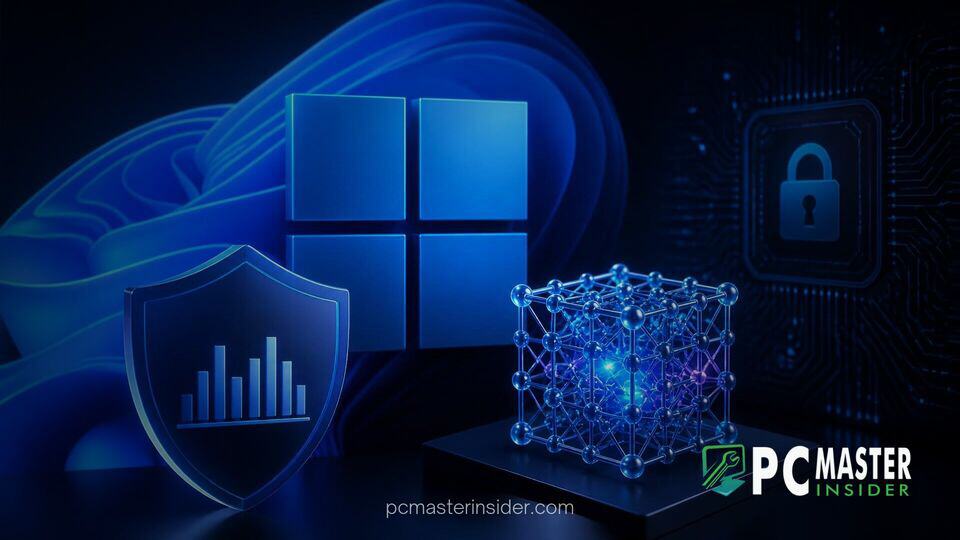
Microsoft has officially released the Windows 11 2026 Update, designated as Windows 11 version 26H2, introducing core architectural changes focused on enterprise security, incident detection, and long-term cryptographic resilience. Delivered as an enablement package for existing Windows 11 installations, the update brings native event tracing capabilities alongside quantum-resistant cryptographic algorithms directly into the operating system.
The release marks a significant consolidation of Microsoft's security tooling, shifting standalone Sysinternals utilities and experimental defense frameworks into core Windows components. IT administrators can now leverage kernel-level system monitoring and post-quantum encryption standards without deploying third-party agents or applying external patches.
Enterprise Security Enhancements in Windows 11 26H2
The core focus of Windows 11 version 26H2 centers on system hardening and rapid threat response. Rather than relying entirely on reactive antivirus measures, the update integrates advanced logging and future-proof encryption directly into the base operating system binaries.
Built-In Sysmon Threat Detection Capabilities
System Monitor (Sysmon), long a mainstay of security operations teams as part of the Sysinternals suite, is now directly integrated into the Windows 11 architecture. The native service provides granular logging of system activity, including process creations, network connections, file creation time changes, and driver load events, writing these logs directly to the standard Windows Event Log interface.
By default, built-in Sysmon remains disabled to conserve system resources and preserve user privacy on unmanaged endpoints. IT teams can activate and manage the service across managed fleets using Microsoft Intune or Group Policy objects. The built-in implementation fully supports custom XML configuration files, allowing analysts to apply standard threat hunting rules such as those from the popular SwiftOnSecurity repository to filter noise and capture high-fidelity telemetry for Security Information and Event Management (SIEM) ingest.
Post-Quantum Cryptography Algorithm Support
Preparing enterprise networks for future quantum computing threats, Windows 11 26H2 introduces native API support for National Institute of Standards and Technology (NIST) standardized post-quantum cryptography (PQC) algorithms. The update implements FIPS 203 (ML-KEM, derived from CRYSTALS-Kyber) for key encapsulation and FIPS 204 (ML-DSA, derived from CRYSTALS-Dilithium) for digital signatures.
These algorithms are exposed through the Windows Cryptography API: Next Generation (CNG) framework and the .NET runtime, enabling developers and security applications to execute quantum-safe key exchanges, signatures, and decryption operations. Furthermore, ML-KEM can now be negotiated as a standalone algorithm for Transport Layer Security (TLS) handshakes, shielding sensitive network traffic against "harvest now, decrypt later" attack strategies. This deployment builds on Microsoft's broader cryptographic roadmap, following early enterprise ISO distributions like the Windows 11 26H2 Enterprise evaluation builds released earlier this year.
System Management and Access Controls
Alongside event logging and quantum protection, version 26H2 refines how local system administrative rights are managed and isolated from untrusted processes.
Administrator Protection and Privilege Elevation
To mitigate persistent elevation-of-privilege vectors, Microsoft has refined Administrator Protection in version 26H2. The security feature ensures that users belonging to the local Administrators group operate in a de-privileged state by default. When an administrative action is triggered, the OS grants just-in-time privileges using a hidden, profile-separated system context authenticated via Windows Hello.
This design enforces isolation between standard user sessions and temporary elevated contexts, preventing malware running in a user workspace from hijacking standing administrative tokens. System administrators can toggle and configure Administrator Protection policies through Intune or centralized Group Policy configurations.
Smart App Control and Enhanced Sign-In Security
Windows 11 26H2 improves usability for application isolation mechanisms. Smart App Control (SAC), which utilizes cloud-powered intelligence and code-signing requirements to block untrusted or malicious software, can now be toggled on or off without requiring a full clean reinstallation of the operating system.
Biometric security also receives a hardware extension. Windows Hello Enhanced Sign-in Security (ESS) now extends hardware-isolated biometric processing to compatible external peripheral fingerprint readers. This expansion allows desktop workstations and docked Copilot+ PCs to utilize enterprise-grade, memory-isolated biometric authentication previously restricted to integrated laptop hardware.
Simultaneously, kernel-level defense is enforced through updated driver trust mechanisms. The Windows kernel no longer trusts cross-signed third-party drivers by default, strictly requiring validation through the Windows Hardware Compatibility Program (WHCP) or inclusion on a designated list of trusted legacy drivers.
Deployment Tools and Policy Configurations
For deployment management, Windows 11 26H2 introduces several operational enhancements designed to streamline OS rollouts and system recovery:
- Windows Autopilot Device Association: Enables organizations to verify device identity prior to enrollment, applying targeted policies automatically during Out-of-Box Experience (OOBE) provisioning.
- Expanded Settings Restore: Expands first-sign-in settings and app restore functionality to Microsoft Entra hybrid-joined devices, Cloud PCs, and multi-user environments.
- Point-in-Time System Restore: Provides an integrated recovery mechanism allowing administrators to roll back system states, installed applications, and configuration files to automatic restore points without data loss.
- Policy-Based App Removal: Gives enterprise IT teams centralized control to clean preinstalled inbox applications across Enterprise and Education SKUs.
These infrastructure changes arrive alongside everyday OS updates, including enhanced archive format support in File Explorer, improved search indexing, and performance monitoring additions in Task Manager. As Microsoft continues phasing out legacy software components, organizations evaluating version 26H2 should also account for broader platform changes, such as hardware adjustments for legacy architectures like Snapdragon 850 devices.
Windows 11 version 26H2 is currently rolling out globally via Windows Update for eligible devices, with enterprise deployment controls available through Windows Server Update Services (WSUS) and Microsoft Intune.