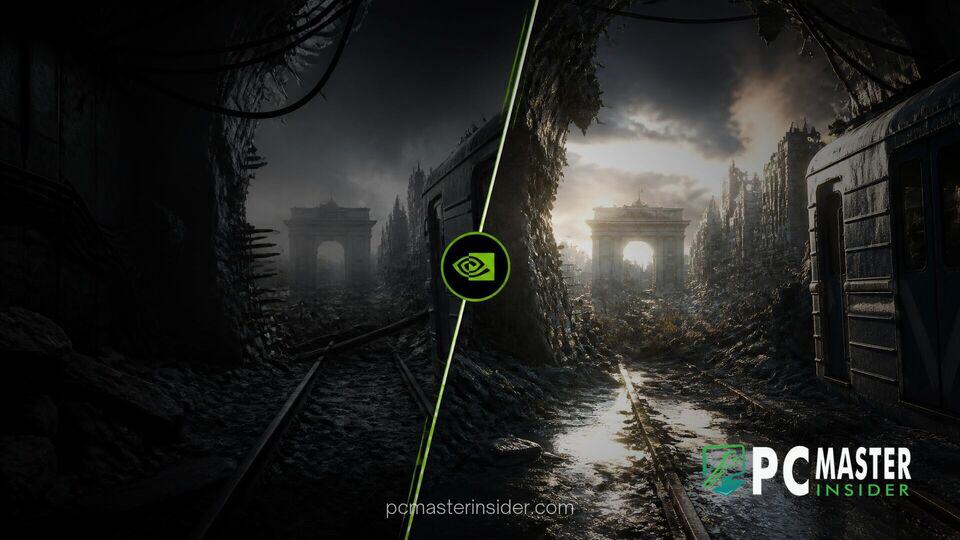
Developer 4A Games and publisher Deep Silver have released a comprehensive Next-Gen Update for Metro 2033 Redux and Metro: Last Light Redux. The patch introduces support for Nvidia DLSS 5 neural rendering alongside uncapped frame rates, 4K texture support, and spatial audio.
This surprise release updates the classic atmospheric shooter to run smoothly on modern hardware, featuring native integration for upscaling tech and stability improvements for modern platforms.
metro 2033 redux dlss 5 update
The latest metro 2033 redux dlss 5 update modernizes the 2014 title by integrating Nvidia's latest neural rendering features into its graphics pipeline. Players running compatible Nvidia GeForce RTX hardware can now toggle neural rendering options alongside standard deep learning super sampling modes. The update also adds support for AMD FSR and 4A TSR (Temporal Super Resolution), providing cross-vendor scaling solutions for all PC configurations.
Alongside upscaling tech, the patch increases geometric and texture details while implementing updated Physically Based Rendering (PBR) materials and Screen Space Global Illumination. These graphical upgrades refine lighting and reflection accuracy across the subterranean tunnels of the Moscow Metro. Furthermore, the developers removed the legacy frame rate cap, letting players leverage high-refresh-rate displays without encountering physics speed bugs.
Metro 2033 Redux Next-Gen Patch Introduces DLSS 5 Neural Rendering
The headline feature of the patch is the addition of Nvidia DLSS 5 neural rendering technology. This new setting leverages deep learning models to process character facial details, skin shading, and fine geometry at runtime. Early visual testing shows that enabling neural rendering under DLSS significantly sharpens character models, bringing new fidelity to non-player characters and story cinematics.
This release makes Metro Redux one of the earliest titles to officially implement DLSS 5 neural features. While community mods like DLSS 5 mods on AMD Radeon GPUs have experimented with cross-platform neural execution, official native developer support ensures higher stability and tighter integration with the game's internal rendering engine.
Key Performance and Graphical Upgrades in the Latest Patch
In addition to upscaling and lighting enhancements, 4A Games delivered a long list of technical fixes aimed at modern operating systems. Players running Windows 11 configurations previously reported startup crashes, freeze screens, and infinite loading loops. The patch directly resolves these startup issues, driver-level black screens, and chapter transition crashes on recent GPUs.
The full changelog includes the following key features and fixes:
- Upscaling & Neural Tech: Support for Nvidia DLSS 5 with Neural Rendering, AMD FSR, and 4A TSR.
- Visual Enhancements: Screen Space Global Illumination, 4K texture support, higher geometry detail, and upgraded PBR materials.
- Display & Performance: Unbound frame rates and fixes for high-FPS physics glitches.
- Audio Improvements: Enhanced spatial audio support and overall sound quality upgrades.
- Input & Controller Features: DualSense adaptive trigger support, Xbox controller impulse trigger feedback, and fixed mouse vertical/horizontal sensitivity scaling.
- Stability Fixes: Resolved crashes on startup, level transitions, gas mask interactions, and high-refresh-rate displays.
How DLSS 5 Neural Rendering Enhances Visual Quality
DLSS 5 neural rendering operates by replacing traditional rasterized shaders for specific surface assets with real-time neural network inference. In Metro 2033 Redux, this approach focuses on complex organic geometry and materials, such as facial skin textures, cloth folds, and subtle ambient lighting interaction. By allowing a neural network to reconstruct sub-pixel detail, the game avoids the temporal shimmering and blur often associated with older anti-aliasing methods.
Combined with AMD FSR upscaling features available for non-Nvidia hardware, PC gamers across various platforms gain access to modern performance tools. The implementation also addresses persistent legacy bugs like flickering shadows, broken post-processing effects, and white halos around illuminated objects.
Current Game Support and Nvidia DLSS 5 Expansion Plans
The quiet inclusion of DLSS 5 neural rendering in Metro 2033 Redux underscores a broader industry push toward AI-assisted graphics techniques. While studios typically reserve major upscaling iterations for upcoming blockbuster releases, retrofitting classic titles provides a testbed for neural rendering efficiency on existing graphics hardware.
Similar graphics optimizations have surfaced across recent software updates, ranging from game engine patches to broader OS performance tweaks like Windows 11 game crash fixes. PC players who own Metro 2033 Redux on Steam, Epic Games Store, or GOG can download the Next-Gen Update for free starting today.
By combining neural rendering tech with comprehensive bug fixes, 4A Games has ensured that one of PC gaming's premier atmospheric franchises remains technically relevant on modern hardware.