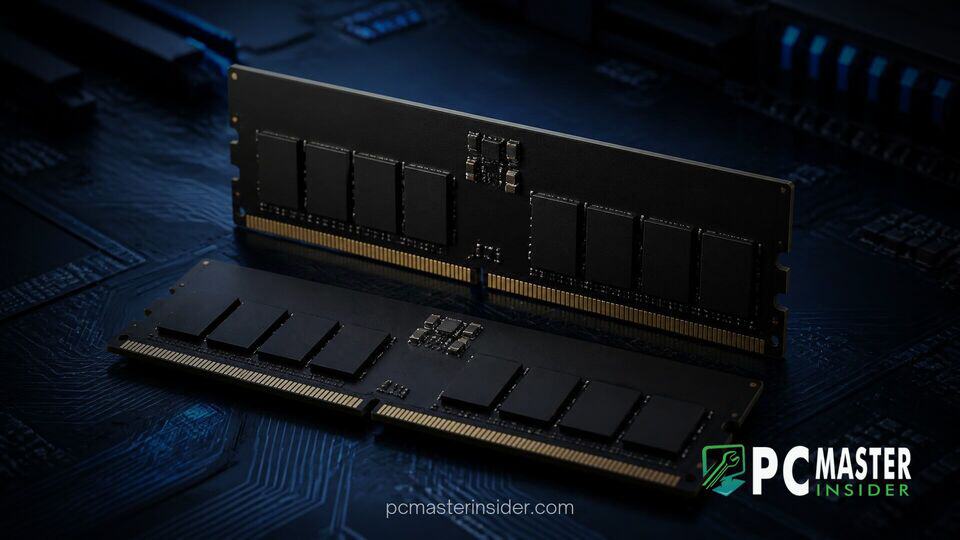
The JEDEC Solid State Technology Association has published an official early preview of its next-generation DDR6 DRAM standard. The upcoming memory specification introduces a 96-bit data bus, transfer rates starting at 12.8 GT/s, and a physical module length that is 44 percent shorter than current DDR5 modules.
Designed to address the steep data demands of artificial intelligence, cloud servers, and high-performance computing, the preview outlines major structural updates. JEDEC expects DDR6 to deliver over 50 percent more memory bandwidth than DDR5 at its initial release, with further performance scaling planned over time.
JEDEC Unveils Early Specifications for DDR6 Memory
The microelectronics industry standards body released technical outlines detailing the directional development of the DDR6 standard. While the specifications remain subject to change prior to formal approval, the preview provides concrete details regarding how system memory will evolve in the coming years.
Demand for higher memory density and faster data pipelines has accelerated rapidly, largely driven by enterprise AI inference and complex computing workloads. Industry announcements highlight how expanding local AI processing across client and server environments requires fundamentally redesigned system memory subsystems. To support these compute needs, JEDEC is restructuring both the electrical architecture and physical form factor of system DRAM.
Higher Transfer Speeds and 96-Bit Bus Width
The headline technical change in the JEDEC DDR6 preview is a fundamental expansion of data pathways. Moving away from the long-standing 64-bit data bus per module used in previous generations, DDR6 expands the bus width to 96 bits (96 DQ). This 50 percent increase in width allows more data to be transmitted simultaneously during every clock cycle.
Transfer speeds are also taking a substantial step forward. DDR6 Registered DIMMs (RDIMMs) will begin at a baseline transfer rate of 12.8 GT/s, compared to the official JEDEC DDR5 RDIMM baseline target of 9.2 GT/s. The official roadmap extends to 14.4 GT/s and beyond for future iterations. Combined with the 96-bit data bus, the initial baseline configuration is designed to yield up to 153.6 GB/s of total module bandwidth, representing a fourfold increase over original baseline DDR5 speeds.
44 Percent Shorter Form Factor for RDIMM and CAMM2
Beyond internal data pathways, JEDEC is introducing dramatic changes to physical memory dimensions. Standard DDR5 modules measure 133 mm in length, whereas DDR6 memory modules are being defined at a length of 74 mm. This represents a 44 percent reduction in overall length.
The shorter module design allows server motherboard designers and system integrators to fit more memory slots into tight server chassis footprints. JEDEC confirmed that DDR6 is being defined across multiple physical form factors, including traditional RDIMM, unbuffered UDIMM, and modular CAMM form factors. The compact module dimensions will facilitate higher overall system density without compromising motherboard routing efficiency.
Architecture Improvements and Power Efficiency
To support higher data rates without introducing severe signal degradation or excessive heat, DDR6 incorporates major architectural alterations. The standard moves to a pseudo-channel architecture that divides memory access into smaller sub-channels. Instead of two 32-bit sub-channels per module as seen in DDR5, DDR6 implements four 24-bit sub-channels, providing greater flexibility for system-level Error-Correcting Code (ECC) and efficient data routing.
To avoid bottlenecks inside the DRAM die, JEDEC is doubling the bank count compared to DDR5, moving from 32 to 64 independent memory banks. This doubling of available banks, paired with refined refresh algorithms, maximizes data bus utilization during heavy memory read and write operations.
Power efficiency improvements are also baked into the early draft. DDR6 transitions to VSS-terminated I/O signaling, which significantly improves signaling integrity and performance-per-watt. Data center specific low-power states are being integrated directly into the specification to curb overall system power draw during idle or partial-load scenarios. Meanwhile, individual DRAM die capacity will scale up to 128 Gb (16 GB per die), enabling multi-terabyte capacity modules through advanced 3D die stacking technologies. Industry research into wafer bonding and advanced lithography for DRAM will play a crucial role in bringing these 128 Gb density targets to commercial production.
Impact on Future Consumer PC and AI Server Workloads
The performance profile of DDR6 is primarily designed to relieve memory bandwidth bottlenecks in modern computing clusters. Large language models and enterprise generative AI workloads rely heavily on fast memory transfer speeds to keep processing units fed with data. Expanding the memory bus width to 96 bits per module provides direct throughput benefits for memory-bound tasks.
For client platforms, such high memory bandwidth is expected to significantly enhance integrated graphics performance and high-core-count desktop processors. As hardware manufacturers push specialized silicon features like desktop local AI ecosystems and multi-core processor architectures, memory bandwidth must scale proportionally to prevent hardware stalls.
Workstation and server platforms will benefit immediately from the increased density and reliability features. Flexible system-level ECC options will allow system architects to balance raw error correction capability against power consumption and overall module cost.
Expected Timeline for DDR6 Standard Finalization and Rollout
While JEDEC's preview offers clear technical direction, DDR6 remains an evolving draft. JEDEC has not yet established a finalized date for the official specification release, nor has it given a definitive timeline for initial commercial hardware.
Industry projections suggest that formal finalization of the specification could take place around 2027, with initial enterprise deployment targeted for 2028 or 2029. Server platforms and enterprise data centers will be the first adopters of DDR6 RDIMMs, with consumer client platforms following later. Until then, DDR5 will remain the dominant memory standard across both server and consumer PC architectures.
JEDEC's early preview confirms that DDR6 will bring one of the most substantial structural overhauls to socketed system memory in decades, combining wider bus channels, compact physical dimensions, and massive bandwidth expansion.