
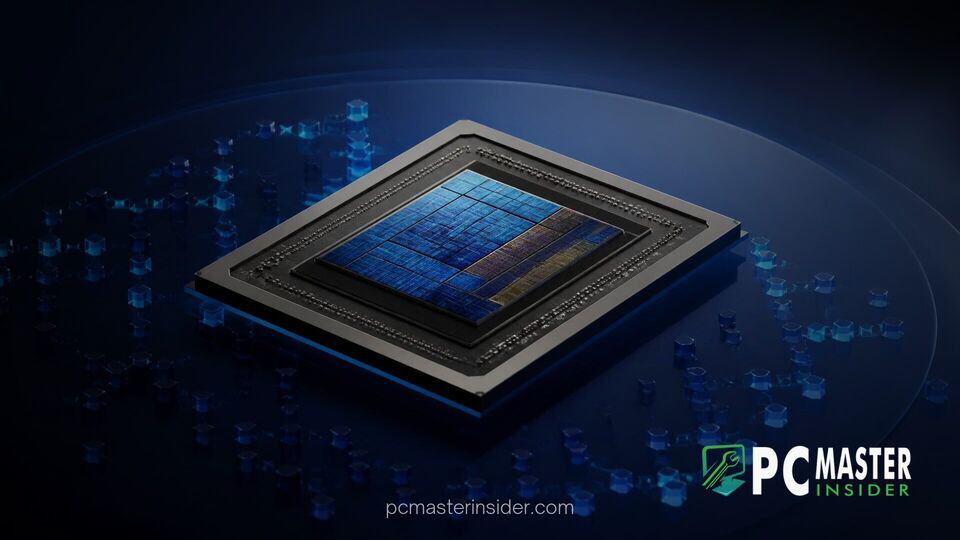
At the annual Hot Chips symposium, Intel shared detailed architectural specifications for its upcoming Crescent Island AI accelerator, a silicon package engineered specifically for high-efficiency artificial intelligence workloads. Designed to balance thermal constraints with dense matrix compute capability, the new accelerator targets high-density data center deployments and edge-computing infrastructure where low power consumption is paramount.
Engineers at Intel revealed that Crescent Island focuses heavily on maximizing performance per watt rather than pushing raw thermal envelopes to extreme levels. The chip incorporates optimized execution pipelines alongside a streamlined memory topology tailored for real-time model inference and lightweight training tasks.
Intel Crescent Island AI Accelerator Hot Chips Architectural Breakdown
During its presentation covering the Intel Crescent Island AI accelerator at Hot Chips, the company highlighted a multi-faceted design built from the ground up to solve modern memory bandwidth bottlenecks. As large language models and computer vision pipelines expand, energy consumption during data movement often dwarfs the power consumed by actual arithmetic operations. Crescent Island addresses this reality through a combination of modular compute clusters, refined execution units, and high-density cache integration.
Unlike enterprise platforms aimed purely at massive multi-node training clusters, Crescent Island caters to cloud operators and enterprise networks that require scalable inference efficiency. The silicon platform provides flexible hardware precision options, allowing developers to execute FP16, INT8, and emerging micro-scaling data types without sacrificing throughput.
Intel Unveils Crescent Island Architecture at Hot Chips 2026
The architectural foundation of Crescent Island rests upon modular tile technology fabricated using advanced process nodes. By decoupling the primary compute array from the I/O and memory interfaces, Intel can scale the accelerator across multiple form factors ranging from standard PCIe add-in cards to dense mezzanine modules used in hyperscale servers.
This announcements coincides with a broader push across the semiconductor industry to tailor hardware for dedicated machine learning tasks. As computing demand shifts toward energy-efficient infrastructure, companies are reconsidering traditional server designs. Intel's latest presentation follows other major industry developments showcased at the event, including details on how Intel Unveils Diamond Rapids Xeon CPUs with Up to 256 P-Cores at Hot Chips to address heavy compute requirements across data center environments.
Expanded Cache Hierarchy and Next-Gen XMX Engines
At the center of Crescent Island lies an updated array of Xe Matrix eXtension (XMX) engines, optimized to process tensor workloads with lower latency. Intel expanded the local cache hierarchy significantly, ensuring that matrix data remains close to the arithmetic logic units. This approach reduces unnecessary reads and writes to external system memory, preserving both speed and energy.
The cache design features an ultra-low latency interconnect that coordinates data sharing across individual compute tiles. By reducing cache miss penalties, Crescent Island keeps its execution pipelines saturated even when streaming complex, unstructured data streams typical of modern enterprise applications.
Energy Efficiency and FLOPS-per-Watt Targets
Energy management was a central focus throughout the presentation. Intel representatives demonstrated how Crescent Island utilizes fine-grained power gating to shut down inactive logic blocks dynamically during idle cycles or low-utilization phases. The accelerator achieves an exceptional FLOPS-per-watt rating, enabling system administrators to rack more processing nodes within existing rack power budgets.
With cloud data centers facing increasing electrical constraints worldwide, maximizing performance within strict thermal envelopes is essential. The efficiency gains delivered by Crescent Island help address rising operational expenditures in hyperscale facilities. As hardware costs fluctuate, broader industry challenges also impact data center buildouts, such as when Nvidia AI Server Prices Set to Jump Over 15% in 2027 Driven by Memory Shortage due to supply chain pressures across the industry.
Positioning in the Lower-Power AI Inference Market
Crescent Island represents a distinct strategic path compared to power-hungry flagship GPUs designed primarily for initial model training. While top-tier hardware consumes hundreds of watts per socket to train multi-billion parameter models, the vast majority of deployed applications run in inference mode where energy efficiency directly governs cost viability.
By specializing in low-latency, lower-power inference, Intel aims to capture significant share in enterprise datacenters, smart retail, industrial automation, and edge gateways. The accelerator natively interfaces with established software frameworks, including OpenVINO and PyTorch, allowing software engineers to deploy existing models onto Crescent Island silicon without undergoing complex code rewrites.
Furthermore, hardware vendors are increasingly looking at processing techniques that integrate computation closer to memory units. Similar innovations are appearing across mobile and client platforms, highlighted by how Samsung Unveils Smart LPDDR5X-PIM Memory with On-Chip AI Processing to handle localized artificial intelligence workloads with minimal power draw.
Next Steps for Intel Data Center and AI Hardware
Intel confirmed that early engineering samples of Crescent Island are currently undergoing testing with selected cloud partners and hardware vendors. Commercial availability and full production schedules are expected to align with upcoming data center platform refreshes over the next calendar year.
The introduction of Crescent Island underscores a growing realization among chipmakers: high-performance computing must evolve in lockstep with strict power budgets. As enterprise software platforms increasingly rely on localized machine learning features, hardware vendors are compelled to deliver silicon capable of continuous operational output without overwhelming electrical grids.
Software support will remain a critical pillar for Crescent Island's ultimate market adoption. Operating system developers and cloud providers continue to refine their platforms to manage distributed workloads efficiently across heterogeneous hardware. For instance, recent operating system updates reflect this shift, as seen where Windows 11 Tests Unified Memory Controls for AI and Graphics Workloads to help systems better balance shared silicon resources.
In closing, Intel's technical showcase at Hot Chips highlights a clear pivot toward specialized, highly efficient processing architectures. By prioritizing FLOPS-per-watt efficiency, memory proximity, and modular scalability, the Crescent Island AI accelerator offers a compelling blueprint for how next-generation data centers will execute artificial intelligence tasks cleanly and sustainably.