
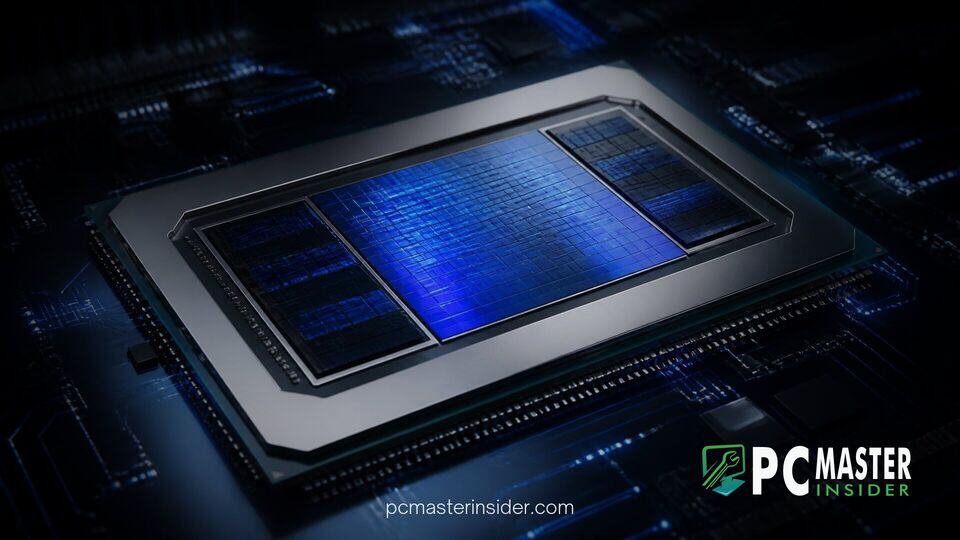
A detailed leak surrounding Intel's upcoming Nova Lake desktop processor lineup reveals plans for a monster flagship chip boasting up to 52 cores alongside a massive cache structure designed to challenge rival silicon. Industry leaks show that the Core Ultra 400 series will introduce a Big Last Level Cache (bLLC) subsystem reaching up to 288MB to drastically accelerate memory-sensitive workloads.
The latest disclosures outline Intel's execution strategy for its desktop lineup through 2027 and beyond, confirming plans to migrate to an all-new platform. With mass production targeted for late 2026, these next-generation processors represent one of the most substantial architectural re-architectures from Intel in years.
intel core ultra 400 nova lake leaks: Massive Core Counts and Modular Compute
According to internal partner presentation materials leaked by tech insider @wxnod on X, the Intel Core Ultra 400 series desktop processor family, codenamed Nova Lake-S, will stretch compute scaling further than any previous consumer desktop generation. The leaks show that Intel plans to employ both monolithic (single compute tile) and multi-chiplet (dual compute tile) designs across the range.
Single-tile SKUs will reportedly scale up to 28 cores, combining 8 Performance cores (P-cores), 16 Efficient cores (E-cores), and 4 Low-Power Efficient cores (LP-E cores). However, the top-tier dual compute tile flagship doubles down on computing units, combining two compute dies to deliver an astounding 52 cores (16P + 32E + 4LPE) running within a 175W thermal envelope. A secondary 44-core model (16P + 24E + 4LPE) is also slated to sit within the same high-tier performance category.
Leaked Core Ultra 400 Specs and Core Configurations
Underneath the hood, the Nova Lake microarchitecture debuts several major architectural shifts for desktop computing. Intel is moving away from the Lion Cove and Skymont architectures seen in prior generations, introducing fresh silicon blueprints for both high-performance and high-efficiency nodes.
Coyote Cove P-Cores and Arctic Wolf E-Cores
The Core Ultra 400 architecture will rely on all-new Coyote Cove P-cores paired with Arctic Wolf E-cores. Early architectural expectations suggest Coyote Cove will yield a double-digit instructions-per-clock (IPC) increase. Concurrently, the Arctic Wolf E-cores will handle heavy multithreaded task distributions while delivering significant efficiency gains. Low-power Arctic Wolf cores will sit directly on the system-on-chip (SoC) tile to keep idle desktop power consumption as low as possible.
Consistent with recent trends, Intel is omitting Simultaneous Multithreading (SMT/Hyper-Threading) on the P-cores. Instead, performance gains rely entirely on raw architectural throughput, higher clock speeds, and an upgraded cache hierarchy.
Intel Big Last Level Cache to Challenge AMD 3D V-Cache
Perhaps the most significant revelation from the leaked documentation is Intel's deliberate answer to AMD's dominant 3D V-Cache technology. Intel is introducing an expansive cache feature known as Big Last Level Cache (bLLC) across select Nova Lake-S desktop chips.
On dual-tile 52-core models, the bLLC architecture will supply up to 288MB of combined cache across the package, with 144MB allocated per compute tile. Single-tile unlocked K-series variants will offer up to 144MB of bLLC cache. This huge expansion in fast, low-latency memory is aimed directly at memory-bandwidth-bound applications like modern gaming titles. The leaked slide explicitly highlights that bLLC cache will deliver a "leap in gaming performance" and position Intel to directly fight back against rival high-cache chips.
To put this in perspective, current top-end enthusiast chips top out significantly lower in total cache reserves. By boosting total cache capacity well past 200MB, Intel aims to reclaim undisputed leadership in PC gaming benchmarks.
Nova Lake-S Mass Production and Desktop Launch Roadmap
The leaked schedule indicates that Intel intends to start mass production of Nova Lake-S processors in the fourth quarter of 2026. However, retail rollout will follow a staged schedule that breaks from Intel's traditional release patterns.
Rather than launching top-tier flagship processors first, Intel will reportedly debut single-tile 28-core unlocked models in the first quarter of 2027. The massive 52-core dual-tile flagships will launch later in 2027, with industry analysts suspecting a mid-to-late 2027 release targeting ultra-enthusiast and high-end desktop (HEDT) users.
The platform transition requires a brand new motherboard foundation. Nova Lake-S will usher in the LGA1954 socket alongside 900-series chipsets. Importantly, internal slides describe LGA1954 as a platform built for long-term direct CPU upgrades. The new socket is slated to support at least two subsequent desktop generations, codenamed Razor Lake and Hammer Lake, providing desktop builders with multi-year socket longevity similar to AMD's popular AM5 ecosystem.
This long-term platform commitment comes at a crucial moment. While Intel has recently made inroads in retail sales with value-focused options, as seen when the Intel Core Ultra 7 270K Plus breaks into top CPU seller lists, enthusiast builders have voiced frustration over short socket lifespans. The LGA1954 roadmap promises a far more stable upgrade path. The move follows broader platform innovations from Intel across enterprise and client divisions, such as the company's work on the Wildcat Lake architecture utilizing UCIe for low-cost 18A CPUs.
As the desktop landscape prepares for fierce hardware competition through 2027, Nova Lake-S appears to be Intel's most ambitious architecture in years. If the leaked specs, massive bLLC cache reserves, and multi-generation socket commitment hold true, PC builders can look forward to a massive shake-up in top-tier desktop performance.