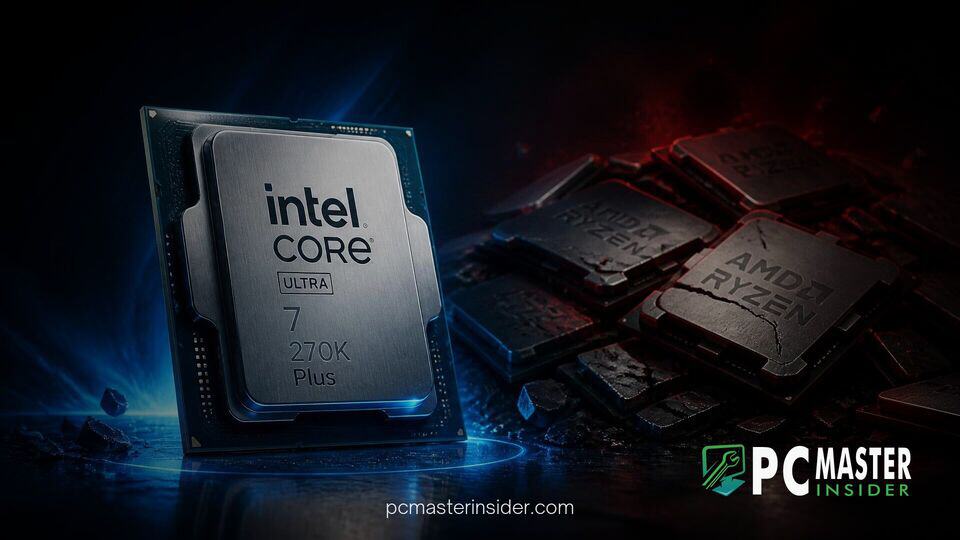
Intel has successfully broken AMD's long-standing monopoly over Amazon's top 10 best-selling desktop CPU list. Recent sales data shows the Intel Core Ultra 7 270K Plus rising to the sixth position among processor sales in the United States, ending a multi-month period where AMD held complete control of the upper chart.
The return of Intel silicon to the top sales tiers marks a significant shift in consumer buying behavior within the DIY desktop market. After extended periods where Ryzen processors swept every top ranking, aggressive pricing and changing memory pricing dynamics have cleared a path for competitive Intel offerings to regain lost ground.
Intel Core Ultra 7 270K Plus Breaks Amazon Top 10 CPUs Monopoly
The core catalyst behind this market shift is the Intel Core Ultra 7 270K Plus, an Arrow Lake Refresh processor featuring a 24-core configuration with 8 Performance cores and 16 Efficiency cores. Recent price reductions have brought the processor down to roughly $250 to $290 at major retail outlets, positioning it as an attractive high-core-count option for custom builders.
Alongside the Core Ultra 7 270K Plus, the older 14th Generation Core i7-14700K also managed to climb back into the top 10, securing a spot near the bottom of the best-sellers list. Together, these two processors have ended AMD's complete stranglehold over the retail top 10 chart for the first time in well over a year.
While AMD's top tier gaming options like the Ryzen 7 9800X3D continue to claim the absolute top positions, Intel's aggressive pricing strategy on modern sockets has begun to draw cost-conscious buyers back toward Team Blue.
Intel Reclaims Spots on Amazon's Desktop CPU Best-Seller List
For over a year, AMD maintained total dominance over retailer ranking lists. Boosted by popular choices like the Ryzen 7 7800X3D, Ryzen 7 9800X3D, and budget-friendly AM4 processors, AMD routinely occupied all ten of the highest volume sales slots. Intel chips were largely pushed down into lower ranking categories across major e-commerce platforms.
Market trackers indicate that the Core Ultra 7 270K Plus made a rapid surge from lower positions to land firmly at number six. Industry analysts point to several factors for this sudden resurgence, including competitive multi-threaded performance in productivity workloads and overall platform costs.
The recent market performance demonstrates that while AMD retains the crown for high-end gaming demand, the mainstream DIY segment remains highly sensitive to price-to-performance metrics. As AMD reaches record x86 client CPU market share figures across the broader market, retail sales demonstrate that pricing adjustments can quickly alter desktop enthusiast buying patterns.
Value Strategy and Socket Compatibility Driving Intel's Growth
Total build budget appears to be playing a central role in driving sales for both Intel chips currently present in the top 10. System builders are looking closely at secondary component costs, particularly modern memory kits and motherboard pricing.
For the Core Ultra 7 270K Plus, compatibility with motherboards like the LGA1851 Z890 platform gives buyers access to current platform features, fast storage interfaces, and updated connectivity at lower CPU acquisition costs. For the Core i7-14700K, its ability to run on LGA 1700 motherboards with affordable DDR4 memory offers a cost-effective upgrade path during times when DDR5 prices remain high.
These pricing dynamics contrast with AMD's current AM5 socket requirement for DDR5 memory. While AMD's AM4 platform chips still sell well at the low end, builders targeting middle-to-high performance tiers often evaluate the complete system price before selecting a CPU family.
Impact on the DIY Desktop Processor Market
The return of Intel chips to Amazon's top tier signals renewed competition in the desktop enthusiast market. Retailers have responded to fluctuating demand by adjusting bundle deals and discounting current-generation parts, encouraging healthy price wars between hardware vendors.
Intel's focus on refining software performance and platform stability has also contributed to consumer confidence. The company has steadily issued BIOS updates and software optimizations, improving system responsiveness and gaming performance across its latest product lines. Meanwhile, tech updates across the ecosystem continue to evolve, ranging from software platform changes to underlying operating system behavior. For instance, recent developments show Windows 11 testing platform changes for next-gen silicon to optimize future hardware architectures.
Furthermore, core platform stability remains a major priority for system builders who want consistent performance out of their setups. As corporate leadership drives quality improvements across tech ecosystems, similar to how Satya Nadella confirmed a focus on core fundamentals in software, hardware vendors are equally focused on delivering reliable out-of-the-box user experiences.
Looking ahead, market watchers expect competition in the DIY processor space to intensify further. As both chipmakers prepare future platform updates and refine existing inventory prices, PC builders are benefiting from wider options and better value across multiple price tiers.
Closing Remarks
Intel's entry into Amazon's top 10 CPU best-sellers with the Core Ultra 7 270K Plus highlights how dynamic pricing and total build costs can reshape consumer choices. While AMD maintains a strong presence at the very top of the charts, Intel's aggressive strategy proves that competitive pricing remains one of the most effective ways to win over DIY PC enthusiasts.