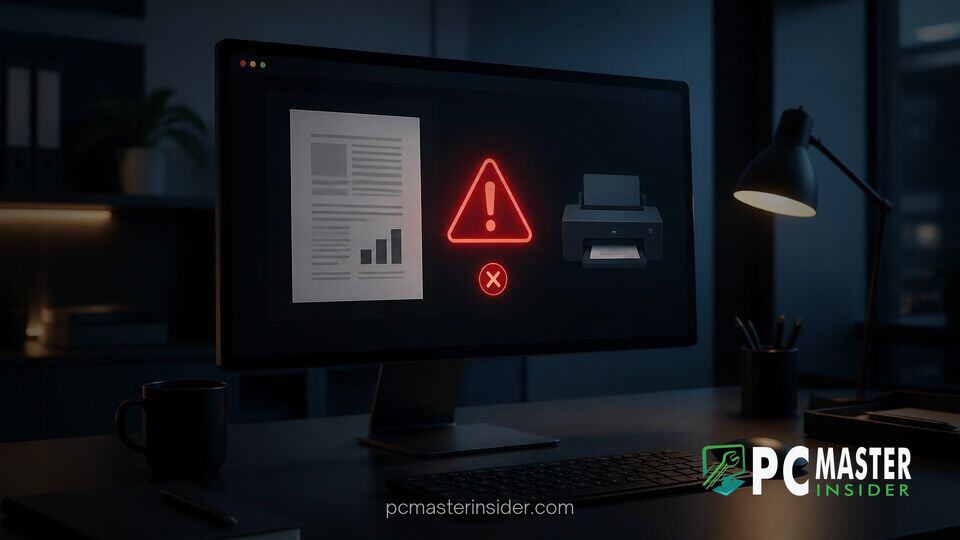
Microsoft has confirmed an issue affecting enterprise desktop applications after installing the August .NET Framework cumulative updates. Developers and system administrators report that applications built on Windows Presentation Foundation (WPF) fail when attempting to print documents or export content to PDF and XPS formats.
The issue stems from security enhancements introduced during the August Patch Tuesday release, which unintentionally break TrueType font subsetting in affected environments. As desktop software across accounting, resource management, and reporting sectors hit unexpected errors, Microsoft has acknowledged the bug and provided temporary mitigation steps while a permanent resolution is finalized.
August .NET Framework Update Breaks WPF Printing PDF Operations
The problem primarily manifests when WPF applications attempt to render or package documents using common Windows system fonts. Users attempting to send invoices, generate system reports, or export documents to digital formats encounter immediate crashes or application freezes. In many instances, the system throws a System.IO.FileFormatException, falsely indicating that standard font files like Calibri or Cambria do not conform to expected file format specifications.
While system diagnostics show that Windows loads and displays these fonts normally on screen, the failure occurs during document compilation. Specifically, the WPF printing engine fails when creating font subsets required for XPS spooling and PDF generation. Enterprise accounting tools, Crystal Reports dependencies, and custom line-of-business applications have all registered widespread disruption.
Affected OS Versions and Application Frameworks
The regression spans multiple operating system versions and framework deployments. Microsoft identified the root cause in cumulative updates released on August 11, including KB5120708 and KB5120705. Operating systems impacted by the issue include Windows 11 version 25H2, Windows Server 2025, Windows Server 2022, and earlier supported server editions.
Organizations tracking system deployments have noted that both legacy software built on .NET Framework 3.5 and 4.8.1 as well as modern applications running on newer .NET runtimes exhibit the behavior under specific font configurations. This incident comes amid ongoing platform refinements across the Windows ecosystem, such as when Windows 11 preview pane adds automatic web PDF previews in File Explorer to modernize file handling workflows.
Temporary Workaround and Associated Security Trade-Offs
To assist impacted organizations, Microsoft released an official workaround that allows administrators to bypass the print failure. Developers can modify the application configuration file by enabling an AppContext override switch:
<configuration>
  <runtime>
    <AppContextSwitchOverrides value="Switch.MS.Internal.TtfDelta.DisableCmapAndSbitOverflowProtection=true"/>
  </runtime>
</configuration>
However, Microsoft explicitly warned that activating this switch disables the exact security overflow protections introduced in the August updates. Disabling these checks may re-expose machines to security vulnerabilities addressed in the patch. As a result, IT departments are advised to implement this override only on essential systems where document export is critical to daily operations.
Administrators managing critical infrastructure face difficult choices between security enforcement and operational continuity. Similar security and system stability dilemmas have emerged in enterprise environments, such as when an unpatched ShieldBreak zero-day flaw targets Microsoft Defender on Windows 11 systems or when Microsoft patches critical Entra ID vulnerability exploited in attacks.
Microsoft Investigation and Upcoming Patch Timeline
Microsoft confirmed that engineering teams are actively developing an out-of-band fix or a refined monthly update to resolve the font subsetting regression without compromising system defense. The company stated that a proper software patch is currently in progress and will be distributed through standard Windows Update channels once validation testing concludes.
In the interim, enterprise administrators are recommended to monitor official release notes and avoid uninstalling broader security patches unless operational workflows are entirely halted. Software vendors reliant on WPF frameworks continue to issue guidance to end users, advising temporary font changes or configuration overrides until Microsoft delivers an official fix.