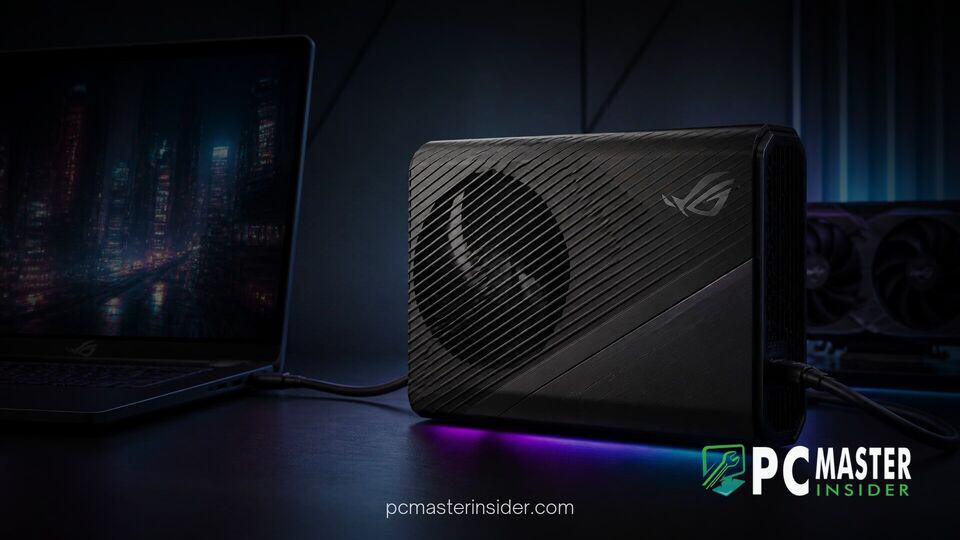
ASUS has officially announced the launch of its compact XG Core external graphics solution, bringing dedicated graphics power to thin laptops, handhelds, and mini PCs. The new unit features an AMD Radeon RX 9060 XT LP GPU with 16GB of GDDR6 memory connected over high-speed USB4.
Designed for gaming, content creation, and local artificial intelligence workloads, the portable dock allows users to expand graphics capabilities without opening or modifying their existing hardware.
ASUS XG Core Radeon RX 9060 XT LP Brings Plug-and-Play Power
The ASUS XG Core Radeon RX 9060 XT LP is targeted at users who require extra graphics processing power while maintaining a highly mobile setup. Modern ultrabooks and handheld gaming devices offer impressive efficiency, but demanding applications frequently require dedicated resources. By delivering an external graphics card in a streamlined enclosure, ASUS aims to bridge the gap between desktop performance and portable convenience.
Equipped with 16GB of GDDR6 VRAM, the unit provides generous frame buffer capacity for high-resolution textures in modern games and intensive rendering tasks. Beyond traditional rasterization, the system supports hardware-accelerated workflows in local AI creation tools. Users running workloads in software such as ComfyUI, LM Studio, and Ollama can leverage the onboard compute power for large language model inference and image generation without depending on cloud servers.
ASUS Announces XG Core External Graphics Solution
The release of the XG Core expands the company's ecosystem of external hardware solutions. Unlike full-sized eGPU enclosures that accommodate massive desktop expansion cards, the XG Core is integrated directly around a low-profile GPU module. This design ethos allows the hardware to remain unobtrusive on a desk while offering straightforward plug-and-play setup.
The release follows previous developments in high-bandwidth external GPU hardware across the industry. Devices in this category frequently balance thermal management, acoustic output, and physical size. For instance, announcements like the ASUS ROG XG Station 3 Thunderbolt 5 eGPU dock have demonstrated growing demand for plug-and-play desktop acceleration among mobile enthusiasts.
Radeon RX 9060 XT LP Specifications and Architecture
At the heart of the XG Core sits AMD's low-profile Radeon RX 9060 XT GPU, constructed on the RDNA 4 graphics architecture. The silicon includes 2,048 stream processors paired with a 128-bit memory interface operating at 20 Gbps memory speeds. The graphics processor delivers up to 406.3 AI TOPS of local compute throughput for neural acceleration.
To fit within a compact chassis without requiring heavy external power bricks or loud cooling solutions, ASUS operates the graphics processor within a strict 75W total board power budget. Power is drawn through the slot infrastructure without requiring extra internal PCIe power cables. As a result of this tight thermal and power envelope, clock speeds are tuned specifically for slot-powered efficiency.
The XG Core operates at a default game clock of 1,010 MHz and a maximum boost clock of 1,600 MHz. When switched to OC Mode using the included ASUS GPU Tweak III software, frequencies increase slightly to a 1,030 MHz game clock and a 1,620 MHz boost clock. While these figures are lower than standard desktop variants operating at higher power draws, the configuration maintains system stability and cool operation inside a small footprint.
Software support is comprehensive, with full compatibility across AMD graphics features. Recent software releases, such as the AMD Adrenalin driver updates, ensure stable execution and game optimization for RDNA-based architecture across external interfaces. Furthermore, wider driver improvements like AMD FSR upscaling support help maximize output performance across lower-power setups.
USB4 Connectivity and Portable Design Features
Physical dimensions are key to the design of the XG Core. The enclosure measures 144 x 117 x 39 mm, making it small enough to slip into standard laptop gear bags alongside cables and accessories. The minimal footprint makes it an easy addition for users traveling between office spaces, homes, or creative studios.
Connectivity relies on a USB4 interface operating at up to 40Gbps of theoretical bandwidth, which is also backward compatible with Thunderbolt 3 hosts. The single-cable interface transmits data signals to the external GPU, while external video outputs handle display passthrough directly to external monitors. Physical outputs on the back of the device include HDMI and DisplayPort connections.
The compact form factor reflects a broader trend in mini PC engineering and compact mobile setups. Similar space-saving solutions have appeared in alternative desktop hardware, such as the ACEMAGIC Starship mini PC, which packs dedicated mobile silicon into tiny custom enclosures.
Target Devices and Market Availability
ASUS highlights seamless integration with host systems that feature full-featured USB4 or Thunderbolt ports. Prime candidates include ultra-thin laptops, compact office mini PCs, and handheld gaming consoles like the ROG Ally X. By handling rendering externally, host devices avoid thermal throttling on their internal graphics engines.
Thermal monitoring and tuning for the dock are managed directly through ASUS GPU Tweak III. The utility gives users real-time readouts of operational temperatures, fan profiles, and memory utilization. Users can quickly toggle between quiet operating modes for work environments and performance profiles when gaming.
ASUS has not yet released final regional pricing details or precise retail release dates across global markets, though official spec pages are live across product channels.
The ASUS XG Core represents a practical entry in the evolving portable eGPU market. By pairing AMD's RDNA 4 low-profile silicon with a 75W USB4 chassis, ASUS delivers a functional balance of VRAM capacity, compact design, and mobile versatility for users needing extra graphics power on the go.